
In June 2022, I ended the school year feeling utterly exhausted. I’ve mentioned this before on the site, have talked about it as my temporary vocational stretch, I believe. It involved adding another layer of duties onto an already full load at work. It resulted in more busyness and a greater level of what I’ve since come to call “bundling.” I volunteered for it, feeling like it was the right thing to do. But I didn’t foresee it lasting five years (with two of them falling into Covidtide). My goal in the summer of 2022 was to stay as far away from work as possible, to get as much of a break as possible. That summer I attended a retreat at Laity Lodge titled “Beginning Afresh in the Deadly End: Resurrection Hope for Real Life.” Because that was the space my head and heart were in: deadly ends and resurrection hope.
I’ve spent the two years since trying to make sense of that five-year window of time (and the spiritual and emotional journey those five years had me on). I’ve done my best not to engage in an over-active lifestyle, less busyness and more “unbundling,” and there’s been a good bit of saying “no” to different things with no one really asking for an explanation. And there’s been no small amount of anger that comes with the realization that systems of every kind don’t care what individuals experience and learn. There have been a few comments of “how did you do all of that?” from peers that make me cringe a bit. It’s felt like there haven’t been many opportunities for honest conversation about the time; that’s what happens, I think, when everyone is over-committed. But I’ve sought out a wise counselor to have that conversation with, have even taken to diagramming out that time and thinking through its effects in different ways.
If in June 2022 I felt exhausted, I can now say, in June 2024, that I have spent time in (and trying to extricate myself from) a culture, a way of life, that is both exhausting and exhausted. Exhausting because it is built on an unspoken principle of demand-and-scarcity that is unsustainable and exhausted because it it is culture that has been running on fumes for some time. And so I’ve kind of started calling these last two years “the Long Epilogue” as its been a time of experiencing and bearing witness to the end of one way of being and doing in hopes that another would take its place.
I fear, at times, that such a different way of being and doing will never appear, but I think that’s just me hoping to put new wine into old wineskins. And Jesus can tell you how that one ends. (added June 20, 2024)
+ + + + + + +
 In A Time to Keep, Ephraim Radner attempts to help readers understand a possible Christian response to the big changes that the “medical revolution” have caused to our understanding of what it means to be human, to be mortal. Radner often casts an odd net for me, but I’m always grateful for what appears in the haul. I recently revisited the book to prepare for a school meeting, which gave me an opportunity to revisit my favorite bits from the book. Here’s one of my favorites:
A central Christian vocation is to grasp an answer to the question of how one learns from life in a way that leads neither to confusion nor resentment but to fear and praise. The answer is given, in Christian terms, only as I see and engage these realities of my life as a creature whose experience turns me toward my creatureliness in God’s hands. Only in this way will the Christian find his or her life to be a path to wisdom rather than to simple dissolution. (128)
He is writing here foremost about mortality, but I can’t help but think there’s some connection to all of the “miniature deaths” we all experience along the way. As I mentioned in my previous post, these last two years have been reflecting on a miniature death or two of my own.
Is Radner’s first statement in that paragraph true? Is the question of “learning from life” central to the work of the Christian faith? I often feel like most Christian work focuses on evangelism and household management and not much else. There’s not much room for thinking well about learning from life (even though church can be one of the few places where an intergenerational mix is a reality). It’s not that we go through life blindly, I think. It’s more that we lack language and framework for that kind of questioned conversation. I get the sense that confusion and resentment are key realities for us as we age- no one knows what they are doing or why they are doing it and we end of resenting what has been done to us in the process. Does the church have something to say to this, or do we simply grin and bear it all the way to the grave?
As Radner puts it, understanding our creatureliness is key. To be a creature is to submit to the humility of being God’s creation and therefore living life “in His hands.” It’s in the humility of creatureliness, it seems, that we can find some real path for the way we hope to walk. It’s interesting to see how he understands that path to diverge. On one side you have wisdom, a word we hear all to rarely. On the other you have dissolution, which we hear absolutely nothing about but that many of us, I fear, feel and experience on a regular basis because of, well, our confusion and resentment. (I think I find more about this side of life in the monastic literature I come across.)
How then, do we make our way from confusion and resentment to fear and praise? How do we see and engage these realties of creaturely living honestly and properly? How do we learn to choose the way of wisdom knowing what it will require of us (because oh, ho we relish confusion and resentment and dissolution!)? Later in A Time to Keep, Radner says this while reflecting on the life and questions of Job:
Godly wisdom is the form of one who is driven to such a context and landscape of listening and who perseveres in inhabiting it and moving through it until such light as God would give is indeed given and received. We have to stick with the life that is ours, with its limits, edges, bumps, and filling. By passing through it steadfastly, we learn deeply and we gain wisdom.
That is what I want. That is what I lacked and what I long for. A godly wisdom that brings light and that acknowledges the rough-and-tumble of life. That gives me a better how rooted in a deeper why. I feel like I missed it then. I refuse to go forward now without it. (added June 21, 2024)
+ + + + + + +
One of the last memorable conversations that I had with my friend Larry before he died unexpectedly almost ten years ago had to do with the idea of renegotiation. I had been in Hawaii for about a decade and had done a decent job fitting in. I was enjoying my work, had been part of a local church, had inherited and mostly enjoyed a good friend group. And I had been there long enough for things to noticeably change. It’s one thing when a favorite bookstore or restaurant closes down. It’s another thing entirely when relational dynamics change. That’s what had been happening in the time leading up to the talk with Larry. Close friends had left the church. A close friend had gotten engaged and then married. Another close friend had changed jobs. Lots of not-so-little things for someone trying to piece together a patchwork life. And I wasn’t quite sure what to do about any of it. I do my best to be a faithful friend: that’s why the faithfulness/freedom tension can be a very real thing for me. It was clear to Larry that I was in a period of change but did not know how to maneuver any kind of “renegotiations” with people whose lives had changed (and had therefore changed mine, too).
It’s been ten years since that conversation, and I haven’t gotten any better at renegotiating people and change. I’ve thought often of Larry over these last few years, often wondering what questions he would ask or what advice he would give about the decisions I’ve wrestled with and made. I think he would laugh a little and call me a fool and I’d laugh a little, too. Like ten years ago, it would have been (mostly) enough just to name things and talk about them. The trick, though, would be to learn to name things with those most closely involved with the change. That’s a skill I almost entirely lack: it would be like I was picking a fight for selfish reasons. And so I edit myself too much and expect those on the other side of the metaphorical table to do the hard work of asking the right questions. (added June 25, 2024)
+ + + + + + +
Imagine that, from good or ill, you had somehow come to the end of yourself. Exhausted, spent. Not resentful, just done with a way of being and doing that was itself exhausted. How would you determine what to do next? Where would you go? Who would you reach out to? Do you simply stick around and go through the motions? Or do you find some way to strike out, to push on, grateful for where you have been and where it has gotten you but also ready for something that would be next, no matter how difficult it would be?
One of the “streams in the desert” this last year or so for me has been the Poco a Poco podcast from the Franciscan Friars of the Renewal. Somehow I came across an episode on monastic loneliness and found a collection of monastic voices who could speak sideways into my own experience. One thing I like most about their conversations is that Jesus seems like a real, live person to them. Jesus cares for them and loves them and speaks to them through their great joys and needs.
One thing in particular has stood out to me from the dozens of episodes I have listened to. One friar, I can’t remember which, said something about how he had given God the first half of his life and that he didn’t want to spend the second half of his life trying to take it back. Because that is always a possibility, one that can seem enticing but that you also know is never in your best interest. (added July 2, 2024)
+ + + + + + +
Another way I’ve been deeply encouraged by the FFR has been in how they talk about God the Father. They speak as if the fatherhood of God actually matters, that it’s not just a title, a designation of one member of the Trinity. That there is something inherently fatherly about the One that Jesus called out to as Father (and that we are told to cry out to as ‘Abba’).
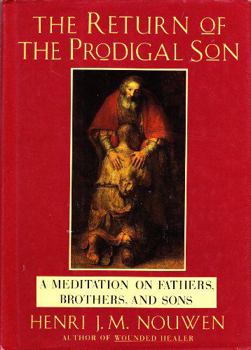 A few months ago, one of the friars mentioned a line about God being a father who doesn’t charge his son rent (in relation to the story of the prodigal son). He name-checked Henri Nouwen as the source of the image, saying that it was from Nouwen’s The Return of the Prodigal Son. I’ve read a number of Nouwen’s books over the years, but have stayed away from that one. It always looked a little too artsy for me, as in more about the famous painting than about God. But after hearing the comment in the podcast, I decided to give the book a try.
First let me say that I never did find that particular comment in the book. It totally fits the book, and it’s highly possible that I missed the moment while reading. Second let me say that I don’t track with everything Nouwen says in the book, though I think I can understand why he says it. Third and final for now, let me say that this is a perfect example of “right book at the right time” for me. Don’t get me wrong: that happens often to me, but rarely with this level of impact.
You can get a taste of the book’s effect in the chapel talk I gave back in May with the outgoing seniors as the primary audience. It’s funny. The friars had just started a series explicitly about God as Father, so I made a point of not listening until I was done with chapel preparation and presentation. I started back in on the podcast soon after to find that their next talk actually used the words faithfulness and freedom that I used in my talk. We didn’t use them in quite the same way, but a connection was there. (added July 11, 2024)
+ + + + + + +
As I’ve mentioned before, this Long Epilogue has given me time to mourn some “miniature deaths,” deaths “without a funeral” for me (nod to Andy Gullahorn). It’s an acknowledgment of loss, mostly for myself, a way to process the death of a way of being and doing that feels beyond resuscitation. It’s been a quiet death full of people unknowingly attempting to conjure or coax something out of me that is no longer there.
 Which is a part of why the thinking of Andrew Root has been important to me, especially as I have tried to make sense of the past and seek some way forward. It’s also why this essay, which is an excerpt of his co-written book, When Church Stops Working, has been important for me. It encapsulates some of the feeling of the end of the busyness I had allowed to become the norm. The essay is mostly about church, which I haven’t said much about. During the five-year “temporary vocational stretch,” I basically served on two successive pastor search committees, even chairing the second one. Through both of those processes and their aftermaths, I became more and more mindful of how necessary a healthy Christian community should be . . . and how hard they are to come by. Hard because most Christian communities are geared towards busyness- for the kingdom, of course, but busyness nonetheless. Covidtide allowed a window for rethinking habits and practices and relationships, but most people were trying to keep the boat they knew afloat. (added July 11, 2024)
+ + + + + + +
As I write this, I’m just a few hours away from a retreat at Laity Lodge. It’s kind of a “full-circle” moment for me, as this “long epilogue” started with my last visit to the Lodge. The theme of the retreat is friendship, which is something I think about a lot. It’s funny, the last time I was at the Lodge I made a comment to the crowd about friendship. I had just finished serving on the second pastor search committee and one of the concerns we had both times around was about pastors and friendship. My comment was an assertion that friendship is a kind of mark of the resurrection. The passion story of Jesus, on some basic level, is about a man and his friends (and how they fail Him and how He loves them). The conversation between Jesus and his disciples at the last supper in John’s account hinges, in a way, on Jesus’ assertion that they are his friends and that “greater love has no man than this: that he lay down his life for his friends.”
These last two years have been a reminder that friendship is important. That was also a truth realized in Covidtide: for many, friendship carried us, particularly at work when everyone felt so far apart (and where improv had to happen frequently and with those you had learned to trust).
 I’ve mentioned the book before, by Justin Whitmel Earley’s Made for People has been a key book for me during the second half of the “long epilogue,” partly because for inspiration but also partly because it contains a solid sense of what it means to be a person and how to be a friend. I’m curious to see if the book is mentioned it at all this weekend.
I am grateful that I’m not the guy that I was two years ago when I last visited the Lodge. It’s difficult to describe the relief I’ve felt over the last two years as well as the struggle of not going back to a way of being and doing that “got the job done” but at some cost. I’m also grateful that the topic is something that I care about deeply. There’s more of a sense of expectation than exhaustion. And I’ve got no real preconceived notions. I just know that I’m ready to tend to what is next more than I want to reflect on what has been.
So what is next? Well, the previous entries here give some hint. After reading Nouwen’s book, I thought it wise to brush up some on quality evangelical theology on the Trinity, which led me to Fred Sanders’s Deep Things of God. I continue to follow the Ephraim Radner vein as I think about daily life in the context of a lifetime. I do think the monastic and recovery movements have much to teach there, too. Andy Root brings together the threads of church and friendship in a way that he doesn’t specifically name but shows evidence of nonetheless. There are lots of good thing to nurture that can bear long-term fruit for God’s kingdom that doesn’t have to be instrumentalized, but that might acknowledge both need and loss.
As I walk the grounds of the Lodge over the next few days, I want to be sure to thank God for His presence and work in my life over these last two years. I want to enjoy what looks to be some slightly cooler weather in the hill country. And I hope to be surprised by what God might have next for me, knowing that all that’s gone before will still be a part of the long story of my life, but also knowing that a particular chapter really is over, that one page has given way to the next. And regardless of whether it is easy or difficult, the new page will be good. (added July 11, 2024)


 Space Enough, and Time