
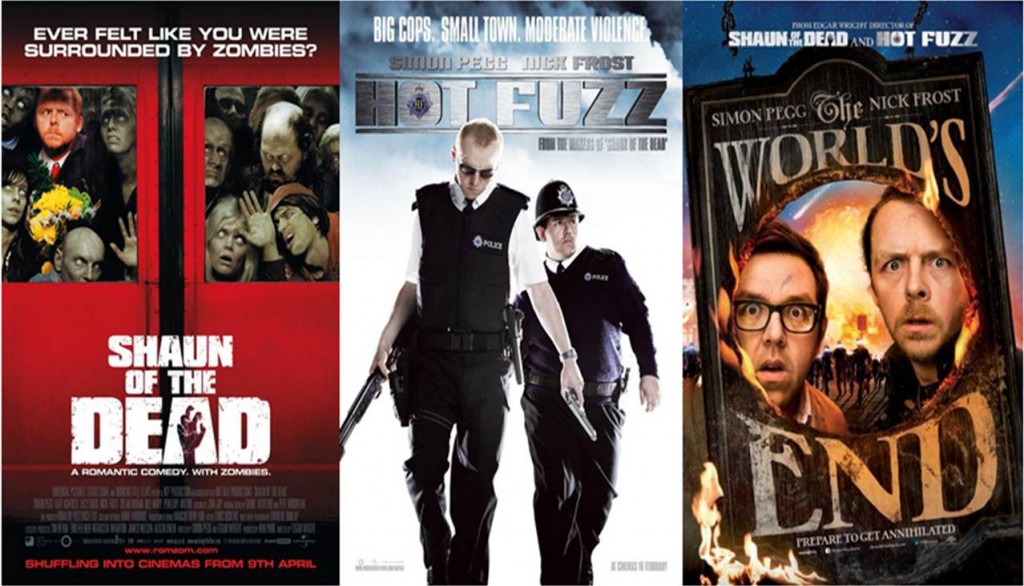
 This past Thursday evening I had the opportunity to watch the “Three Flavors Cornetto Trilogy,” the three movies made by Edgar Wright, Simon Pegg, and Nick Frost. I’ve been a fan of their work for years (including two great seasons of Spaced) and was excited to see two classics and the latest work back-to-back-to-back. The short of it: Shaun of the Dead really is simply amazing. Hot Fuzz is wonderfully polished and well-played. And The World’s End? Well, it’s definitely the more sober of the lot, which is interesting when you realize that it centers on a pub crawl.
The movie follows four childhood friends as they are brought together by their long-dismissed leader, Gary King, to finish a 12-stop pub crawl that didn’t go to well the last time they tried it, twenty years earlier. It’s a movie tinged with a manic sadness. It’s not about the loss of society to plague or the loss of real community for twisted civic pride like its predecessors. This one is about remembering and forgetting and stumbling upon the problem at the heart of the world today. That, of course, is where the sci-fi twist comes in. Which is funny, because so much of the normal lives of the characters (cell phones, blue tooth devices, sleek cars, glass offices without posts and lintels) often look like the stuff of early sci-fi movies and shows. The World’s End is well-done, kinetic and thoughtful and brutally honest.
Any critique of the movie will probably settle on the big technology-centered reveal near the movie’s end. It’s a popular trope these days, what technology is doing to us. But I like the spin the movie puts on it, the seemingly benign and innocuous way things have changed over the last two decades. It’s the perfect contrast to Gary King’s final cry for help, his own personal apocalypse, when his jacket comes off and he reveals the genuine deficiency in humans and their systems, too. It’s a quick moment, two sentences maybe, that are bulldozed over by the next fight scene. But the moment is true.
“To err is human; to forgive is divine” is a saying plastered in the background of one scene near the movie’s end. It’s a good visual and a brilliant reminder. And while most of the movie epitomizes the first part of the saying, it’s the promise of the second line that should give us all, Gary King included, hope.


 Space Enough, and Time