
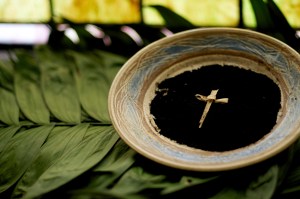
 Today Christians from all over the world will commemorate Ash Wednesday. They will have ashes drawn on their foreheads, will be reminded that they are dust first and last, will be called to repentance because God’s kingdom is near. They will commit to giving up certain things (often “worldly” in nature) and will strive to live a life of more positive spiritual discipline as they move towards the Easter season.
I really like how Robert Webber talks about Lent in light of what has happened previously in the church calendar with Advent-Easter-Epiphany. That “cycle of light” moves into a “cycle of life.” From Ancient-Future Time:
The emphasis of the cycle of light is on incarnation, whereas the central motif in the cycle of life is the death and resurrection . . . One accents God coming among us in the person of Jesus of Nazareth; the other recalls the purpose for which he came– the self-giving sacrifice of his life to free the world from the domain of Satan and thus secure forgiveness and healing for the peoples of the world . . .
There is another way the cycles of light and life are brought together: both follow the pattern of expectation, fulfillment, and proclamation. Advent is expectation, Christmas is fulfillment, and Epiphany is proclamation; Lent is expectation, Easter is fulfillment, and Pentecost is proclamation. Thus there is a historical progression into both Christmas and Easter as well as spiritual procession from each. When we recall and relive the experience of God’s people who pilgrimage into and out of the incarnation or into and out of the death and resurrection, we mark our own spirituality with expectation and fulfillment . . .
. . . Lent is a journey into death, a death that will result in a new birth, a spiritual beginning again, for during Lent we journey into an event that not only happened in history as an actual occurrence that changed history but an event that happens within us. Christ conquered death, turning our death to sin into a resurrection to the fullness of life in the Spirit, which is available to us through faith. But this new life is not a mere proposition or a thing out there to be observed, analyzed, and systematized; it is to be experienced. It is a real, life-changing experience that shaped our vision of reality, informs our relationships, forms our values, puts us in touch with transcendence, and causes us to experience the spiritual dimension of life itself.
I think that’s a good bit about why the church calendar has such potential for guiding the rhythm of the Christian life. It’s a reminder of the connection and flow of the entire biblical story, which comes to its climax in Jesus and continues in the life of the Spirit lived out by people like you and me.
Webber begins his chapter on Lent with a quote from John Chrysostom that quotes Paul’s letter to the Romans. When I reread it yesterday, it struck me in a nicely ambiguous-yet-obvious way. From Romans 5:
For if while we were enemies we were reconciled to God by the death of his Son, much more, now that we are reconciled, shall we be saved by his life.
Lent, of course, is a strong reminder of the life that saves us. And it saves us in so many ways, from our everyday graves, from our zombie-like existence, into that which truly is life, even and especially in the here and now.
(image from pineshorepres.org)


 Space Enough, and Time