
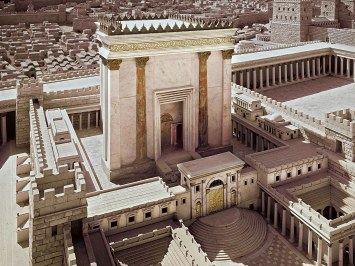
 One of the things I like most about N. T. Wright’s image of the biblical story like a five-act play is how it holds the story together while also emphasizing the underlying connective tissue.
One such tissue is found in the God who makes something (someones) with or in which to dwell. Peter Leithart recently wrote about this in his First Things article, “You Are a Temple,” which begins:
Yahweh descended from Sinai to take up residence in the tabernacle, to make His home in the midst of His people. Though access to His house was limited, He intended the tabernacle to be a house of hospitality. In the house were a table of showbread for food, a lampstand to shed light, an altar of incense that represented prayer. Bread, light, and incense are God’s gifts to Israel.
He then traces that thread succinctly through Jesus and Paul’s thinking. It is an interesting and necessary balance between holiness and hospitality, two things that are often hard to come by in the rough-and-tumble of culture today. Leithart adds:
When Paul tells the Corinthians that they are temples of the Spirit, he emphasizes the restrictions: Because they are holy space, claimed by God in the Spirit, they are not to use the members of their bodies in ungodly ways. They are not to join the members of Christ to prostitutes, but to remain in one Spirit with Christ (1 Corinthians 6:12-20).
But the entire theology of the sanctuary comes into play. When the Spirit consecrates an individual as a temple of the Spirit, that person becomes a locus of hospitality – offering the bread, light, incense, and all the other gifts of the sanctuary to his neighbors. When a household is indwelt by the Spirit, it is remade into an image of God’s own house, a place of hospitality, prayer, light, life. When a church receives the Spirit, it is opened as God’s house to offer Christ the Bread, Christ the Light, Christ the intercessor to the world.
How humbling and exciting to think that we might be, as Leithart puts it, “God’s own house.”
You can read the rest of Leithart’s article here.
(image from media.tcc.fl.edu)


 Space Enough, and Time