
 One of the things you find on almost every copy of J. R. R. Tolkien’s The Fellowship of the Ring is a quote from C. S. Lewis. “Here are beauties which pierce like swords or burn like cold iron; here is a book that will break your heart,” the copy reads. Those words are from the Lewis-penned review of FOTR that was published in the August 1954 issue of Time and Tide under the title “The Gods Return to Earth.” I finally got a copy of the review as an entry in Image and Imagination, a Canto Classics collection of Lewis’s literary pieces. And while the reviews aren’t the books themselves, they’re pretty darn close.
*****
What Lewis most appreciates about The Fellowship of the Ring (it seems) is something that is an almost-instant turn-off for newbies to the novel: the long introduction “concerning hobbits.” In Lewis’s estimation, the long description of “the life and times of hobbits” is essential to the story.
Yet there were good reasons for such an opening; still more for the Prologue (wholly admirable, this) which precedes it. It is essential that we should first be well steeped in the ‘homeliness’, the frivolity, even the (in its best sense) the vulgarity of the creatures called Hobbits; these unambitious folk, peaceable yet almost anarchical, with faces ‘good natured rather then beautiful’ and ‘mouths apt to laughter and eating’, who treat smoking as an art and like books which tell them what they already know. They are not an allegory of the English, but they are perhaps a myth that only an Englishman (or, should we add, a Dutchman?) could have created. Almost the central theme of the book is the contrast between the Hobbits (or ‘the Shire’) and the appalling destiny to which some of them were called, the terrifying discovery that the humdrum happiness of the Shire, which they had taken for granted as something normal, is in reality a sort of local and temporary accident, that its existence depends on being protected by powers which Hobbits dare not imagine, that any Hobbit may find himself forced out of the Shire and caught up into that high conflict. More strangely still, the event of that conflict between strongest things may come to depend on him, who is almost the weakest.
Readers of the books (not so much viewers of the movies) know that the Shire plays a major role in the stories last major movement. All of that unambition, peace, and good-naturedness gets put to the test in a way that Frodo and friends are more than prepared to deal with.
It’s interesting to think of the peace of the Shire as “a sort of local and temporary accident.” The world beyond its protected borders, though, is full of “high conflict.” For sure the Shire is there for contrast, but I can’t help but think there’s more going on than simply saying “here’s life at its simple best.” Lewis mentions the “myth” aspect of the story early in the review, something that comes up often in the rest of the review (and which we’ll see more of tomorrow).
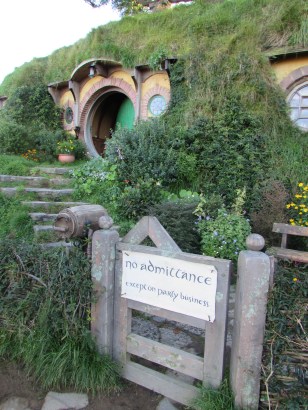
(image taken in Hobbiton in New Zealand, summer of 2014)


 Space Enough, and Time