
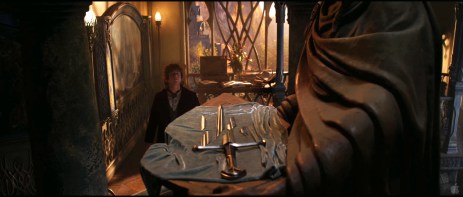
 In his review of The Fellowship of the Ring, Lewis tackles the charges of “fiction as escapism or nostalgia” head-on. We saw hints of it in yesterday’s excerpt. We get an even better sense of it in the selection below. As with so many other things, Lewis does a great job of adding a “twist” to our understanding of what’s going on.
Nostalgia does indeed come in; not ours nor the author’s, but that of the characters. It is closely connected with one of Professor Tolkien’s greatest achievements. One would have supposed that diuturnity was the quality least likely to be found in an invented world . . . But in the Tolkienian world you can hardly put your foot down anywhere from Esgaroth to Forlindon or between Ered Mithrin and Khand, without stirring the dust of history. Our own world, except at rare moments, hardly seems so heavy with its past. This is one element in the anguish which the characters bear. But with the anguish there comes also a strange exaltation. They are at once stricken and upheld by the memory of vanished civilizations and lost splendour. They have out-lived the second and third Ages; the wine of life was drawn long since. As we read we find ourselves sharing their burden; when we have finished, we return to our own life not relaxed but fortified.
Lewis is, of course, making mention of Tolkien’s creation of a world with depth in all directions. It’s a well-worn world, with a (hi)story beneath every stone. And that’s why the loss in the story is so palpable: it’s felt on multiple levels. We feel loss. We feel the characters’ immediate loss. We feel the characters’ deep and lasting loss, too. “Our own world, except in rare moments, hardly seems so heavy with the past,” Lewis asserts. That might even feel more true half a century later.
I like Lewis’s final comment a lot, that we leave Tolkien’s world “not relaxed but fortified.” That should be its own genre of literature, really. Definitely a list worth making.
(image from lotr.wikia.com)


 Space Enough, and Time