
 Few things serve the break between comic book movies as well as a good financial thriller, right?
In between the shield-slinging of Captain America: Civil War and X-Men: Apocalypse neatly stands Money Monster. It’s the latest in a short string of recent financial movies (the best being The Big Short). And while it’s more thriller than commentary, it’s a movie that handles both kinds of moments well.
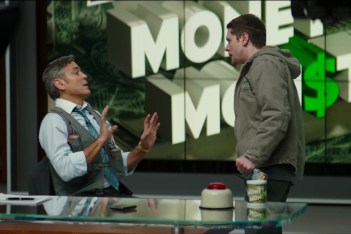
George Clooney plays Lee Gates, a tv personality whose overconfidence in a safe stock that ends up losing millions, is taken hostage by Kyle Budwell (played by Jack O’Connell), who lost all of his savings in the “glitch.” Julia Roberts plays the show’s producer, who has to keep things from falling apart long enough for the mystery of the “glitch” to be solved. The acting walks the line between muted (Roberts) and almost maniacal (O’Connell and Gates), but they find a steady, believable tone for most of the movie’s mid-section.
While I’m not sure how believable the scenario is in a general sense, I was totally invested the entire time. Granted, I was approaching the movie from a few different perspectives (including gauging audience reaction). There’s the angle of talking about a financial system that is fast and has little to do with actual cold, hard cash. There’s the approach of seeing how a movie by Hollywood elites would handle a blue collar worker like Budwell (which has been a topic of some interest to conservative bloggers over the last week or so). There’s the muted but percolating relational drama playing out between Gates and the many people (producer included) that he has burned as an over-bearing personality. So yeah: lots of levels to think about.
What I liked best about the movie, though, is a stylistic device that almost always moves me: when the personal drama somehow becomes a public spectacle, or when the line between the imagined and the real gets blurred. You get it best in movies like the original Muppet movie or in something like Moulin Rouge, where the audience witnesses a true thing thinking it is something else. The scene where Gates and Budwell move from the studio to a meeting place a few blocks away encapsulates something right (and also sad) about our current state. People reveal themselves by how they respond to what they think they are seeing.
Money Monster ultimately belongs in the same category of movie as Side Effects or Contagion: a little too close for comfort, a little too awkward to do much more than stick in the brain for a while, but a valiant effort nonetheless. The solution to the “glitch” ultimately serves as a swerve from the deeper issues of our current financial system, which is unfortunate (and which is one of many reasons why The Big Short is the better movie). The movie may be a stretch, but it’s one worth trying.
(image from hitfix.com)


 Space Enough, and Time