
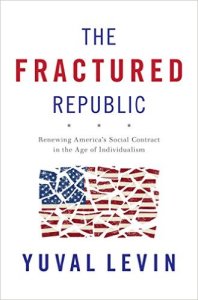
 If there’s a book out this summer that’s worth your time and money, it’s Yuval Levin’s The Fractured Republic. I read it a few weeks ago and have been mulling over it ever since. In the book, Levin draws a picture of how 20th century America became 21st century America. In doing so, he points out that the thing most political leaders in the 21st century want to do is go back in time, to realign our common life with some particular moment from decades ago. From the introduction:
… in our time, in particular, our politics is overwhelmed by an usually intense and often debilitating frustration that is rooted in a form of that illusion [that getting back to a good place in national life is that easy], but runs deeper. Liberals and conservatives both frequently insist not only that the path to the America of their (somewhat different) dreams is easy to see, but also that our country was once on that very path and has been thrown off course by the foolishness or wickedness of those on the other side of the aisle. Liberals look back to the postwar golden age of midcentury America, which they believe embodied the formula for cultural liberalization amid economic security and progress until some market fanatics threw it all away. Conservatives look fondly to the late-century book of the Reagan era, which they say rescued the country from economic malaise while recapturing some of the magic of the confident, united America of that earlier midcentury golden age, but was abandoned by misguided statists.
Each side wants desperately to recover its lost ideal, believes the bulk of the country does, too, and is endlessly frustrated by the political resistance that holds it back. The broader public, meanwhile, finds in the resulting political debates little evidence of real engagement with contemporary problems and few attractive solutions. In the absence of relief from their own resulting frustration, a growing number of voters opt for leaders who simply embody or articulate that frustration.
Over the next few days I’m going to write through a few of Levin’s major points. Some of what he sees and says seems to be true for other, smaller organizations and communities, only writ large. Even individuals can find themselves trapped, frozen in time, by a certain nostalgia. Nostalgia has its place, of course. But it cannot be something that keeps you from being faithful and effective in the current moment. As Levin suggests:
To learn from nostalgia, we must let it guide us not merely toward “the way we were,” but toward just what was good about what we miss, and why.
That, I believe, is thinking in the right direction.
You can read a review of the book by James K. A. Smith here.


 Space Enough, and Time