
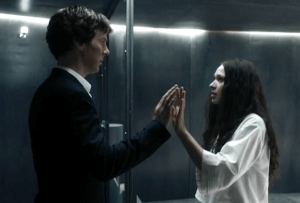
 Series four of Masterpiece’s Sherlock came to an end Sunday night. I must admit to having seen it twice now: first on TV and then second tonight at the theater. I’m happy to say that they episode held up well. I am often put off by overly psychological episodes for mysteries (which I feared to be the case last week, too). I’m also not a huge fan of “you have a forgotten sibling” stories (Cobalt Blue, anyone?). Back stories are often tricky, too, particularly when a show has been around for a while.
Perhaps the episode worked so well because of Sian Brooke’s Eurus Holmes. She took the creepiness bar set by Toby Jones to a different level this week. And while her story invoked Moriarty, his presence did not overshadow hers. The episode also worked because it was strung together well and almost relentless in moving forward. The ethical issues set by Eurus were basic but well-played (and also helped us contrast Mycroft and Watson one last time). The scene with Molly Hooper was tragic, of course, with one of the most genuinely emotional parts of the story. The humorous moments with Lestrade and Mrs. Hudson were nice, too.
In fact, it was Lestrade’s comment at the episode’s end, that Sherlock was a good man, that most summed up the episode and series, really. Which is interesting because Moffat’s Doctor (Who) spent at least an entire series asking that question of himself. That was where the character needed to grow in understanding the most, I suppose. This series and this particular episode reflected this through his commitment and sense of responsibility towards others (both friends and family).
Which is another reason to believe that this episode could be the series’ “final bow.” When asked about the show’s end by Deadline (referenced in this article at comicbook.com), Stephen Moffat and Mark Gatiss had this to say (Moffat first):
“If this is the last time — and I’m not planning on it to be, but it might be — it is possible that we could end it. . . We couldn’t have ended it on any of the previous series because there was what have been great cliffhangers.”
(and then Gatiss):
“It may be the final problem, you never know. I think what has actually happened is we have now done the story of how the Sherlock Holmes and Doctor Watson that you’ve always known became those men. It’s actually a backstory and we never intended it to be, but the reason to leave it at that place is that actually if we do come back — and we’d love to come back — then we could have it absolutely start with a knock on the door and Sherlock saying, ‘Do you want to come out and play?’”
Time will tell many things of course, particularly if the show will ever return and how well or poorly it will age. It is definitely the product of a particular place in time. But if the show’s success tells us anything, time is something these characters, actors, and creators can easily transcend.
(image from tvline.com)


 Space Enough, and Time