
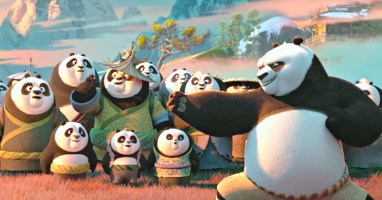
 The story of Kung Fu Panda 3 begins with adversaries on parallel paths. Po, the hero of the series, is set to take on the duties of teacher. At the same time, the villain Kai has returned from the spirit realm in order to steal all of the chi of the remaining masters. Po, of course, knows nothing of chi. Fortunately, Po’s long-lost father returns and takes him to the hidden village where the secrets of chi were said to have been kept. What starts as a sweet family reunion quickly sours when Po’s father confesses that the pandas of the hidden village have long forgotten the art of chi. The pandas are cute, cuddly, but ultimately clueless when they are called on to train Po in the only way that can bring him victory over Kai.
When I watched the movie over its opening weekend, my mind immediately turned to Rod Dreher’s Benedict Option. Over the last couple of years, Dreher has attempted to articulate what he sees as a dire plight for the church in contemporary society. The concept comes from Alisdair McIntyre’s After Virtue and is a nod to the work of Saint Benedict centuries ago. Much like Po’s panda village, the church was at one time known for embodying something good, life-giving, and necessary. Forces and movements have been at work, though, that have assisted in a real divergence from any perceived Christian roots in the American story. And so when our culture perhaps most needs what the church has to offer, we find ourselves sort of cute, potentially cuddly, and too-often clueless about what we have to offer to the world around us. Much like the panda village, Dreher might assert, we have forgotten what made us salt and light, a source of life, in the first place.
Dreher has, of course, been colored a doomsday prophet by some and a cultural coward by others (his use of the term retreat in his articulation of the Benedict Option has been a key point of attack). I am not usually given to such perceived alarmism. But there’s something about his articulation of the issue that I can’t quite shake. So over the next few days, I hope to unpack some of his thinking, particularly its root and its potential fruit. Tomorrow I’ll share a video of Dreher talking about the Benedict Option at a Q conference from last year. Then I’ll consider an essay on church history that has been a go-to document for the “why” of the Benedict Option. I’ll also try to write through some of the pushback that Dreher has received, some of it from thinkers Dreher would call his friends.
While the final confrontation between Po and Kai in Kung Fu Panda 3 is beautifully rendered, the final turn of Po’s mastery of chi is disappointing. Turns out that the power to defeat the great evil of Kai can be found in the pandas being who they are, in embracing what is already true of them. On one level, that’s weak storytelling sauce. It’s the lesson of The Wizard of Oz without the actually journey down the Yellow Brick Road. There is something (biblical) to be said about remembering what you have forgotten. It’s more sobering and hopeful, though, to learn things beyond and better than what you already know (or at least seem to practice).
(image from movieweb.com)


 Space Enough, and Time