
 I’ve been trying to think of some way forward for some time now. Forward in lots of ways really: faith, work, relationships, the rhythms of life. I get bits and pieces here and there, often from what I read, sometimes from the words and encouragement of others. Something that I find myself more and more convinced of, though, it that the way forward is going to look (at least a little bit, if not a lot) like looking back. You get a sense of that with the Benedict Option. You get a strong sense of it in the Old Testament. And you get a sense of it in the ideas of others who are trying to figure out how to be faithful in “what comes next.”
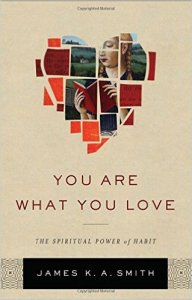
I think one of the greatest strengths of Smith’s You Are What You Love (and with his other thoughts on cultural liturgies) is his insistence on looking to what has gone before. To the Church Fathers, for sure, but also to Jesus and Paul. As he wraps up his book while thinking about vocation, Smith sums it up like this:
In order to foster a Christian imagination, we don’t need to invent; we need to remember. We cannot hope to re-create the world if we are constantly reinventing “church,” because we will reinvent ourselves right out of the Story. Liturgical tradition is the platform for imaginative innovation.
I’me reminded of the Andrew Peterson song, “You’ll Find Your Way,” where AP encourages the listener to seek out “go back” and “seek the ancient paths.” There’s something to that. Maybe it’s everything. I’m thinking You Are What You Love is a great step in the direction of finding that out.
(image from amazon.com)


 Space Enough, and Time