
 Over the last year, I’ve slowly added a couple of professors/theologians to the list of authors that I “follow.” One of those, Kevin VanHoozer has helped me articulate “next steps” when thinking about the biblical story as a “drama” that calls us into faithful action. The second, Stanley Hauerwas, hasn’t made it into my classroom thinking just yet, but he’s definitely challenged the way I think about Christian practice in a “post-Constantinian” world. He recently had a substantial interview with Plough Quarterly in which he answered questions about the Christian faith and community. Here’s an interesting set of comments about the connection between the two.
My hunch is that you don’t just make a community up. You discover that you need one another because you’re in danger. We need to figure out how to reclaim the disciplines that are necessary for building a communal life in a manner that indicates that we are a people who need help. We need to pray to God to help us, because we’re not quite sure anymore where we are – we’re not quite sure what the dangers are. We need all the help we can get from one another, and we need God in order to know how to be accountable to one another . . .
First, community for community’s sake is not a good idea. Sartre is right: hell is other people! Community by itself cannot overwhelm the loneliness of our lives. I think we are a culture that produces extreme loneliness. Loneliness creates a hunger – and hunger is the right word, indicating as it does the physical character of the desire and need to touch another human being.
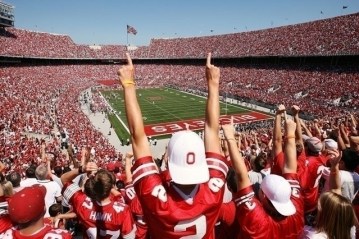
But such desperate loneliness is very dangerous. Look at NFL football. Suddenly you’re in a stadium with a hundred thousand people and they are jumping up and down. Their bodies are painted red, like the bodies that surround them. They now think their loneliness has been overcome. I used to give a lecture in my basic Christian Ethics class that I called “The Fascism of College Basketball.” You take alienated upper-middle-class kids who are extremely unsure of who they are – and suddenly they are Duke Basketball. I call it Duke Basketball Fascism because fascism has a deep commitment to turning the modern nation-state into a community. But to make the modern state into a kind of community – for the state to become the primary source of identity through loose talk about community – is very dangerous. It is not community for its own sake that we seek. Rather, we should try to be a definite kind of community.
(image from bloomberg.com)


 Space Enough, and Time