
 Chuck Klosterman’s new book, But What If We’re Wrong?, dropped this past week. The premise of the book is to cast thought forward a few hundred years and try and understand what we think we’re getting right now but might ultimately be getting wrong (ah, the time-space continuum). The folks at The Ringer were kind enough to post the section of the book where Klosterman reflects on television (something of great interest to those of us from the time-before-the-internet). The article’s opening paragraphs:
Television is an art form where the relationship to technology supersedes everything else about it. It’s one realm of media where the medium is the message, without qualification. TV is not like other forms of consumer entertainment: It’s slippier and more dynamic, even when it’s dumb. We know people will always read, so we can project the future history of reading by considering the evolution of books. (Reading is a static experience.) We know music will always exist, so we can project a future history of rock ’n’ roll by placing it in context with other genres of music. The internal, physiological sensation of hearing a song today is roughly the same as it was in 1901. (The ingestion of sound is a static experience.) The machinery of cinema persistently progresses, but how we watch movies in public — and the communal role cinema occupies, particularly in regard to dating — has remained weirdly unchanged since the fifties. (Sitting in a dark theater with strangers is a static experience.) But this is not the case with television.
Both collectively and individually, the experience of watching TV in 2016 already feels totally disconnected from the experience of watching TV in 1996. I doubt the current structure of television will exist in two hundred fifty years, or even in twenty-five. People will still want cheap escapism, and something will certainly satisfy that desire (in the same way television does now). But whatever that something is won’t be anything like the television of today. It might be immersive and virtual (like a Star Trekian holodeck) or it might be mobile and open-sourced (like a universal YouTube, lodged inside our retinas). But it absolutely won’t be small groups of people, sitting together in the living room, staring at a two-dimensional thirty-one-inch rectangle for thirty consecutive minutes, consuming linear content packaged by a cable company.
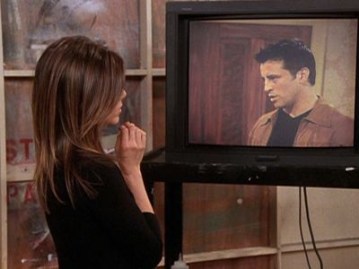
Much like the thinker Klosterman alludes to (McLuhan and the medium being the message), Klosterman has a good grasp of the particularly unique (and passing) place of television in culture. Time changes things, and quickly. I remember a couple of years ago watching the entire run of Friends and being surprised at how “present” the television was in the first two seasons. If it wasn’t being used as a plot device, it was on in the background reminding viewers, if only in a meta way, of what was actually going on between viewer and television.
And so Klosterman sets out to determine “What is the realest fake thing we’ve ever made on purpose?” as it relates to television, which is an interesting task. And while I might not agree with Klosterman’s conclusion, I can at least respect it.
You can read the whole article here. And if you want to know why I refer to the “essay” as an “article” . . . you’ll need to read the book.
(image from quora.com)


 Space Enough, and Time