
 The New York Times recently posted a short piece about the life of JRR Tolkien and its connection to The Lord of the Rings. The author, Joseph Loconte, recently published a biography connecting Tolkien and Lewis. The article begins:
In the summer of 1916, a young Oxford academic embarked for France as a second lieutenant in the British Expeditionary Force. The Great War, as World War I was known, was only half-done, but already its industrial carnage had no parallel in European history.
“Junior officers were being killed off, a dozen a minute,” recalled J. R. R. Tolkien. “Parting from my wife,” he wrote, doubting that he would survive the trenches, “was like a death.”
The 24-year-old Tolkien arrived in time to take part in the Battle of the Somme, a campaign intended to break the stalemate between the Allies and Central Powers. It did not.
The first day of the battle, July 1, produced a frenzy of bloodletting. Unaware that its artillery had failed to obliterate the German dugouts, the British Army rushed to slaughter.
It was during this moment (and the four months that followed for Tolkien), that the seeds of the world of Middle Earth were born.
Tolkien’s creative mind found an outlet. He began writing the first drafts of his mythology about Middle-earth, as he recalled, “by candle light in bell-tents, even some down in dugouts under shell fire.” In 1917, recuperating from trench fever, Tolkien composed a series of tales involving “gnomes,” dwarves and orcs engaged in a great struggle for his imaginary realm.
In the rent earth of the Somme Valley, he laid the foundation of his epic trilogy.
Some of the worst places in the Tolkien’s world found root in those moments.
On the path to Mordor, stronghold of Sauron, the Dark Lord, the air is “filled with a bitter reek that caught their breath and parched their mouths.” Tolkien later acknowledged that the Dead Marshes, with their pools of muck and floating corpses, “owe something to Northern France after the Battle of the Somme.”
The article crescendoes with a nod to the spiritual reality that infused Tolkien’s work:
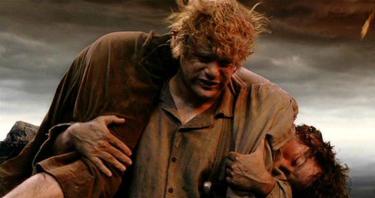
Even this was not the whole story. For Tolkien, there was a spiritual dimension: In the human soul’s struggle against evil, there was a force of grace and goodness stronger than the will to power. Even in a forsaken land, at the threshold of Mordor, Samwise Gamgee apprehends this: “For like a shaft, clear and cold, the thought pierced him that in the end the Shadow was only a small and passing thing: There was light and high beauty forever beyond its reach.”
Good triumphs, yet Tolkien’s epic does not lapse into escapism. His protagonists are nearly overwhelmed by fear and anguish, even their own lust for power. When Frodo returns to the Shire, his quest at an end, he resembles not so much the conquering hero as a shellshocked veteran. Here is a war story, wrapped in fantasy, that delivers painful truths about the human predicament.
Even the most fantastic of worlds and stories, in the end, can sit in the shadow of reality. Leconte’s article is a great reminder of that, one hundred years after the loss of so many lives at such a major moment in history.
You can read the entire article here. It’s a good read.
(image from lots.wikia.com; tip-of-the-pipe to Gerry Canavan)


 Space Enough, and Time