
 Try as we might to make it otherwise, place matters. At our best, we are people rooted in place and time in a way that makes us mindful of the good and bad of our moment. This is less and less true, I think, particularly as each unique place looks more and more like every other formerly unique place (thus: wherever you go, there you are). I often feel it when I travel, primed for it by a strong hometown and home state culture, reinforced by living in a state with a strong sense of its historic culture (and the struggle to maintain that culture against the forces of contemporary life).
Writer and editor Matthew Schmitz (of First Things) recounts a recent trip to England in his article titled “An Accidental Pilgrimage.” In the article, Schmitz recounts how he found hints of his Christian (and particularly Catholic) faith in a culture many consider post-Christian. The article hits high stride at the end, where he brings his experience in England to bear on what he perceives to be a particularly American approach to faith.
Flannery O’Connor described the American South as “Christ-haunted”. We Americans are proud of this observation, believing it indicates our nearness to God. We do not realise that one cannot draw close to a ghost. For an American, it seems more natural that Christ be accepted into one’s heart than that he be placed on one’s tongue. Rather than encounter him through sacrament and stone, we go searching for him in the vicissitudes of emotion or the obscurities of philology. What we find is a disembodied Christ, whether he is reconstructed by fundamentalist preachers on revivalist lines or by historical-critical scholars on liberal-humanist ones. Only in such a country could Jesus seem a mere spirit.
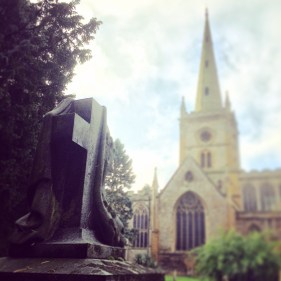
In England, Christ is no wisp or symbol, but an incarnate Lord, a king who once held the nation under his sway. He is bodied forth everywhere in ancient churches and sites of pilgrimage. These sites speak the truth of the Incarnation: Christ took on flesh, and so assumed definite physical limits. He founded a Church visible in history that has definite limits as well. There is no danger of collapsing the Second Person of the Trinity into the Third. Christ’s Church is his body, and even where the Church has been turned to ruin, we recognise him, for we know that his body was wounded.
Is he a bit harsh? Perhaps. But I get the sense of what he’s going for. It’s worth reflecting on, worth thinking about what our approach to our faith might (or might not) leave behind in material evidence.
You can read the rest of the article here.


 Space Enough, and Time