
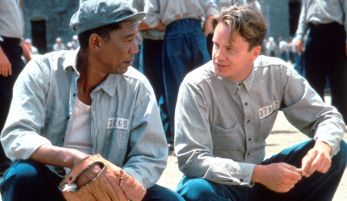
 One of the many great moments in Shawshank Redemption that sticks with you long after that wonderful final shot closes is Andy’s take on hope:
Remember Red, hope is a good thing, maybe the best of things, and no good thing ever dies.
Andy Dufresne has a particular hope, of course, one that involves freedom and rest. And his hope is what helps him survive in a situation that was on many levels beyond his control.
In No Man is an Island, Merton speaks of hope and a different kind of situation for those trying to understand his place in a particularly Christian culture (which we should, of course, call church). The situation is asceticism, which is a word you don’t often hear in Christian circles. We often have a strange relationship with “the things of this world,” whether they are things created or manufactured. Mix in an awkward theology of “blessing,” and you almost end up with no need to rethink “the things of this world.”
Hope is the living heart of asceticism. It teaches us to deny our ourselves and leave the world not because either we or the world are evil, but because unless a supernatural hope raises us above the things of time we are in no condition to make a perfect use either of our own or of the world’s true goodness. But we possess ourselves and all things in hope, for in hope we have them not as they are in themselves but as they are in Christ: full of promise. All things are at once good and imperfect. The goodness bears witness to the goodness of God. But the imperfection of all things reminds us to leave them in order to live in hope. They are themselves insufficient. We must go beyond them to Him in Whom they have their true being.
We cannot often hope because we are too busy reshaping the world around us as a form of induced forgetfulness about the bigger and broader picture. To chose a path of asceticism, much like both Jesus and Paul, requires some of “engine” for living. That engine is hope.
We leave the good things of this world not because they are not good, but because they are only good for us insofar as they form part of a promise. They, in turn, depend on our hope and on our detachment for their fulfillment of their own destiny. If we misuse them, we ruin ourselves together with them. If we use them as children of God’s promises, we bring them, together with ourselves, to God.
Leaving good things is no easy task. And yet leaving them behind is a way of putting things in their place, too. Like Michael Card once sang, ” we can’t imagine the freedom we find in the things we leave behind.”
Upon our hope, therefore, depends the liberty of the whole universe. Because our hope is the pledge of a new heaven and a new earth, in which all things will be what they were mean to be. They will rise, together with us, in Christ. The beasts and the trees will one day share with us a new creation and we will see them as God sees them and know that they are very good.
Meanwhile, if we embrace them for themselves, we discover both them and ourselves as evil. This is the fruit of the tree of the knowledge of good and evil—disgust with the things we have misused and hatred for ourselves for misusing them.
But the goodness of creation enters into the framework of holy hope. All created things proclaim God’s fidelity to His promises, and urge us, for our sake and for their own, to deny ourselves and to live in hope and to look for the judgment and the general resurrection.
An asceticism that is not entirely suspended from this divine promise is something less than Christian.
The question all of this begs in light of Merton’s subject in No Man is an Island is how this relates to people. Is there a way of practicing an asceticism of relationships? That doesn’t sound very appealing. And yet if there is one category of “thing” that we treat like objects, that category is people.
(image from biography.com)


 Space Enough, and Time