
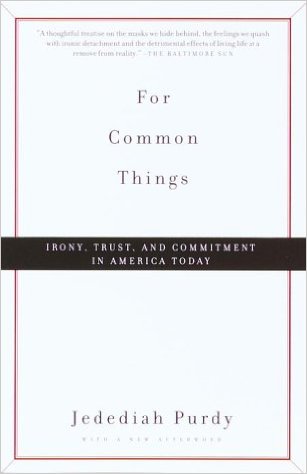
 A few months ago I spent some time working through Jedediah Purdy’s For Common Things. I first heard of the book when it was name-dropped on The Newsroom. When I read it, I found a genuine struggle with making sense of the world in a way that was both generative and formative. As Purdy articulated the need for a non-ironic approach to the most important issues of our culture, I found myself agreeing more than not. It was an odd bonus, of course, that the book actually came to print in 1999. And so even though the book was obviously dated, it was both a reminder of “the way things were” as well as a hopeful sign for something different.
I have since bought Purdy’s other books and followed him on Twitter and tried to piece together what became of the non-ironic idealist. It was clear things had changed for him (and for us all, of course), but I couldn’t quite find a good, succinct articulation of the change. Then, about a week ago, an essay that Purdy had written in 2014 for n+1 magazine jumped the paywall, giving me my answer.
I left college in 1997 with a motto, Czesław Miłosz’s “What is unpronounced tends to nonexistence,” and a corollary, that pronouncing things might bring them into being. What I wanted to pronounce was politics. To me, that meant making all my book-learning come alive in a shared awareness that people create, preserve, or degrade their own world, joined to a sense that its justice or injustice, peace or violence, belongs to everyone. There were no movements then, and campus politics were tiny and self-involved. The dismaying figures on the big, pre-internet podiums—Thomas Friedman, Maureen Dowd—were materialists without dialectic, polemicists without politics, and I wanted to make them impossible.
That’s how the long essay begins, with something of a recapitulation of the author as evidenced in For Common Things. It is a good reminder of culture in general, how different things were as so many of us left college. From there, Purdy revisits the basic tenets of neoliberalism, (something that just in the last few days was discussed over at First Things in an interesting article here). Of neoliberalism, Purdy says
The chief, and maybe sole, task of neoliberal politics is to stand watch over the market institutions—chiefly private property, free contract, and the right to spend money however one wants—that give those bargains their home. Neoliberalism welcomes market utopianism, wherein Bangladeshi factory conditions are automatically legitimate because workers agreed to work under them; but neoliberalism won’t be pinned down to a position where such conditions are celebrated. Challenged, neoliberalism switches to the tragic wisdom of (adulterated) Burke, (exaggerated) Hume, and (pretty faithfully rendered) Hayek. It might be nice if the world were different, neoliberal realism intones, but it is what it is, and so are we. Politics is no way out because, like the market, it is just the play of passions and interests, but lacking the discipline of the bottom line. Using politics to reorder social life is the dangerous dream of the utopian engineer. To try would just set loose the selfish, vain, and ignorant on our good-enough market system. Economic waste is the best we could expect from such efforts; the worst would be piles of dead. The neoliberal mind is never far from an interpretation of the 20th century’s worst disasters as symptoms of visionary politics.
It was in this context and understanding that Purdy had to find a way to articulate himself, to name the brand without becoming a brand himself (which is something that the book did for him). He became the sincere (non-ironic) voice of hopeful wisdom in a world full of irony (cue the contrast with Dave Eggers, considered then the “sincere ironist”). And so the challenge became, for Purdy, how to move in a world (how to speak and be heard in a world) full of commodification as a seemingly sincere and non-ironic person in a world riddled with irony. Of the book’s greatest failure, Purdy writes
My signal failure in the book was refusing to decide between nostalgia and alienation, keeping both in play, with plenty of concrete, rustic details to buttress the nostalgic reading.
That failure helped make the book a success. My call, for politics addressed to political economy and ecology and anchored in would-be universal ideas of equality and collective responsibility, fell nonetheless into the idiom of identity politics, a story about commitments that tied them essentially to origins. Calling for substance, I defined myself by style—by the careful, unfunny sentences of someone raised by artisans, of a purveyor of seriousness, whatever Harper’s or the New Republic might imagine the politics of seriousness to be. Against a sense that speech, relationships, and actions were thinned out and cheap, I offered the handmade, the locally grown, sustenance grabbed directly from trees and the bodies of beasts. I anticipated, as it happened, the substantial “artisanal” economy of this decade.
Which now seems one of my book’s greatest failings. Identity, style, and the integrity of objects are all things that this world knows how to market. I knew, in the half-naive, half-sophisticated way that bright young people do, that this kind of story—tying a political perspective back to an origin story, weaving it into an identity—made sense to readers, teachers, and editors. I do not think I knew how perfectly this anticommodification style would lend itself to a commodification that offered an anticommodification frisson among its features.
Purdy says much in the essay about the socio-political climate of his young adulthood. And while I wasn’t all that political myself in those times, the tenor of what he recollects is right. He asks good questions and must confront a real sense of futility. Near the essay’s end, Purdy remembers a particular moment.
One drunken evening in February 2000, I hacked and carved a hardback copy of For Common Things into thousands of paper shards. My housemate found me sitting in this butchered confetti, bleeding from one hand. I looked up at him and explained, “It’s full of lies.” As far as I can tell, I meant that I had falsified, simplified, used the consonance of sentences to slip around the dissonance of people and things. I was hacking at my own nostalgia and the glibness of seriousness. I also meant that I had failed: my poetics of political imagination had made nothing happen beyond selling books.
But the struggle has also brought with it a realization.
I realize now that I was trying to undo by writing what could only be undone by action, not alone but with others—and through connections that incantation alone would not conjure. Words, it turned out, did not have all the performative powers that 1990s book-learning sometimes seemed to suggest.
I was reading this essay last weekend while at a camp. It was awkward explaining what I was reading to a co-worker who asked. It’s odd sitting in a evangelical and conservative setting (during free time, mind you) reading a long-form essay by a guy who seems to embody the opposite of those evangelical and conservative ideals. What I most respect about Purdy, though, is his willingness to struggle and to share. We often see stories of failure. We rarely see stories of genuine ideological struggle and what happens to the idealism of youth. And while I don’t fully comprehend it, I cannot help but appreciate Purdy’s willingness to move beyond writing as the sole way of changing things. Because he’s right. I’m still trying to figure out a way of being in the world while holding fast to belief, ideals, and the power of words.
Purdy ends the essay with a helpful, practical image for how he sees life and vocation today.
Feeling out knots and tugging at them, looking for a loose end: you can help others by saying (when it’s true), Look here, this is stuck, try that. This good work fits the mood of the time. It’s modest, person-to-person. Is there anything spectacular left to do, without becoming fatuous?
It’s a good image, one that translates well to a number of contexts, including the classroom (and the life of the heart and mind).
You can read the essay in its entirety here. I think it’s worth your time, if only for a good challenge to how we approach the world around us. I know that I haven’t come to the same conclusions as Purdy, but I understand a little better how he came to his current answers. For that, I am thankful.
(image from amazon.com)


 Space Enough, and Time