
A couple of days ago I mentioned spending the summer with some saints. In that entry, it was St. Francis of Assisi through the writings of G. K. Chesterton. At the same time I was reading about Francis, I was also reading about Augustine via The Augustine Way by Joshua Chatraw and Mark D. Allen. Augustine has been on my radar in different ways over the years: I’ve taught parts of Confessions, I’ve read some of his shorter works and dabbled in some of his longer works. He was the subject of one book by James K. A. Smith. And he pops up in a number of places in Christian thought today because of his place in church and world history.
Which is a major thread for Chatraw and Allen, who seek to help readers understand how Augustine’s unique place in history (and his own personal history) how we might (re)think how we communicate with others, especially those who are not Christians. From early in the book:
Augustine is swimming in and against a current that looks surprisingly familiar [to our own contemporary current]. And because Augustine has to navigate these waters himself and instruct doubters and believers on how to make it through them, he is uniquely equipped to speak into contemporary apologetics.
Why? Because
… if we do not sufficiently grapple with our culture’s growing denial of the goodness and beauty of Christianity and the impact that this has on how people reason as an apologetic issue, ministers on the ground will often be flat-footed.
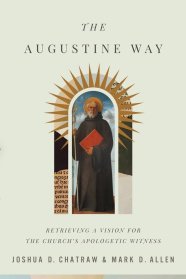 And apologetics is the chief concern for the book: how to we talk to those outside of the Christian faith about why they should get inside it. What follows in the book is a consideration of both Confessions and The City of God as pertinent pictures of a Christian thinker using (1) his personal story of conversion and (2) the story of “the city of God” moving through history as means to help us consider the weakness of a presuppositional approach to arguing for God’s existence and the truth of Scripture (think “arguments for God’s existence” and arguments for the nature of the Bible), not because those arguments are wrong but because many people just don’t think that way. Those kind of arguments, the authors suggest, “lack mass.”
Chatraw and Allen synthesize some of the great thinkers of the last few decades. You’ve got Alasdair MacIntyre and Peter Kreeft, Peter Brown and Charles Taylor, James K. A. Smith and C. S. Lewis all in the mix. And you’ve got lots of Augustine. So many great experts from his various works.
The book is divided in two parts, with the first (shorter) part looking back at Augustine, his circumstances and story and the second part focusing on a potential “vision” for today. That vision includes two “p” words: posture and pilgrimage and ends with a lengthy “therapeutic approach” that is more robust than one might think when considering that phrase. I really like the two “p” words used. Posture is a word that people get that also challenges us to think about how we situate ourselves in the world around us. And pilgrimage (which here is called a “pilgrimage of hope”) is a reminder of a key image for the church as it moves through history. Chatraw and Allen assert:
The church is to be a community of pilgrims on a journey home; the journey together is part of that healing process (the process that “puts back together fragmented souls and redirects disordered loves and longings toward the love of God and others”).
They continue:
[Augustine] models for his congregation how the story of Scripture and its lived narrative in the church can refashion their lives as they walk along the pilgrim way. The church helps the seeker of truth trace the hand of God in their life as a part of their pilgrimage homeward. Here, seeking lovers believe in order to understand.
There is much to learn from Augustine (and from Chatraw and Allen and the many who have written about Augustine before they did). I found the book encouraging to me as a teacher, both as an affirmation for things already being done but also as a challenge to think differently and engage those around me lovingly and well.


 Space Enough, and Time