
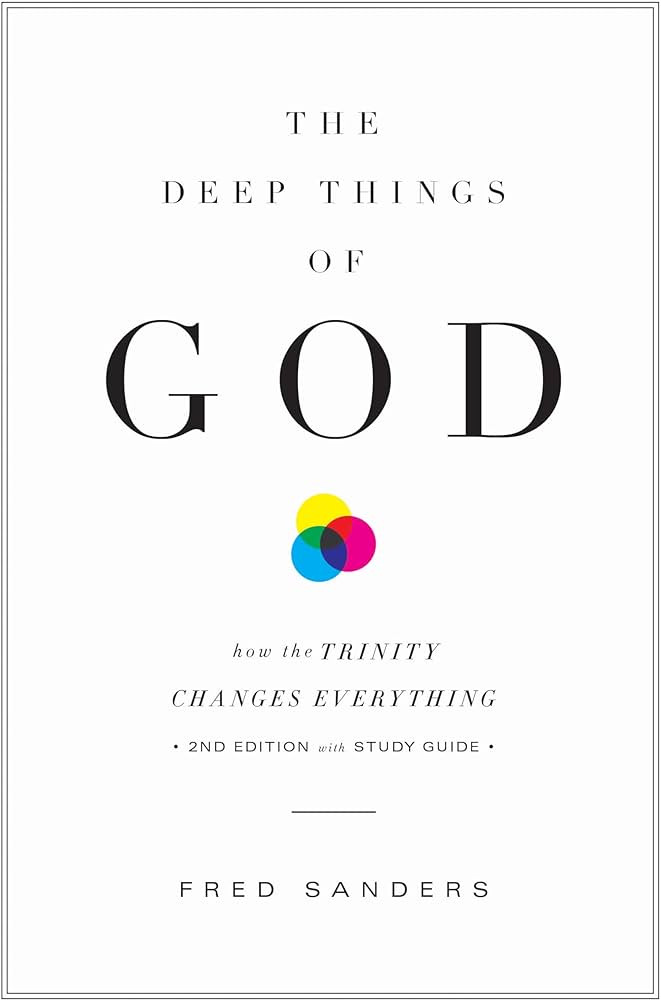
 Fred Sanders begins The Deep Things of God with a distinction that is worth making in many areas: the emphatic and the reductionistic. He’s thinking specifically of the Trinity in relation to the many other things that healthy evangelical Christians think about. The emphatic, of course, has to do with emphasis. Sanders asserts that healthy evangelism has landed on a few things for real emphasis: the Bible, the cross, conversion, and heaven. Sanders’s concern is that other key things get loss when things are under-emphasized and forgotten, what he calls an “anemic condition.” An example:
Instead of teaching the full counsel of God (incarnation, ministry of healing and teaching, crucifixion, resurrection, ascension, and second coming), anemic evangelicalism simply shouts its one point of emphasis louder and louder (the cross! the cross! the cross!). But in isolation from the total matrix of Christian truth, the cross doesn’t make the right kind of sense. A message about nothing but the cross is not emphatic. It is reductionistic. The rest of the matrix matters . . . You do not need to say all those things at all times, but you need to have a felt sense of their force behind the things you do say. When that felt sense is not present, or is not somehow communicated to the next generation, emphatic evangelicalism becomes reductionist evangelicalism.
Emphatic evangelicalism can be transformed into reductionist evangelicalism in less than a generation and then become self-perpetuating.
Remembering things you never really even knew is a tricky thing to do.
One of the interesting things about some healthy evangelical Christianity over the last decade or so has been at attempt at “retrieval,” of revisiting the history of the broader Christian tradition and learning from what has been forgotten. It’s a good shift, though I feel like it’s only happening in some pockets here and there. Even still, it is a good reminder that there are important truths and practices waiting to be rediscovered. And with each rediscovery can be asked many good questions: where and when did it start? why was it neglected? when was it forgotten? how can the Spirit bring edification with this rediscovery?
I intended this post to be about both more and less than theology. Because there’s a lot of reductionism going on in the world today, some of it intentional but much of it accidental. It happens in theologies and traditions and organizations and relationships. In the 21st century, it feels like every body of knowledge is overwhelming and in need of some kind of shorthand. Which is all well and good until something vital is inadvertently lost. We would do well to guard against that, though first we’d have to know what we’re guarding (and why it’s worth guarding in the first place). Emphasis, yes. Reductionism, no.


 Space Enough, and Time