
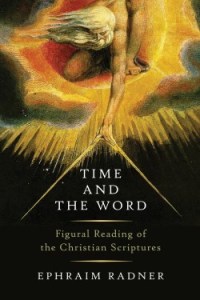
 The folks over at Eerdman’s just posted a nice interview with Ephraim Radner, whose latest book drops this week. Radner has been interesting to me over these last few months, both in his posts over at First Things and in A Time to Keep. He seems to have a good grasp on some of the vital parts of “being human” that many of us don’t articulate well when talking about faith over time.
His new book, Time and the Word, takes on the concept of the figural reading of Scripture. When asked about why he researched and wrote such a book:
Contemporary Christians are forgetting how to read the Bible. The main question driving everything else remains the modern one, “did it happen?” Obsessively answering that has taken us out of the Bible, not into it. It’s misguided: past, present, and future—our era’s critical categories—are simply insufficient to engage the realities of creaturely existence that derives from God, who creates and recreates. Why would God’s Word be captive to time? I have been prodded to rethink all this in part by my work within non-Western churches and societies—filled with people who are educated, read newspapers or watch TV, and are hardly historically naïve (as some Westerners like to think). But they have grasped how their lives are “given” by God to such a radical extent that their conformance to the details of Scripture is an obvious promise, not a problem to be argued for. Most Christians, over the centuries have intuited this: Scripture, as God’s Word, is what structures the world, not the other way around. Things happen because Scripture, the Word of the Creator, speaks them; Scripture doesn’t speak them because they happen. This is the fundamental presupposition of figural exegesis, which my own book explores: it is a discipline whereby we read the text in order to see how divine words structure events, and how experienced time reveals the experiences of every Scriptural moment. Just to think about this is liberating.
I feel the tension of Radner’s observations almost every day in my classroom, with students on all ends of the belief spectrum. I’m curious, then, to see where his explorations have led him.
It’s a fun little interview really, moving from his writings to what kind of books he prefers reading at 2 in the morning. I particularly liked his closing comments about advice to those striving to think along biblical lines.
You can read the whole interview here.
(image from eerdword.com; hat tip to my Twitter feed)


 Space Enough, and Time