“The Blue Back in My Eyes”

One of the nice surprises of these last few weeks has been the chance to hear some new/old U2 music that’s rooted in their How to Dismantle an Atomic Bomb phase.  I already shared the link to “Country Mile.”  Here’s another song from the recent 20th anniversary reissue of HTDAAB: “Luckiest Man in the World.”  A quick glance at the comments reveals that it’s a “redone” version of an older, never-released song called “Mercy.”  That version is also worth checking out.

Posted in Music | Leave a comment

A Short Poem for Christmas Day

“Xmas Day” by G. K. Chesterton (an early poem)

Good news: but if you ask me what it is, I know not;

It is a track of feet in the snow,

It is a lantern showing a path,

It is a door set open.

From Chesterton’s The Spirit of Christmas

Posted in Books, Faith | Tagged , | Leave a comment

One Season Turns to Another

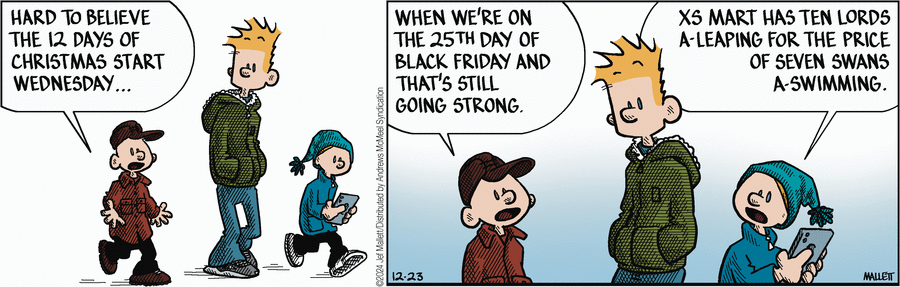
And so one season turns to another, the the folks in Frazz are right, time tends to blend things together in weird ways.

Frazz 12 Days

Twelve days for Christmas can be nice, though difficult to hold together when things in the world move on.  Here’s my annual post of one of my favorite Christmas songs, “I Will Find a Way” by Andy Gullahorn and Jason Gray.

(image from gocomics.com)

Posted in Faith, Holidays, Music | Tagged , , | Leave a comment

Advent and “The World’s Last Night”

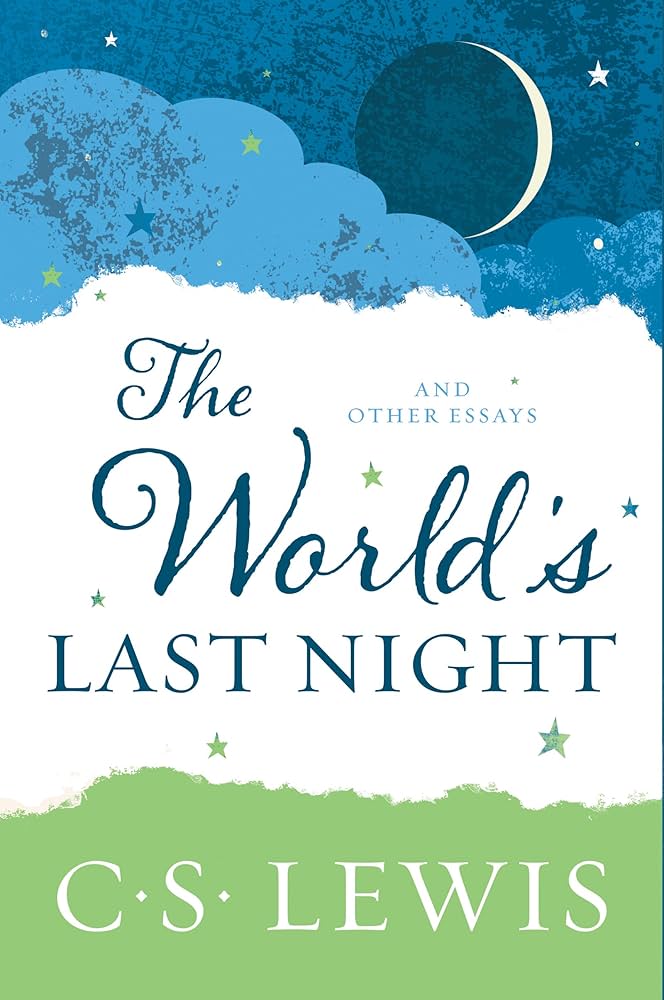
Lewis Worlds Last NightAdvent, as I understand it, helps us consider two truths: the birth of Jesus (His first coming) and the return of Jesus (His second coming).  That’s a lot to hold together, I think, especially with the strong pull of Christmas Day and all that comes with it.  But that second truth still stands, which is why I often think of “The World’s Last Night” by C. S. Lewis.

The essay starts with the doctrine of Jesus’ second coming and the frustration that the doctrine can bring to people, especially those with a strong desire to pinpoint exact time and location of that event.  Lewis does a solid job of reminding us of a number of truths surrounding the second coming, including an interesting section on the place of apocalyptic literature in the first place:

. . . our Lord’s production of something like the other apocalyptic documents (of first-century Judaism) would not necessarily result from his supposed bondage to the errors of his period, but would be the Divine exploitation of a sound element in contemporary Judaism: nay, the time and place in which it pleased him to be incarnate would, presumably, have been chosen because, there and then, that element existed, and had, by his eternal providence, been developed for that very purpose.

Lewis also deals with the knowledge of the incarnate Jesus: what did he know (or not) and how did he know it.  It’s a theological question that lots of people ask often, and I think he handles it well.  Near the essay’s end, he asserts:

What is important is not that we should always fear (or hope) about the End but that we should always remember, always take it into account . . . What modern Christians find it harder to remember is that the whole life of humanity in this world is also precarious, temporary, and provisional.

And so what Ash Wednesday does for the individual, this facet of Advent does for all of humanity and all of our history.  Both are good and necessary reminders, particularly as Advent gives way to Christmas.

Posted in Books, Faith, Notes for a World's End | Tagged , , | Leave a comment

Advent Ending

While it didn’t quite happen, I did have high hopes for a solid Advent season.  I had planned on slowly reading through some of Augustine’s “Advent homilies” as recently collected by the Davenant Institute.  Unfortunately, not even pre-ordering the books weeks in advance could make up for spotty shipping that saw the book get here just a few days ago.

Having said that, the readings from the Daily Office have been solid: Isaiah and both Thessalonian epistles and 2 Peter.  That set of New Testament letters rarely, if ever, get much airtime in any church more taken with Paul’s other letters (or James, which seems to be the go-to General Epistle for many).  Isaiah is a great mix of strange and familiar, which is always nice this time of year.  And the same for the epistles, which bridge the Incarnation and His Return really, really well.

The best short piece I’ve read about the season is this piece from Anthony Robinson over at Mockingbird.  A couple of quality quotes:

Advent is a season that tells an important truth, one we need to hear, perhaps especially in the weeks before Christmas when the pressure can be on to be constantly jolly and generally perfect.

Advent positions the church where we do in fact live, between hope and fulfillment, and in contested territory where all that distorts, disfigures, and destroys life is yet real and powerful.

And after remembering the medieval focus of Advent on “the last things,” Robinson writes:

Nowadays, we name the four Sundays of Advent, hope, peace, joy, and love and light a candle on the Advent wreath for each one in turn. A return to the older themes is, well, let’s just say “unlikely.” Probably just as well. I’m sure the death, judgment, heaven, and hell menu gave rise to plenty of fearmongering sermons and urgings to “clean up your act or else,” which by the way is not the gospel.

Still, the modern quartet — hope, peace, joy, and love — do suggest that we don’t have a lot of room for the darker side, which is often now relegated to a special “Blue Christmas” service for those who can’t quite pull off the bright-side program of this, “the most wonderful time of the year.”

“The darker side” is such an interesting thing, something that we all know about but can’t seem to name very well (perhaps in our rush to get to the light of Christmas).  The older I get, the more important framing is for me.  Context matters.  And the context of living this life matters.  It’s the reminder of Paul to the Colossian church: that we have been rescued from the dominion of darkness and brought into the kingdom of his beloved Son.  But the darkness is still there; we’re still in the world.  And we’re still waiting for the Brighter Light to shine fully.

+ + + + + + +

So I’ve got my Augustinian Advent collection to read (it helps that they are quite short).  I’m also slowly rereading “The World’s Last Night” by C. S. Lewis, which I think about often this time of year (and any time I’m reading anything slightly apocalyptic in the Bible).  Advent’s not over yet.  The darkness is passing away, but it also has deep roots and a real presence in our lives and the world around us.  This season is set to remind us of that, and that we ought not be hopeless, for hope has come into the world.

Posted in Books, Church, Faith, Life in the Fifth Act, Notes for a World's End, Scripture, The Long Story | Tagged | Leave a comment

Just As I Am [December 19-20, 2024]

It’s not just the fact that there’s water under the bridge, it’s the amount of water the flows under the bridge in such a short amount of time.  In those terms, I suppose this Advent season has been a flood.

The nice thing about my mostly-annual trip to Victoria, BC is that it usually coincides with the beginning of Advent.  That was a really nice way to start things this year, as I spent more time at church that Saturday evening than usual (traveling on Sunday doesn’t usually allow for any time at church).  Things have been non-stop since then, though, which I wasn’t totally expecting.  Time with neighbors, time and more time at work, time at church.  The days, and the nights, have been packed.  These last couple of days have been full of grading, final classes, and lots of meetings (because we hit the ground, hopefully running, in January).  While I’m not prepared for it, I do feel more than ready to head to the airport and make my way to Tennessee for Christmas.

I suppose one of my favorite Advent moments this season was the first one.  I was late getting out of the inn to get to church.  The “Santa Claus” parade was warming up and people were everywhere.  I clicked over to my Advent playlist from 2019, one of my best playlists ever, and the first song to play was “When the Fullness of Time Had Come” by Randall Goodgame.  Yes, it’s a Scripture song, and yes, it’s geared towards children.  But it’s also a Scripture that helps frame this season perfectly.  I think I have shared this most years, so there’s nothing wrong with sharing it again!

Posted in Just As I Am, Travel | Leave a comment

Early Thought on The Skeleton Crew

We’re two episodes into Star Wars: The Skeleton Crew, and the best mystery has nothing to do with Jude Law’s character.  That’s a nice twist.  Episode three drops later this week.

Posted in Uncategorized | Leave a comment

On Thanksgiving

A song for Thanksgiving Day (and every day, really) from Andrew Peterson.  Best super-long song since “American Pie.”

Posted in Faith, Music, The Long Story | Tagged , | Leave a comment

Believing and Beseeching

Not sure how I missed this, but I did.  U2 just remastered and released How to Dismantle an Atomic Bomb in celebration of its 20th anniversary.  And it also shared a number of unreleased singles from that window of time.  Here’s one of the best: “Country Mile.”

Posted in Music | Tagged | Leave a comment

Movies and Meanings

The OutrunThis past weekend was a rare, double-feature weekend for me.  First up was The Outrun, which tells the story of a recovering alcoholic trying to make-do in the Orkney Islands.  The lead, Rona, is played by Saoirse Ronan, whose life is told in jarring-but-effective flashbacks involving both family and friends.  She is a sympathetic character, one whose pain and suffering and frustration you can feel. It’s an incomplete story, of course, but aren’t they all?

The second movie was A Real Pain starring Jesse Eisenberg and Kieran Culkin, who play estranged cousins traveling to Warsaw, Poland to honor their recently-deceased grandmother.  In its own way, A Real Pain is the more difficult story to watch as there are some genuinely funny moments that make the difficult moments that much more potent.  Eisenberg plays the responsible, no-nonsense cousin while Culkin plays the wildly frustrating-yet-inspiring one.  Both character get a chance to shine in the story.

A Real PainA Real Pain tells a kind of full-circle story, with opening and closing shots taking place in a busy airport, where Culkin’s character enjoys getting to know those around him.  But what you feel at the end isn’t quite the same sensation that you hade with the opening scene.  A Real Pain, it turns out, has at least two meanings: one obvious, one less so.  It’s the double-meaning that stays with you as the credits roll.

There’s also the sense of a double-meaning in the title of The Outrun.  I didn’t see a trailer prior to watching the movie, I just knew it was a chance to see a movie about recovery.  “The Outrun” is only mentioned once in the script, when Rona’s father tells her that some things need to be taken care of on their farm in a location called the outrun.  The Dictionaries of the Scots Language gave me some illumination on an exact definition- turns out there are two,  First, an outrun is “a piece of outlying grazing land on an arable farm” that can, by extension be understood as “an exposed part of the body, one of the extremities.”  Both seem fitting for the story.

Not the happiest time at the movies, obviously, but both movies told good stories with beautiful moments.  I recommend them both.

Posted in Movies | Leave a comment