
A classic song from Rich Mullins to close out the day.
Like so many of Rich’s songs, it balances the beauty and the tension that can come with life as we know and experience it. Always a good thing to keep in mind.
A classic song from Rich Mullins to close out the day.
Like so many of Rich’s songs, it balances the beauty and the tension that can come with life as we know and experience it. Always a good thing to keep in mind.
It’s crazy to me that it’s been three months since Apple TV+ dropped this teaser trailer for the third (and supposedly final) season of Ted Lasso.
It’s been three months, yes, and the background song hasn’t played a role in the actual show, which is unfortunate. There’s one more chance this week, though. It would be great if it did. But even if it didn’t, I’m grateful that the trailer introduced me to the song playing in the background: “I Still Believe” by Frank Turner. Here’s the music video from twelve years ago:
It’s an ode to the power of rock’n’roll. But it’s also been something of a gateway song for me, which I’ll get into later this week. Just wanted to post this before the final episode of Ted Lasso drops tomorrow night.
 These last couple of weeks, my morning reading has been a slow (mostly re-)read of Frederick Buechner’s The Remarkable Ordinary. It was one of the last two books of Buechner’s to be published before his death last August. I started the book back in 2017 when it was published, but I didn’t make it past the first few pieces. Buechner has been a part of my story since college, when I found him through the liner notes of a Wes King album, Since then, I’ve read most of his sermons but not enough of his fiction. The Remarkable Ordinary, which I’m about to finish, includes some talks that he gave at Laity Lodge (one of my favorite places ever), back in 1990 (long before I had heard of either person or place).
The collection has a lot to say about faith, but mostly through the arts. He says a good bit about his own life story, which always feels fresh no matter many times you have read similar pieces of his. “Stop, Look, and Listen for God” is the title of the first part of the collection. It’s a good summation of his approach to faith, too. He wrote about attention long before it became an early 21st century buzzword. And he often and effortlessly brings what he thinks of art or his own life back to the presence of God, to the God revealed in Scripture, and to Jesus. And then, in the middle of it all, he reminds us:
Love each other knowing that you are loved.
Such a simple statement. It’s a reworking of a key New Testament teaching that I’d not really heard that way (or that well) before.
Buechner is definitely a product of his time (or times, as the case may be). The third part of the book is the most obviously biographical. And he starts it with the assertion that “the twentieth century comprised three worlds”: pre-World War II, the world of the war, and the post-World War II world (which he still lived in when he penned the piece). He brings those different eras to life well without indulging in nostalgia. And he practices what he preaches: listening to God in the story of his life.
I really thought there’d be more quotes from the book in this piece, but they just didn’t materialize. There are a number of lines that I marked in the book, but they make the most and best sense in the context of all the other words and phrases on the page.
Revisiting Buechner these last couple of weeks has been nice. The times they are a-changing, with things happening both at Home and in the Neighborhood. It is good to be reminded that God is at work around us, and more often than not in many less-obvious ways. Still in the obvious, of course, but often the obvious gets lost in the mix. Early in the book, Buechner writes about the reading of books:
You can escape the little world that’s inside your skin and live inside the world the writer produces for you.
That’s especially true for the world that Buechner wrote with his life. It has so many little tributaries, too, with people like Lewis and Chesterton and other writers he has either led me to or helped me enjoy. It’s good to be reminded, every day really, of the remarkable ordinary of our lives.
Brad East has been blogging a bit more recently. His take on academics and AI is pretty genius (and something I’ve shared with a number of co-workers). He also recently posted a piece on fantasy literature, comedy, and the question of God’s existence (and His allowance of evil). His reference is a series I’ve not heard of anywhere else except in one or two of his posts. But he says something about (fantasy) literature in general that I really like, the middle paragraph in particular:
For modern fantasy to avoid theodicy, it would have to embrace tragedy. Not darkness, not “grittiness,” not violence and sadism and gratuitous sex and playing footsie with nihilism. Actual, bona fide tragedy. I’ve not encountered fantasy that does that. And even then, if there’s a human author doing the tragedy-writing, there’s a case to be made that it can’t fully escape the pull of theodicy. It seems to me you’d have to go full Sartre and write a fantasy akin to La Nausée. But what world-building fantasist wants to do that? Is even capable of stomaching it?
We write because we are written. We make because we are made. We work providence in our stories because providence works in ours. We give the final word to the Good because the Good has the final word in our world—or will, at least; we hope, at least.
This is why every fantasy is a theodicy. Because every fantasy is a comedy. And comedy is a witness to our trust, howsoever we deny it or mask it, of our trust that God is, that God is good, and that God will right all wrongs in the End.
It reminds me of a quote from Anthony Thiselton that I fear I have totally misremembered but love anyway: history reminds us of what is possible; fiction reminds us of what is necessary.
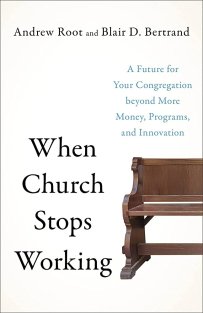 Probably the thinker who has influenced me most these last five years when it comes to faith and church life is Andrew Root. His writing on church life in a secular age has been a vital way for me to orient myself in my understanding of the way the world of today works. Part of what resonates with me from his work is that he doesn’t simply restate the party line of “church growth.”
He just released a shorter book that brings together various threads from his work from the last few years. Co-authored with Blair Bertrand, When Church Stops Working revisits the ideas of secularity, acceleration, resonance, and even the “watchword” concept from Root’s most recent book. Root and Bertrand attempt to help readers understand that the problem of decline is not the thing the church should be worried about. It’s not about speeding up and doing more to keep up with our always-accelerating culture. Instead, the one thing the local church can and should do is learn how to wait. An excerpt:
But waiting is our friend. The only way we can survive is by waiting. Waiting puts our attention in the right place. When we forget to wait, we become too distracted, too impatient, too angry to see God’s action. The stories that form the church are about God’s actions. Attention ought not to be on the church but on the God who moves, the Jesus who lives, bringing life out of death. The church is the witness, the narrator, to the bigger story of God’s action to save the world.
We know of very few churches that intentionally turn away from God. They don’t do it on purpose. It happens because our attention is directed somewhere else and our secular imaginations don’t let us see that. With our attention on the anxiety to survive and the rush to do something, God is inevitably replaced as the star of the church’s story. It becomes so easy, particularly in our secular age, for God to be just a subplot of our congregational life. We’re so anxious that this becomes inevitable.
Root and Bertrand make suggest a handful of good “moves” that the church would be wise to take, but they are the kind of moves that have to be made intentionally and at the right place/right time. The key move is to think about Acts chapter one before jumping into Acts chapter two. Many churches, at least those you hear about the most, will likely keep moving faster and faster, trying to grow larger and larger, applying one corrective or new program after another to keep the ball in the air. For the rest of us, though, the word to wait is good and right and definitely worth considering.
You can read more of the excerpt here. And while Root’s longer books are better, this one reads well (and is almost a nice bookend to Jamie Smith’s book on secularity from almost a decade ago).
(image from amazon.com)
This piece by Richard Beck is the best thing I read today about the observance of Ash Wednesday. It’s an interesting snapshot of a modern approach to an ancient tradition.
Back in early January, I attempted a short series of reflections on the hot-button of the turn of the year: the Christian faith and a “therapeutic gospel.” This piece by Brad East of Abilene Christian University was going to be the through line, and it would have run for five or six posts. I got through two before promising an excursion into the thoughts of Charles Taylor. I actually wrote that post, but didn’t feel it was ready to post. And then the rest of January happened . . . and now most of February, too.
I like East’s post because it covers important ground about preaching in a way that sums things up quite nicely. He provides a framework for thinking about what preaching should be since it out not be therapeutic. The framework includes things that ought to go without saying as advice because they should always be said. But life on the ground, preaching or speaking on a regular basis, can lead you to lose sight of such things. That and a few of repetition or of preaching two sermons in one (one part exegetical, one part invitation that doesn’t really connect with the first sermon).
Perhaps the thing I like most about East’s post was the final point. After talking about God and salvation and sin and heaven, East asserts that “one test for preaching that seeks to avoid reducing the gospel to therapy is whether it mentions the Devil, demons, and evil spiritual forces.” Why? Well:
Show me a church that talks about Satan, and I’ll wager it also talks about sin, salvation, heaven, and God. Show me a church that never talks about Satan, and I’ll wager that next Sunday’s sermon won’t mention sin or heaven. Such a church is on its way to disenchantment, secularism, a therapeutic gospel, and functional atheism. The point isn’t that talk of devils is spooky, though it is. It’s that talk of devils presupposes and projects a universe with stakes.
Not much gets said about Satan, it seems. Perhaps when technical issues or health conditions are bad, but not as part-and-parcel of proclamation. But it makes sense to include it in the big picture, and as more than just a nod to Lewis’s Screwtape Letters. East writes:
For ordinary believers, this cashes out in how they understand their daily lives. Are they living in enemy territory? Are they constantly under assault by the Enemy? You don’t have to be charismatic to think or talk like this. But preaching makes evident whether this is the right way to experience the world.
Here’s the fundamental question: Is following Christ like living in wartime or in peacetime? The flavor of a sermon tells you all you need to know. And if, as I began this post, therapeutic preaching finally serves to reassure disenchanted professionals in the upper-middle-class that God affirms them as they are—that a well-adjusted life is attainable, though ennui on the path is to be expected—then we have our answer: there are no demons; there is no war on; we are living in peacetime.
Such a message may be the best possible way to lull believers to sleep. Not literal sleep (a TED Talk can be entertaining), but spiritual sleep. Jesus commands us to be alert, to be watchful, to stay awake as we eagerly await his coming. The command, in short, presumes a wartime mentality. Peacetime is thus a myth, a lie from the Enemy. Each of us forgets this at our own peril, but preachers most of all.
I included two quotes from East as titles for this post. “A Universe with Stakes” because it is a truth that is easy to forget. Or we forget that “stakes” in this case applies to a number of aspects of the life of faith. And then the second title, “The Right Way to Experience the World,” because it opens a door not just to the thoughts of Charles Taylor but also Hartmut Rosa and so many thinkers who write about how we actually interact with and move through the world. You could even, I suppose, make a link to Lewis’s “Learning in Wartime.”
+ + + + + + +
I’ve got a few different posts ready for the rest of the week. I really want to be regular here, but sometimes the best I can do is the Sunday post. I’ve got some comics and some music lined up. And hopefully I can get some more reflection and thinking down, too.
I finally finished my re-read of Microserfs by Douglas Coupland. I read it the first time over a decade-and-a-half ago: once I read one of Coupland’s novels, I had to read them all. I re-read another Coupland novel, Eleanor Rigby, during and after my Thanksgiving trip to Victoria, BC. The re-read took a little longer than usual because it became my bus-and-downtown read. On some level, I re-read the book to rediscover one line of dialogue that I’ve thought of often over the last 15 years (and that, it turns out, I didn’t quite remember word-for-word, but I at least got the sentiment).
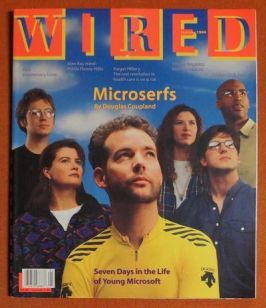 The book is set in the early 1990s, which makes it a time capsule on almost every level. The story is told in a diary-type form and includes all kinds of nods to the pop culture that had accumulated up until that point. The story follows Dan and his friends and family during his time at Microsoft and then at a start-up. There are lots of lists and quirky facts and even a good amount of usage of the old font that Macintosh computers used to use.
As with many books that I read quickly, I had forgotten the ending (the same was true for Eleanor Rigby as well as Harry Potter and the Half-Blood Prince, whose identity I still have to work hard to remember). And it really is quite the ending because it’s out of no where but also makes perfect sense.
It’s odd, having lived through the 90s but not having read so much of the literature of the time. No complaints, of course: it would have been totally over my head. But I’m glad to read and re-read it now, to see what was going on in the bigger world around my own and to understand those times better. And I appreciate Coupland’s “take” on the times (something that is also true with Dave Eggers’ take, though they are different). Humorous, optimistic, but also aware of the ephemeral and potentially cruel.
Not quite sure what’s next for my “bus-and-downtown” read. Might be good to take a short break from Coupland. Then again, it’s clear that there’s some much I’ve forgotten (but also so much that I obviously enjoyed).
(1994 cover of WIRED magazine from biblio.com)
This week’s classic Peanuts strip had Chuck and Peppermint Patty talking under the tree, which almost always leaves one of the two frustrated. That’s especially true for holidays, it seems.
 (image from gocomics.com)
The last week or so has been pretty busy, which explains my dropping of some threads here even if it doesn’t excuse it. Back to those threads soon. But for now . . .
The Nerd of the Rings recap of each episode of The Rings of Power was almost as interesting as show itself. Before Christmas, a full-season review of the show’s first outing was promised, and it finally dropped today. I’m putting it here for sharing . . . and for reminding myself to watch it soon.


 Space Enough, and Time