“Waiting is Our Friend”

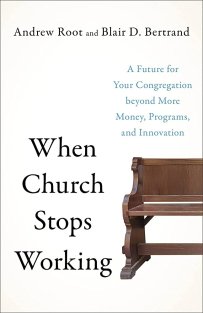
When the Church Stops WorkingProbably the thinker who has influenced me most these last five years when it comes to faith and church life is Andrew Root.  His writing on church life in a secular age has been a vital way for me to orient myself in my understanding of the way the world of today works.  Part of what resonates with me from his work is that he doesn’t simply restate the party line of “church growth.”

He just released a shorter book that brings together various threads from his work from the last few years.  Co-authored with Blair Bertrand, When Church Stops Working revisits the ideas of secularity, acceleration, resonance, and even the “watchword” concept from Root’s most recent book.  Root and Bertrand attempt to help readers understand that the problem of decline is not the thing the church should be worried about.  It’s not about speeding up and doing more to keep up with our always-accelerating culture.  Instead, the one thing the local church can and should do is learn how to wait.  An excerpt:

But waiting is our friend. The only way we can survive is by waiting. Waiting puts our attention in the right place. When we forget to wait, we become too distracted, too impatient, too angry to see God’s action. The stories that form the church are about God’s actions. Attention ought not to be on the church but on the God who moves, the Jesus who lives, bringing life out of death. The church is the witness, the narrator, to the bigger story of God’s action to save the world.

We know of very few churches that intentionally turn away from God. They don’t do it on purpose. It happens because our attention is directed somewhere else and our secular imaginations don’t let us see that. With our attention on the anxiety to survive and the rush to do something, God is inevitably replaced as the star of the church’s story. It becomes so easy, particularly in our secular age, for God to be just a subplot of our congregational life. We’re so anxious that this becomes inevitable.

Root and Bertrand make suggest a handful of good “moves” that the church would be wise to take, but they are the kind of moves that have to be made intentionally and at the right place/right time.  The key move is to think about Acts chapter one before jumping into Acts chapter two.  Many churches, at least those you hear about the most, will likely keep moving faster and faster, trying to grow larger and larger, applying one corrective or new program after another to keep the ball in the air.  For the rest of us, though, the word to wait is good and right and definitely worth considering.

You can read more of the excerpt here.  And while Root’s longer books are better, this one reads well (and is almost a nice bookend to Jamie Smith’s book on secularity from almost a decade ago).

(image from amazon.com)

Posted in Books, Faith, Notes for a World's End | Leave a comment

The Ash Wednesday Confrontation

This piece by Richard Beck is the best thing I read today about the observance of Ash Wednesday.  It’s an interesting snapshot of a modern approach to an ancient tradition.

Posted in Faith, The Long Story | Tagged | Leave a comment

“A Universe with Stakes” or “The Right Way to Experience the World”

Back in early January, I attempted a short series of reflections on the hot-button of the turn of the year: the Christian faith and a “therapeutic gospel.”  This piece by Brad East of Abilene Christian University was going to be the through line, and it would have run for five or six posts.  I got through two before promising an excursion into the thoughts of Charles Taylor.  I actually wrote that post, but didn’t feel it was ready to post.  And then the rest of January happened . . . and now most of February, too.

I like East’s post because it covers important ground about preaching in a way that sums things up quite nicely.  He provides a framework for thinking about what preaching should be since it out not be therapeutic.  The framework includes things that ought to go without saying as advice because they should always be said.  But life on the ground, preaching or speaking on a regular basis, can lead you to lose sight of such things.  That and a few of repetition or of preaching two sermons in one (one part exegetical, one part invitation that doesn’t really connect with the first sermon).

Perhaps the thing I like most about East’s post was the final point.  After talking about God and salvation and sin and heaven, East asserts that “one test for preaching that seeks to avoid reducing the gospel to therapy is whether it mentions the Devil, demons, and evil spiritual forces.”  Why? Well:

Show me a church that talks about Satan, and I’ll wager it also talks about sin, salvation, heaven, and God. Show me a church that never talks about Satan, and I’ll wager that next Sunday’s sermon won’t mention sin or heaven. Such a church is on its way to disenchantment, secularism, a therapeutic gospel, and functional atheism. The point isn’t that talk of devils is spooky, though it is. It’s that talk of devils presupposes and projects a universe with stakes.

Not much gets said about Satan, it seems.  Perhaps when technical issues or health conditions are bad, but not as part-and-parcel of proclamation.  But it makes sense to include it in the big picture, and as more than just a nod to Lewis’s Screwtape Letters.  East writes:

For ordinary believers, this cashes out in how they understand their daily lives. Are they living in enemy territory? Are they constantly under assault by the Enemy? You don’t have to be charismatic to think or talk like this. But preaching makes evident whether this is the right way to experience the world.

Here’s the fundamental question: Is following Christ like living in wartime or in peacetime? The flavor of a sermon tells you all you need to know. And if, as I began this post, therapeutic preaching finally serves to reassure disenchanted professionals in the upper-middle-class that God affirms them as they are—that a well-adjusted life is attainable, though ennui on the path is to be expected—then we have our answer: there are no demons; there is no war on; we are living in peacetime.

Such a message may be the best possible way to lull believers to sleep. Not literal sleep (a TED Talk can be entertaining), but spiritual sleep. Jesus commands us to be alert, to be watchful, to stay awake as we eagerly await his coming. The command, in short, presumes a wartime mentality. Peacetime is thus a myth, a lie from the Enemy. Each of us forgets this at our own peril, but preachers most of all.

I included two quotes from East as titles for this post.  “A Universe with Stakes” because it is a truth that is easy to forget.  Or we forget that “stakes” in this case applies to a number of aspects of the life of faith.  And then the second title, “The Right Way to Experience the World,” because it opens a door not just to the thoughts of Charles Taylor but also Hartmut Rosa and so many thinkers who write about how we actually interact with and move through the world.  You could even, I suppose, make a link to Lewis’s “Learning in Wartime.”

+ + + + + + +

I’ve got a few different posts ready for the rest of the week.  I really want to be regular here, but sometimes the best I can do is the Sunday post.  I’ve got some comics and some music lined up.  And hopefully I can get some more reflection and thinking down, too.

Posted in Faith, Life in the Fifth Act, Scripture, The Long Story | Leave a comment

Microserfs Up!

I finally finished my re-read of Microserfs by Douglas Coupland.  I read it the first time over a decade-and-a-half ago: once I read one of Coupland’s novels, I had to read them all.  I re-read another Coupland novel, Eleanor Rigby, during and after my Thanksgiving trip to Victoria, BC.  The re-read took a little longer than usual because it became my bus-and-downtown read.  On some level, I re-read the book to rediscover one line of dialogue that I’ve thought of often over the last 15 years (and that, it turns out, I didn’t quite remember word-for-word, but I at least got the sentiment).

Wired MicroserfsThe book is set in the early 1990s, which makes it a time capsule on almost every level.  The story is told in a diary-type form and includes all kinds of nods to the pop culture that had accumulated up until that point.  The story follows Dan and his friends and family during his time at Microsoft and then at a start-up.  There are lots of lists and quirky facts and even a good amount of usage of the old font that Macintosh computers used to use.

As with many books that I read quickly, I had forgotten the ending (the same was true for Eleanor Rigby as well as Harry Potter and the Half-Blood Prince, whose identity I still have to work hard to remember).  And it really is quite the ending because it’s out of no where but also makes perfect sense.

It’s odd, having lived through the 90s but not having read so much of the literature of the time.  No complaints, of course: it would have been totally over my head.  But I’m glad to read and re-read it now, to see what was going on in the bigger world around my own and to understand those times better.  And I appreciate Coupland’s “take” on the times (something that is also true with Dave Eggers’ take, though they are different).  Humorous, optimistic, but also aware of the ephemeral and potentially cruel.

Not quite sure what’s next for my “bus-and-downtown” read.  Might be good to take a short break from Coupland.  Then again, it’s clear that there’s some much I’ve forgotten (but also so much that I obviously enjoyed).

(1994 cover of WIRED magazine from biblio.com)

Posted in Books, Internet, The Long Story | Tagged | Leave a comment

Happy Valentine’s Day, Charlie Brown

This week’s classic Peanuts strip had Chuck and Peppermint Patty talking under the tree, which almost always leaves one of the two frustrated.  That’s especially true for holidays, it seems.

Peanuts Valentine(image from gocomics.com)

Posted in Uncategorized | Leave a comment

Lord of the Full-Season Review

The last week or so has been pretty busy, which explains my dropping of some threads here even if it doesn’t excuse it.  Back to those threads soon.  But for now . . .

The Nerd of the Rings recap of each episode of The Rings of Power was almost as interesting as show itself.  Before Christmas, a full-season review of the show’s first outing was promised, and it finally dropped today.  I’m putting it here for sharing . . . and for reminding myself to watch it soon.

Posted in Internet, Television | Tagged , | Leave a comment

Between Stories and Ages

In his discussion of churches and “the therapeutic gospel,” Brad East writes this about a possible generational difference in retelling the Gospel:

Boomers, Gen X, and even some older Millennials do not want to reproduce what they understand themselves to have received: namely, an imbalanced spiritual formation, whereby believers of every age, but especially youth, are perpetually held out over the flames of hell, rotting and smoldering in the stench of their sin, unless and until God snatches them back—in the nick of time—upon their confession of faith and/or baptism. Such ministers and older believers do not want, in other words, young people to feel themselves to be sinners, tip to toe and all the way through. Instead, they want them to feel themselves beloved by God. For they are. They are God’s creatures, made in his image, for whom Christ died.

He goes on to say:

But there’s the catch. Why would Christ die for creatures about whom all we can say is, they are beloved of God, and not also, they have sinned and fallen short of God’s glory? The more sin drops out of the grammar of Christian life, the more the cross of Jesus becomes unintelligible. So much so that children and teenagers can’t articulate, even in basic terms, why Jesus came to earth, died, and rose again.

The story we tell matters.  And I don’t mean “story” in a fictional sense.  I mean “story” in the narrative that we live by.  And a story that should be able to hold together “sin” and “love” may seem impossible, but I have to believe that it is possible and true.

+ + + + + + +

There are other stories that the church tells (and that it tells itself).  East mentions some essential elements in the remainder of his post.  What I want to do, for a paragraph or two, is redirect attention to something I learned from reading A Secular Age by Charles Taylor, which is itself a story of how the West went from a Christian understanding of the world to one in which disbelief in a transcendent God has become the new default.  It’s a story involving two different ages.

The first age Taylor calls the Age of Mobilization.  About the time that Luther nailed his theses to the Wittenberg Cathedral door, a shift was occurring that decentralized that Catholic Church and its social imaginary from its dominant position.  Things were splintering (perhaps in slow motion, but still splintering).  What that does is create an opportunity for new forms of things (or re-freshed forms of old things).  Such opportunities were often led by cultural elites and involved recruitment into something new: a new denomination or church, a new social movement, a new scientific field.  And so mobilization became the dominant note for some time.  All cards on the table: it’s clear to me that some level of mobilization is built into the Christian Story.  You see it in Jesus sending out his disciples, in the Great Commission, and throughout the book of Acts.  What the Age of Mobilization does (in my estimation) is it acts as a kind of “hot house” that accelerates things on multiple levels.  And organisms (and organizations) can’t live long that way.  (For more on that, see the writings of Andrew Root, who writes about this a lot and has obviously influenced me.)

Then, thanks to the expressive individualism found in the Romantic movement amongst other areas, the West moves into a second age: the Age of Authenticity.  It’s a kind of interior turn, one that rejects the idea that you are defined by what is outside or beyond you; instead, who you really are is determined by what is on the inside.  You see it in lots of areas of life, of course.  It’s “your best life now” married to “telling your own truth.”  And while it has had seriously negative or disastrous consequences (same as some aspects of the Age of Mobilization), Taylor suggests that there are also some positive things to come from the shift.  I think some of the talk of a “therapeutic church” has its roots in the Age of Authenticity.  And many churches, especially those still driven by the Age of Mobilization, don’t know what to do about it.  Ultimately, both Ages fall short of the full Christian story.

As a member of an evangelical Christian church in the Baptist tradition, I feel the tension all of the time (and have for some time, so this isn’t just about one church . . . the same can also be said of para-church ministries, too).  The people in charge are always trying to get people to do something.  There are many needs in the world around us (of this there is no doubt), and people are needed to help meet those needs (to be the hands and feet of Jesus, some would say).  But drumming up participation can ultimately beat everyone down.  One almost can’t blame people who leave “mobilizing” churches for churches who seem to take a real “interest” in the hearts, minds, bodies, and souls of people.  Enter the “therapeutic church.”  Enter care for people who are on a quest for “authenticity” who want to be all God wants them to be (and who don’t have to be on three committees to do so).

+ + + + + + +

Both ages are, of course, incomplete.  They are parentheticals in a bigger bracketed equation.  But I imagine it is difficult to do both well and in balance (just like it can be difficult to hold sin and love together, it seems).  (I also imagine that I have grossly miss-summarized Taylor’s argument.)  But the Christian story, with Jesus at the heart, calls us reconcile lots of things that might seem irreconcilable.  The sunk costs of the Age of Mobilization are huge, though, just like the promises of the Age of Authenticity my prove to be phantasms.

+ + + + + + +

I’ve got more to think through with East’s essay.  But before I return to it, I want to say one more thing about Taylor’s work in A Secular Age.  But I’ll save that for tomorrow.

Posted in Books, Faith, Life in the Fifth Act, Notes for a World's End, Organizations and Institutions, The Long Story | Leave a comment

On the Twelfth Day of Christmas . . .

For some time, I’ve been meaning to write something about this blog post by Brad East of Abilene Christian University.

+ + + + + + +

I discovered East’s blog through Twitter some time in 2022.  It was a great find for me, as he writes as both a teacher (at the college level) and someone invested in the Bible.  I had unexpected pleasure of meeting him this summer while at Laity Lodge.  He was there as a guest of one of the speakers.  When I saw his name on the guest list (which everyone receives upon arrival), I was super-excited.  It was a real joy to talk with him a couple of times, both as Christians and as teachers.

+ + + + + + +

East wrote the above-linked-to post near the end of an online discussion about what actually gets preached in most churches these days.  There has been great concern about churches and pastors taking more of a “therapeutic approach” to the Christian life, one that focuses on the wellness of life without much connection with the Gospel.  East begins his piece with lots of links to previous moments in the discussion.  Then he adds his own thoughts, which amount to five big ideas.

+ + + + + + +

Before he gets to the list of his five big ideas, East spends some time talking about sin and the shift that has occurred in churches, likely as a response to what he calls the “imbalanced spiritual formation” from previous generations.  I want to start there tomorrow and take a detour into one of the most important books I’ve read over the last few years.

But more than anything else on this twelfth and final day of Christmas, I wanted (at the very least) to link to the East blog post that I’ve been thinking about for some time now.  There are lots of wonderful things to unpack with it.

Posted in Faith, Notes for a World's End, Scripture, Teaching, The Long Story, Travel | Leave a comment

Rivers and Years

A new year started Sunday, but a new semester starts today.  Sometimes it’s difficult to tell which is the most daunting.  The last two semesters (spring 2022 and fall 2022) were different yet draining, so I’m not sure what to expect this time around,  Once again, though, I think Caulfield is onto something.

Frazz RiversYesterday was one of those logistical/routine-maintenance days that breaks allow for.  Took the car into the shop, had a visit with the dermatologist, spent some time at the gym before heading into school to get some work done.  Lots of little, necessary things that will hopefully make the next few days go well.

But there’s always the detritus that Caulfield mentions, the stuff that clings to the bottom of the shoes you wore as you walked through the river.  Often, it’s a matter of habits or dispositions frustrations that don’t go away just because a ball drops when a clock strikes midnight.  But there are also new things in the mix: new students, new routines, new tasks to craft and execute.  That’s a good thing.  And I’m hoping that today is the start of a good semester.

(image from gocomics.com)

Posted in Teaching, The Long Story | Leave a comment

One Word (of many) for the Year

ImplosionYears begin and end with words . . . or, more fittingly, one word each.  Over the last few years, many people have taken to the idea of “claiming” a word for the new year, a word they would like to focus on and live into.  At the other end of the year, though, is the annual quest to choose the word that best fits what has actually happened, which is a good challenge in its own way.

Over at Vanity Fair, Kenzie Bryant has gone for the latter, year-end task.  In her look-back piece, Bryant declares that 2022 has been “the year of the implosion.”  And she has interesting proof to back up her claim.  She wisely starts, though with defining the term:

An implosion can occur because the middle is hollow. There is no there there, and nothing can’t support something, so it’s all done in. Collapsed. It’s categorically different from an explosion—those take out everything around them. With an implosion, if anything was relying on the imploded thing for support, it too would topple. With enough of them, it adds up to a general atmosphere—a vibe even!—of broader social flimsiness. A tension that barely holds. Entropy.

Bryan is most concerned with the “frauds” that fell through this year, which I understand but also find a little frustrating.  Things don’t have to be fraudulent in order to implode.  But the point is well-taken, and the “social flimsiness” that she mentions is true on multiple levels.  “The centre cannot hold,” Yeats wrote.  The same is true for many organizations and institutions and relationships and habits, even.

+ + + + + + +

Like many others, I’ll likely spend the next couple of weeks reflecting on the year.  Like some, I’ve been doing it for a while now.  I don’t think 2022 will easily boil down to one word for me.  It would be wise, I think, to take Bryant’s assertion as a warning, as an opportunity not so much to dance on the remains of the implosion, but to consider the foundation and infrastructure we have lived this last year with, to check on the soundness of things before we build more in the new year.

(image from news9live.com)

Posted in Notes for a World's End | Leave a comment