
 This past weekend was a rare, double-feature weekend for me. First up was The Outrun, which tells the story of a recovering alcoholic trying to make-do in the Orkney Islands. The lead, Rona, is played by Saoirse Ronan, whose life is told in jarring-but-effective flashbacks involving both family and friends. She is a sympathetic character, one whose pain and suffering and frustration you can feel. It’s an incomplete story, of course, but aren’t they all?
The second movie was A Real Pain starring Jesse Eisenberg and Kieran Culkin, who play estranged cousins traveling to Warsaw, Poland to honor their recently-deceased grandmother. In its own way, A Real Pain is the more difficult story to watch as there are some genuinely funny moments that make the difficult moments that much more potent. Eisenberg plays the responsible, no-nonsense cousin while Culkin plays the wildly frustrating-yet-inspiring one. Both character get a chance to shine in the story.
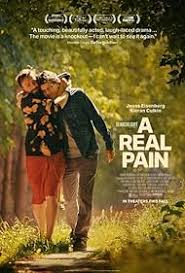 A Real Pain tells a kind of full-circle story, with opening and closing shots taking place in a busy airport, where Culkin’s character enjoys getting to know those around him. But what you feel at the end isn’t quite the same sensation that you hade with the opening scene. A Real Pain, it turns out, has at least two meanings: one obvious, one less so. It’s the double-meaning that stays with you as the credits roll.
There’s also the sense of a double-meaning in the title of The Outrun. I didn’t see a trailer prior to watching the movie, I just knew it was a chance to see a movie about recovery. “The Outrun” is only mentioned once in the script, when Rona’s father tells her that some things need to be taken care of on their farm in a location called the outrun. The Dictionaries of the Scots Language gave me some illumination on an exact definition- turns out there are two, First, an outrun is “a piece of outlying grazing land on an arable farm” that can, by extension be understood as “an exposed part of the body, one of the extremities.” Both seem fitting for the story.
Not the happiest time at the movies, obviously, but both movies told good stories with beautiful moments. I recommend them both.
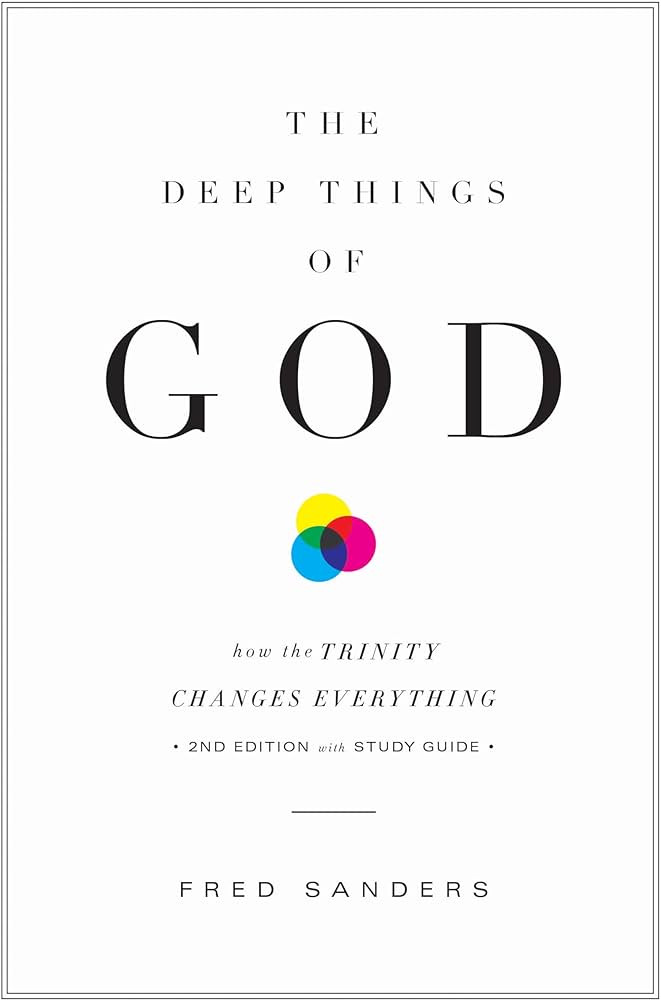 Fred Sanders begins The Deep Things of God with a distinction that is worth making in many areas: the emphatic and the reductionistic. He’s thinking specifically of the Trinity in relation to the many other things that healthy evangelical Christians think about. The emphatic, of course, has to do with emphasis. Sanders asserts that healthy evangelism has landed on a few things for real emphasis: the Bible, the cross, conversion, and heaven. Sanders’s concern is that other key things get loss when things are under-emphasized and forgotten, what he calls an “anemic condition.” An example:
 The trip started with a late morning drive from Fresno with my friends and an itinerary made by my friend. The drive up (and down, actually) was beautiful. And long. So when we finally made it to the Tunnel View stop, I was both amazed and relieved. The view was as beautiful as I had hoped. From there, we drove past Bridalveil Falls and into the valley floor. We parked one of our two vehicles at Curry Village and made our way to Yosemite Lodge for some rental bikes. The rest of the afternoon was spent biking around the valley floor, where we ultimately ended up at Mirror Lake (which was neither thanks to the autumn weather). From there we made our way back to YL, dropped off our bikes, and drove back to Curry Village for a pizza dinner. My friends went with me to check in and check out my lodging for the night: a one-bed vinyl tent on a wooden platform with a metal locker outside for food and other things that might attract local bears. At that point, my friends left and I did my best to settle in for the night. I did some walking around that that point, checking out the general store and the communal lodge with its porch and comfy seating. I wanted to see as much of the quiet night sky as I could, but everywhere I went I found talking people, cars still pulling in for the night, and flashlights shining in all directions. Ah well. I did get a better sense of the quiet night sky when I woke up to tip-toe to the communal bathroom after midnight.
 The next morning started with a decent amount of sleep achieved. I cleaned the tent up some and made my way to the lodge for breakfast: biscuits and gravy, eggs, and some Lucky Charms (a pleasant mixture of what I would usually eat at a camp). I checked out of the tent and then made my way by foot to Vernal Falls. It was quite the hike, but the view was worth it. After making my way back to the lodge, I took a cherry Coke break and then took the free shuttle to a few different sites in the valley: the Ahwahnee Hotel, lower Yosemite Falls, and finally the El Capitan Meadows. The meadows ended up being my favorite location, both because there were very few people there and because it had lots of trees along with the river.
 At that point, I was pretty wiped out. I had thought about ending my trip with a visit to Glacier Point (at the suggestion of my friend), but after starting on the winding road out of the valley, I decided that I wouldn’t stop until I was somewhere in Oakhurst (a town between Yosemite and Fresno). I have to admit: I’m no fan of winding mountain roads without railing on the side.


 Space Enough, and Time