Lord of the Metaphors?

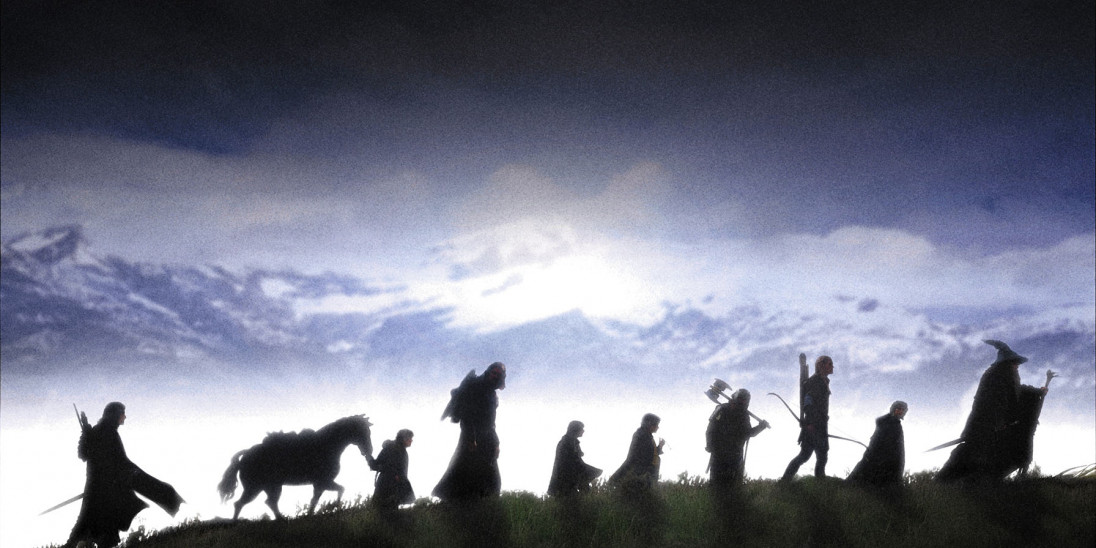
FellowshipIt’s been a Lord of the Rings weekend here, as the Cannery has been playing the extended versions of the trilogy one per day.  And while I have thoughts on watching the series again, I think the timing of the screenings match up nicely with this piece by Sam Bush over at Mockingbird about the life-as-journey metaphor (since it name-checks the story).
Metaphors are, of course, a big deal.  There’s a nice chunk of How to Think by Alan Jacobs that speaks to the significance of unacknowledged metaphors and their power over us (just as they also give us power to make sense of life).  Bush’s concern is that we have bought too much stock from the “life is a journey” metaphor, Christians as much as anyone else.  After mentioning John Bunyan as “the progenitor of the Christian faith narrative,” Bush writes:

For instance, many Christians today view their own sanctification as a long process in which, over time, virtues are cultivated through the work of the Spirit. Call it a “journey of justification,” if you will. As you traverse through the perilous Valley of Adolescence and through the wicked city of College, you are expected to come out unscathed or at least find your way back to the trail. Just pray that you don’t get lost in the Desert of Doubt, where many people don’t make it out alive.

Christians, therefore, have fallen prey to the pitfalls of the journey story as much as the rest of the world. If the task, as pilgrims, is to read the road signs and make the right choices, we are no different than the weight loss gurus and influencers offering to guide you through their journey of spa vacations.

Warning acknowledged, though I do think those considering themselves “pilgrims” are looking out for something other than gurus and spa vacations.

One of the best bits of the essay is given in the title and then not mentioned again until the end of the piece.  After mentioning the changing metaphors used when describing cancer, Bush notes:

In the words of Paul Zahl, life is not a journey, but a train wreck. We may buy ourselves a ticket, climb aboard, and imagine the distant places of our dreams, but we are almost always derailed.

Definitely a true statement, an apt metaphor.  He then debriefs the assertion with the reminder of our need for rescue in the Christian story.  It’s a good reminder of where we started and the landscape of where we have to go in our mortal lives.

While I appreciate the piece, I’m not totally sold on ditching the journey metaphor.  If anything, perhaps, it needs rehabilitation.  My least favorite take on life-as-journey is when someone says “it’s about the journey, not the destination.”  That’s pure hogswallop.  That’s wilderness without Promised Land and a mark of rebellion.  I think, in the long run, we are all of us looking for a guiding metaphor that takes in both the train wreck and whatever forward motion we get after the rescue.  Rescue is there, for sure, but there is also the drudge, trudge, and even joy of the road before us.

(image from mavnewspaper.com)

Posted in Books, Faith, Movies, The Long Story | Tagged | Leave a comment

Parting Glances, Parting Shots

I celebrated the first official day of summer vacation yesterday by . . . going to work.  There was an almost-last-minute request to sit in on some interviews that I couldn’t/shouldn’t turn down.  In a way, interviews are always interesting to me.  I did walk away from yesterday’s time thinking that everyone should have to re-interview for their own job every few years, if only to try and speak more clearly and honestly than the constant forward motion of the regular year allows.

+ + + + + + +

I’m not sure how I would describe this school year.  Not bad, for sure.  There were a few unanticipated things that shaped the year, that were really threads more than specific moments.  I decided this morning to keep a simple “work journal” in Google Docs, because I do want to learn from my experiences.  I definitely enjoy the classroom most.  When that goes poorly, nothing goes well.

+ + + + + + +

These last few weeks I’ve been slogging through The Diary of a Country Priest by Georges Bernanos.  Somehow I came across a copy of it a few years ago but never got to it.  I thought it might be a fitting read for the beginning of “ordinary time.”  And while I still hold to that, it’s definitely slower than I anticipated.  Lots of long speeches from various figures in the villages the lead character serves as priest.

This morning I came across something that points to why I acquired/kept the book for so long.  It’s mentioned in passing in Ephraim Radner’s A Time to Keep, which I was thinking about before diving deeper into his most recent book, Mortal Goods.  The name-drop happens in the chapter titled “The Arc of Life,” which I also revisited this week in preparation for a meeting with the English department because of how Radner’s brings in the “all the world’s a stage” speech from As You Like It as a way of thinking about, well, the “arc of life.”

+ + + + + + +

In preparation for that meeting with the English department (my own department had our final meeting earlier in the week), I ended up tracking down work from the faith and literature class I taught a couple off times about a decade ago.  It was a brief-but-fun revisit that reminded me of some of the deep threads in my own life with it comes to literature and faith.  Some of the books and passages I taught in the class are still amongst my favorites.  Part of me would love to teach the class again; part of me knows that now is not the time for that.

+ + + + + + +

I’m grateful for this now-closed school year.  The trip to England and Scotland back in October feels like a million years ago.  It’s a trip that I love that I will likely never run again.  And I had a good (in my opinion) semester with my seniors.  I think I can trace some of the work of God throughout these last few months, as much in “clearing the table” for me as in “setting the table” for whatever is next.

I’ve already set my “out for the summer” email response, a reminder to myself (if no one else) that there is a time and place for everything and that all time is not work time.  But I will think about work some, will likely even visit my classroom a few times to make sure some things are in place for the end of July, which feels like it comes earlier every year.

Posted in Books, Faith, Teaching | Leave a comment

In the Middle

I’ve been thinking about this recent post from Seth Godin a good bit for the last few days.  I’ve even referenced it once or twice with friends.  It’s not a particularly new thought, but I agree with Godin that we’re seeing something on a larger, more significant scale for our culture than we’re used to.  And as someone who loves going to the movies (and loves browsing “record stores”), I feel the loss and the bewilderment.  The thing is, there are other major cultural shifts happening at the same time, which can make it doubly frustrating.  Because “digital native” is only one major shift, one perspective that can catch many of us off our guard.  

What it means to navigate culture in general is getting trickier and trickier.  And even though the internet makes it seem like things last forever, things still won’t quite be the same.  One danger is that you start sounding like the proverbial “old fogey.”  One hope is that maybe those who come after us will understand, appreciate, and even revitalize older ways of being.  But that will likely only happen in pockets, since the broader culture has no brake system and limited steering.  

Posted in Internet, Movies, Television | Leave a comment

“A List of Non-Negotiables”

Speaking of television anticipation, we’re just a few weeks away from the third season of The Bear.  Anxiety-inducing television has never been so beautiful, I think.  At its best in season two, the show rivaled and maybe surpassed Ted Lasso at its best (and Ted Lasso got lots of moments right).  This season looks to be the same.  Check out the trailer below.

Posted in Television | Leave a comment

Hey Dol! Merry Dol! Where are the Big Yellow Boots?

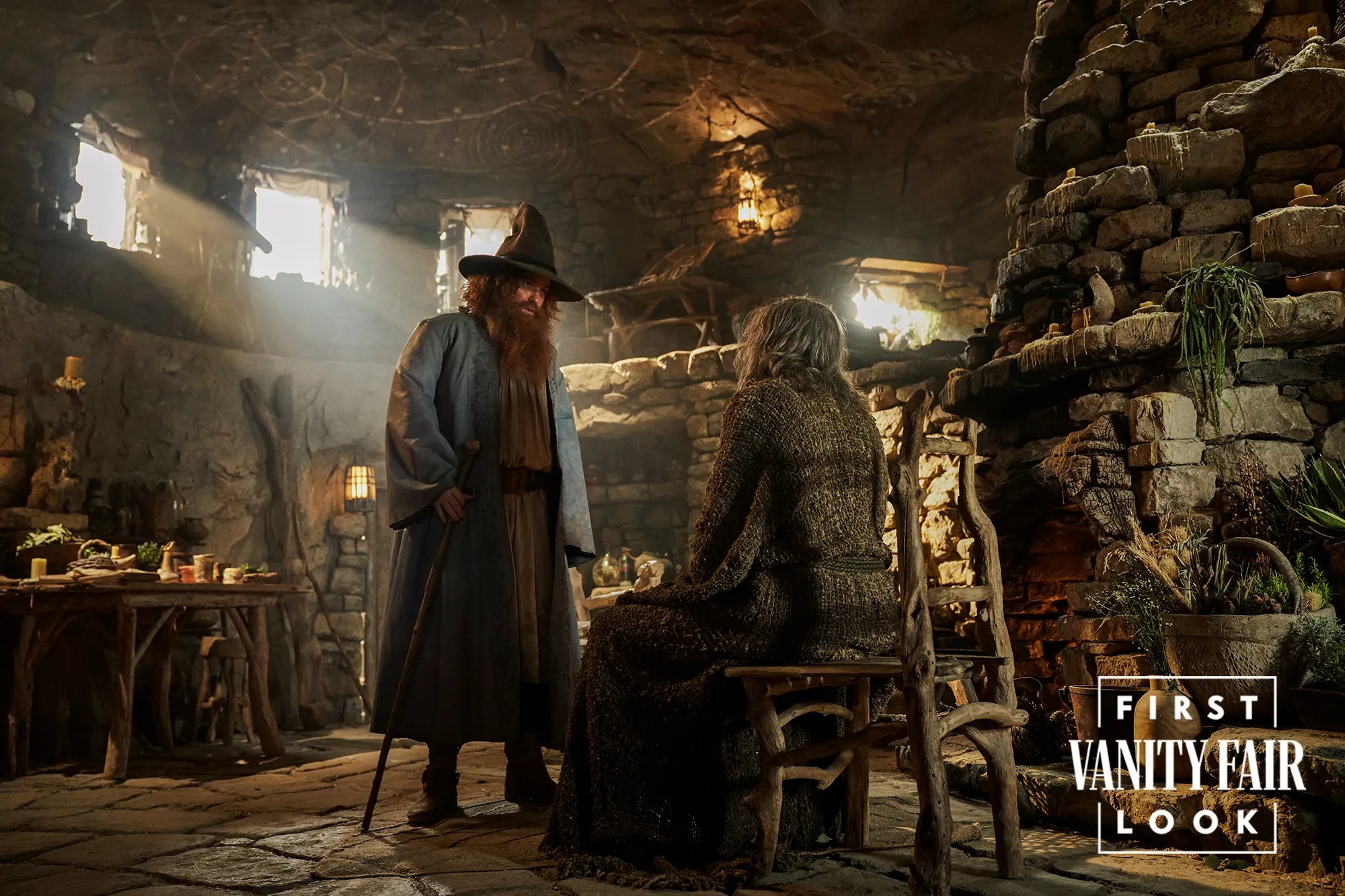
Yesterday we all awoke to the news that Tom Bombadil would appear in the upcoming second season of The Rings of Power on Amazon Prime.  Here’s the picture from Vanity Fair:

Tom-Bombadil-Lord-of-the-Rings-First-Look-01.jpgI will, of course, hold off on judgment until the show actually airs (and I hope those boots end up being a little more yellow, for sure).  It’s a gutsy move, bringing in a character that has never made it to screen before.  Bombadil’s appearance in the early part of Fellowship of the Ring is both entrancing and distracting.  But he’s also a fascinating foil for all of the ring-lust that happens in the story.  I don’t remember seeing much of “the Stranger” in the recently posted teaser trailer, which I was actually glad about; I’d much rather spend time with the dwarves, elves, and people of Numenor.  Either way, this looks to be an interesting (and somewhat unpredictable) season that we have ahead of us (and dropping at the end of August).
Posted in Books, Television | Tagged , | Leave a comment

2×2 for Resilience

I’ve mentioned and attempted to use the idea of a 2×2 square before, particularly when it comes to faithfulness and freedom.  And while Andy Crouch is synonymous with the tool for me, it shows up in other places at times.  Yesterday it showed up in a post by Seth Godin about resilience (amongst other things).

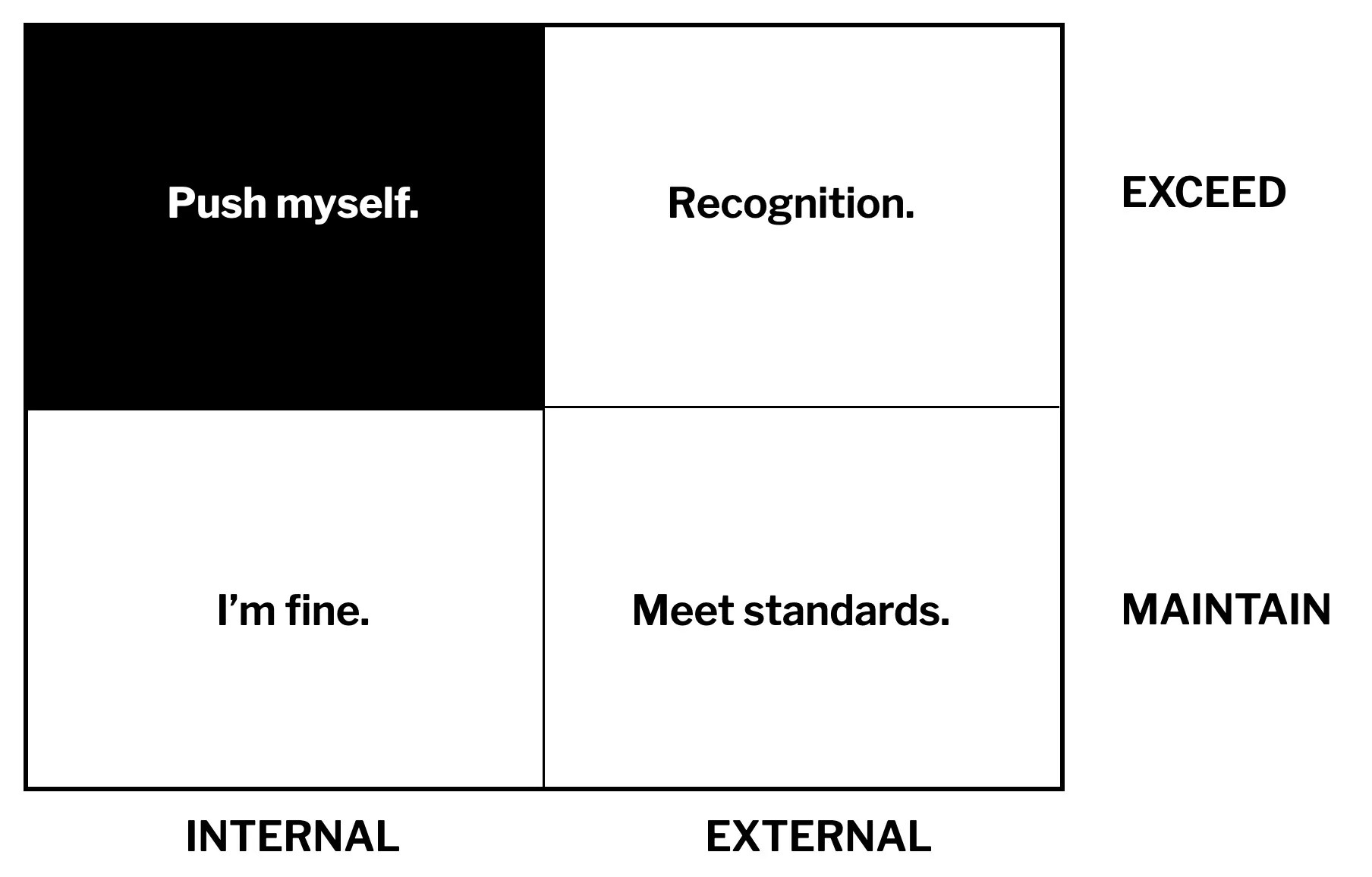
For Godin, the question is what to expect from different kinds of people and how/whether or not they will “show up”.  The title to the post gives it away: exceed or maintain.  On the horizontal axis, things move from internal to external motivations.  The vertical axis is where exceeding and maintaining come into play.  It looks like this:

Godin 2x2

I recommend the whole piece.  It’s definitely an interesting diagnostic tool, perhaps for yourself more than for how you perceive others.  Once again, you can read the whole piece here.

Posted in Organizations and Institutions, Teaching | Leave a comment

Mortal (and Immortal) Goods

Tonight is the season finale of Survivor which, for all intents and purposes, marks the end of the 2023-2024 television season.  Summer television is less an odd duck than it used to be, since reruns are mostly a thing of the past and new content is spread out over time.  So there are still a few episodes of Doctor Who, a new Star Wars series, and the third season of The Bear to get us to and through June, which is nice.  But good, old-fashioned network TV is over for the time being.

But this post isn’t (directly) about television, though maybe you could place it in the “mortal” category that this posts’s title suggests.

+ + + + + + +

Now that the Easter season is over (marked by Ascension Day and Pentecost Sunday), it’s time for ordinary time.  And with it, a hopeful focus on some of the more ordinary aspects of life.  I’m still thinking a few things through, and I have to admit that I’m not thinking very far ahead (as ordinary time runs up to Advent, which starts on December 1st (and that feels like a world or two away from now).  So I’m taking the chunk from now until the end of June, when I make my way to the mainland to visit family and go for a retreat at Laity Lodge.  I definitely have plans to do some deep cleaning (up and out).  I’m hoping to do more evening walking than I have recently.  And I’m planning on doing some basic things like doctor and optometrist appointments and car maintenance.  But the thing that will guide me most will likely be my reading.  So here’s the rundown of what I hope to read between now and the end of June.

+ Mortal Goods by Ephraim Radner.  I’ve been a Radner fan for some time now (since his Time to Keep dropped in 2016).  His style is always a little odd to me, but it’s also almost always worth it.  In Mortal Goods, Radner is hoping to shine some light on the day-to-day realities that politics used to be concerned with.  He frames the book with the concept of writing a letter to his children, which is always an interesting form of writing.  I’m already a decent chunk into the book and have found it a good challenge.  He’s doing his best to let faith frame the discussion without intruding in it too much (which is almost impossible).

+ Why Everything That Doesn’t Matter Matters So Much by Andi Ashworth and Charlie Peacock.  I mentioned this book back in April as a possible read.  The book by this husband-wife team is rooted in lived Christian experience and is topical, focusing on things that seem to line up well with Radner’s thinking.  The book is a collection of essays with alternating speaker.  So far, it seems wonderfully autobiographical, too.

+ The Diary of a Country Priest by Georges Bernanos.  I’ve had this book sitting around for some time.  It may have been a gift.  It tells the story, via diary, of, well, a country priest.  French.  First released in the 1930s.  I feel like it could sum up nicely some of the everyday, ordinary stuff that I hope to reflect on during this next month and change.  When this one is finished (and it will mostly be bus reading, so it might be a while), I’ll likely start another book by Lief Enger.

+ Finally: The Deep Things of God by Fred Sanders.  This is the “immortal” thing hinted at in this post’s title.  And it’s a recent addition to the list.  It’s a book of the Christian belief of the Trinity, which is something I think a lot about for various reasons (not the least of which is the approach the Franciscan Friars of the Renewal take to the Trinity in their podcast).  I’m already a third of the way through the book: Sanders is a great writer.  Some of the desire to read this is a way to honor the story of Pentecost, of course, but it’s about something more, too.

I’m sure other books will crop in between now and the end of June.  But, for now, this is where I’m planting my “reading flag.”  I’ll likely post reflections for each book throughout the summer when things come up (or when I need to write something out to make sense of things).  I’m genuinely curious to see how each of these books supports the others.  It’s always a cool gift when it happens.

Posted in Books, Faith, The Long Story | Leave a comment

Freedom and Faithfulness Revisited

Back in April, I posted a longer entry that included a four-square consideration of freedom and faithfulness.  I’d meant to revisit the topic later, but not this later (over a month later).  Even though I didn’t write about it, though, doesn’t mean I wasn’t thinking about it.

Last week I had the opportunity to say a few words in our “senior chapel.”  It was my second time to speak to them in the last month, but the first time speaking to a gym full in years (for which I am grateful, really).  The talk brings in the ideas of freedom and faithfulness in the context of the story of the Prodigal Son.  It’s a piece definitely inspired by the thinking of Henri Nouwen, but then I take a slightly different turn with it.  If you want, you can read the piece here.

+ + + + + + +

When I started putting the piece together a few weeks ago, I decided to stay away from the Poco a Poco podcast, as it was set to talk about freedom and our relationship with the Father.  I’m glad I did.  I started back on the podcast this morning and found that they had a lot to say about freedom and faithfulness (though in a slightly different way).  Looking forward to unpacking that now that the chapel is over and done.

Posted in Faith, Scripture, Teaching, The Long Story | Tagged | Leave a comment

Pentecost and the Passage of Time

Yesterday was the day of Pentecost in the church calendar, a celebration of the sending of the Spirit 50 days after the resurrection of Jesus.  I marked the occasion yesterday with a song, but I want to say one or two more things about it before the week gets away from me.

Pentecost marks the end of what I guess I consider “extraordinary” time in the church calendar.  For the most part, the time between Advent (usually in November) and Passover (in May) is a time to retrace the Biblical Story from the events surrounding the birth of Jesus through his suffering, death, resurrection, and ascension, and ending in Pentecost.  I say “extraordinary” because I’m a low-church Baptist with amateur knowledge of liturgical things.  We have now entered the “ordinary” time of the calendar.  “Ordinary,” according to what I have looked into, is more about “ordered” and “orderly” time than it is about “common day-to-day existence.”  Regardless, this chunk of time is meant to be lived in light of the events of “extraordinary” time, which is key to everyday Christian living.

I hope to spend the rest of my life marking time with the church calendar, with the life of Christ leading to the sending of the Spirit.  It seems fitting, appropriate to do so.  This time around, I found more resonance with Lent and Eastertide than with Advent, which is odd for me.  This Lent I wrote and reflected on Erik Varden’s The Shattering of Loneliness.  I tried having a few other practices that simplified life and made some space not normally there (things about diet and sleep and reading shorter books).  I tried to bring some of those practices over into Eastertide, though one of the best things I did was start most mornings with “Christ is Risen from the Dead” by Matt Maher.

There’s a part of me that is sad to see the “extraordinary” season go.  It’s nice having a framework beyond yourself for things.  I’ll get more into my plans for at least the first month or so of “ordinary time,” but for now I just want to mark “extraordinary time’s” passage.  We live in light of the whole Biblical Story, of course, and every Sunday is intended to be an Easter resurrection celebration.  Every day is important, too.  The events of “extraordinary time” remind me of that.

Posted in Books, Church, Faith, Holidays, Life in the Fifth Act, The Long Story | 2 Comments

A Song to End the Season

Today is Pentecost Sunday, which marks the arrival of the Holy Spirit in the book of Acts and brings an end to the not-so-ordinary part of the church calendar.  Here’s a song that didn’t make the cut for U2’s All That You Can’t Leave Behind to mark the occasion.

Posted in Church, Faith, Music | Tagged | Leave a comment