
Yesterday I posted a long lecture by Andrew Root about the shift that has changed in youth (ministry) culture over the last decade. I’ve read a decent chunk of Root’s most recent output the last few months (3 1/2 full books and 2 short pieces). And while I don’t agree with all of Root’s premises or conclusions, I do think he has a number of wise things to say. I shared the video with some co-workers a couple of weeks ago and have gotten a little response from them. For those who have worked with young people over time, a lot of what Root speaks of or hints at rings true.
+ + + + + + +
This week was an odd one for me. The weather has been wonderful: the evenings and mornings have dipped into the lowers 60s, which is not often but nice. Even wore a jacket at work yesterday. Classes have been good. Grade check was yesterday, which is always a load off. I’m still learning to navigate perspectives and personalities. I was totally caught off guard with one conversation this week. At the least, I am learning valuable things. At the most, I’m preparing for a difficult conversation the outcome of which may not be in my favor, if that makes any sense.
+ + + + + + +
Caught a second showing of 1917 yesterday with a movie-making friend. I’m glad he finally saw it. It’s the most I’ve heard him praise a new movie in some time. The movie flows much better the second time, mostly because the first time you see it you’re marveling at the film’s key narrative mechanism and wondering what they could do in the next scene . . . even though that term is almost meaningless when discussing the movie. There is, of course, some chiastic structure to the store: beginning and ending leaning on a tree, racing through trenches, making a run over dangerously empty fields. The small role played by noticeable actors is also less jarring, which is nice. I have no problem if it wins best picture tomorrow night at the Oscars. It’s a whole-package movie, even though its key cast could be counted on your big toes.
+ + + + + + +
Last night after the movie, my friend and I ran into some former students. Most of them are done with college and have moved on to the world of work. It was a chance meeting, which made it just a bit sweeter, too. I am constantly amazed at how much it feels like time has passed even when it’s just been a few years. Ever since I started teaching seniors, I’ve had to process the sensation that each year is uniquely itself: its own language, its own highs and lows, its own tenor that can be revisited but never replicated.
 It took me a little longer than usual to get ahold of this year’s Tolkien calendar. When I finally remembered my need to order it around Christmas time, it was nigh impossible to find. Not at Amazon. Not at Barnes and Noble. It seemed to be out of stock everywhere. Luckily, I found a copy at ebay from a Canadian bookseller. Took a little longer than usual to get here, of course, but that’s okay. The Alan Lee art is beautiful as always. And I quite like the quote for January from the first chapter of The Hobbit:
 In his survey of failing institutions in American life, Yuval Levin writes about the church in the “close to home” section (which also includes the family and community organizations. While he writes about the loss of authority of the Catholic church, Levin approaches the plight of the Protestant Evangelical church through the lens of “unmediated individual authority.” In chapter seven of A Time to Build, Levin writes:
 In class I often revisit the question of “how can I play my role fittingly?” in light of the biblical story. This is a nod to both N. T. Wright’s “five-act play” of the biblical story and Kevin Vanhoozer’s “drama of doctrine” approach to Scripture and the Christian life. Turns out it is also an important question we should be asking from a civics perspective. That’s what Yuval Levin is asserting, at least, in A Time to Build, which picks up the thread (and threat) of our failing institutions (and our perceptions of those institutions). From
  Last week America posted
 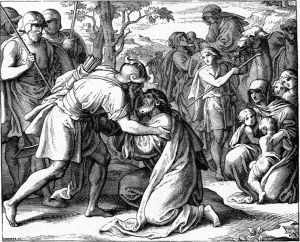 Yesterday I mentioned the manuscript I wrote for this week’s chapel. The topic was Jacob’s encounter with God. The task was partly to retell the story to an audience who has a basic knowledge of the story. Here’s a cleaned-up version of the sermon’s first half.


 Space Enough, and Time