Wordsworth’s “Old Man Traveling”

Lake DistrictWhile in England, we spent a couple of days in the Lake District, the stomping grounds of William Wordsworth.  We spent some time at his house, Rydal Mount, and then walked the Coffin Trail down into Grasmere.  We also spent some time in a little town with a big castle called Skipton.  While there, I found a “Everyman’s Poetry” edition of Wordsworth’s poetry.  I’ve not spent much time with Wordsworth since college (probably a survey class, maybe in my Romanticism class), so it’s been interesting to revisit some of his works.  Here’s “Old Man Traveling,” the first poem from the collection, which has a nice but sobering turn at the end.

                The little hedge-row birds,
That peck along the road, regard him not.
He travels on, and in his face, his step,
His gait, is one expression; every limb,
His look and bending figure, all bespeak
A man who does not move with pain, but moves
With thought—He is insensibly subdued
To settled quiet: he is one by whom
All effort seems forgotten, one to whom
Long patience has such mild composure given,
That patience now doth seem a thing, of which
He hath no need. He is by nature led
To peace so perfect, that the young behold
With envy, what the old man hardly feels.
—I asked him whither he was bound, and what
The object of his journey; he replied
“Sir! I am going many miles to take
A last leave of my son, a mariner,
Who from a sea-fight has been brought to Falmouth,
And there is dying in an hospital.”

(poem from wikisource.org)

Posted in Books, Teaching, Travel | Tagged | Leave a comment

The Sorrow of Lady Constance

Constance CryingYesterday I made note of my favorite “King John” moment from Shakespeare’s King John.  There was one other scene in the first plays first half (as presented by the Royal Shakespeare Company) that has stuck with me.  In the previously mentioned scene, King John tasks Hubert with dispatching Arthur, a rival to the throne.  In this scene, Arthur’s mother Constance (played wonderfully by Charlotte Randle in the RSC production), is grieving the loss of her son.  Earlier in the play, Constance’s presence is played to almost comic effect, which makes this scene that much more powerful, a real picture of grief and loss.  It’s the kind of scene that would shock and surprise if done for a Shakespeare presentation.

KING PHILIP

Well could I bear that England had this praise,
So we could find some pattern of our shame.
Enter CONSTANCE

Look, who comes here! a grave unto a soul;
Holding the eternal spirit against her will,
In the vile prison of afflicted breath.
I prithee, lady, go away with me.

CONSTANCE

Lo, now I now see the issue of your peace.

KING PHILIP

Patience, good lady! comfort, gentle Constance!

CONSTANCE

No, I defy all counsel, all redress,
But that which ends all counsel, true redress,
Death, death; O amiable lovely death!
Thou odouriferous stench! sound rottenness!
Arise forth from the couch of lasting night,
Thou hate and terror to prosperity,
And I will kiss thy detestable bones
And put my eyeballs in thy vaulty brows
And ring these fingers with thy household worms
And stop this gap of breath with fulsome dust
And be a carrion monster like thyself:
Come, grin on me, and I will think thou smilest
And buss thee as thy wife. Misery’s love,
O, come to me!

KING PHILIP

O fair affliction, peace!

CONSTANCE

No, no, I will not, having breath to cry:
O, that my tongue were in the thunder’s mouth!
Then with a passion would I shake the world;
And rouse from sleep that fell anatomy
Which cannot hear a lady’s feeble voice,
Which scorns a modern invocation.

CARDINAL PANDULPH

Lady, you utter madness, and not sorrow.

CONSTANCE

Thou art not holy to belie me so;
I am not mad: this hair I tear is mine;
My name is Constance; I was Geffrey’s wife;
Young Arthur is my son, and he is lost:
I am not mad: I would to heaven I were!
For then, ’tis like I should forget myself:
O, if I could, what grief should I forget!
Preach some philosophy to make me mad,
And thou shalt be canonized, cardinal;
For being not mad but sensible of grief,
My reasonable part produces reason
How I may be deliver’d of these woes,
And teaches me to kill or hang myself:
If I were mad, I should forget my son,
Or madly think a babe of clouts were he:
I am not mad; too well, too well I feel
The different plague of each calamity.

KING PHILIP

Bind up those tresses. O, what love I note
In the fair multitude of those her hairs!
Where but by chance a silver drop hath fallen,
Even to that drop ten thousand wiry friends
Do glue themselves in sociable grief,
Like true, inseparable, faithful loves,
Sticking together in calamity.

CONSTANCE

To England, if you will.

KING PHILIP

Bind up your hairs.

CONSTANCE

Yes, that I will; and wherefore will I do it?
I tore them from their bonds and cried aloud
‘O that these hands could so redeem my son,
As they have given these hairs their liberty!’
But now I envy at their liberty,
And will again commit them to their bonds,
Because my poor child is a prisoner.
And, father cardinal, I have heard you say
That we shall see and know our friends in heaven:
If that be true, I shall see my boy again;
For since the birth of Cain, the first male child,
To him that did but yesterday suspire,
There was not such a gracious creature born.
But now will canker-sorrow eat my bud
And chase the native beauty from his cheek
And he will look as hollow as a ghost,
As dim and meagre as an ague’s fit,
And so he’ll die; and, rising so again,
When I shall meet him in the court of heaven
I shall not know him: therefore never, never
Must I behold my pretty Arthur more.

CARDINAL PANDULPH

You hold too heinous a respect of grief.

CONSTANCE

He talks to me that never had a son.

KING PHILIP

You are as fond of grief as of your child.

CONSTANCE

Grief fills the room up of my absent child,
Lies in his bed, walks up and down with me,
Puts on his pretty looks, repeats his words,
Remembers me of all his gracious parts,
Stuffs out his vacant garments with his form;
Then, have I reason to be fond of grief?
Fare you well: had you such a loss as I,
I could give better comfort than you do.
I will not keep this form upon my head,
When there is such disorder in my wit.
O Lord! my boy, my Arthur, my fair son!
My life, my joy, my food, my all the world!
My widow-comfort, and my sorrows’ cure!
Exit

(image from stratfordobserver.co.uk; text from http://shakespeare.mit.edu)

Posted in Teaching, Travel | Leave a comment

Concerning King John

King John CrownedWhile in Stratford over break, we had the opportunity to see the Royal Shakespeare Company’s version of King JohnKJ is not that well-known a play, of course, and I can imagine that there are many reasons why.  Where it shines, it burns.  When it doesn’t shine, it’s dense and forgettable.  The RSC made good work of the play, though, particularly the first half.  They took two creative turns.  First, they cast King John as a woman (played admirably by Rosie Sheehy).  Second, they placed the play in what felt like a 1960s-era spy genre (think the British Avengers series).  That turn was most effective in the first half of the play, where there were a number of creative flourishes (dance numbers, boxing scenes) that served as spoonfuls of sugar to help the medicine.  By the beginning of the second half, that creative flourish was gone (and the overall play the lesser for it).

My favorite scene involving the play’s main character happens near the end of the first half, when John is contemplating how to solidify his reign amidst the claims of others for sovereignty.  He must find some way to dispatch with Arthur, his young rival.  He tasks Hubert (described in the list of roles as the “imperfectly obedient intimate of King John”) with the job in this scene:

KING JOHN

Come hither, Hubert. O my gentle Hubert,
We owe thee much! within this wall of flesh
There is a soul counts thee her creditor
And with advantage means to pay thy love:
And my good friend, thy voluntary oath
Lives in this bosom, dearly cherished.
Give me thy hand. I had a thing to say,
But I will fit it with some better time.
By heaven, Hubert, I am almost ashamed
To say what good respect I have of thee.

HUBERT

I am much bounden to your majesty.

KING JOHN

Good friend, thou hast no cause to say so yet,
But thou shalt have; and creep time ne’er so slow,
Yet it shall come from me to do thee good.
I had a thing to say, but let it go:
The sun is in the heaven, and the proud day,
Attended with the pleasures of the world,
Is all too wanton and too full of gawds
To give me audience: if the midnight bell
Did, with his iron tongue and brazen mouth,
Sound on into the drowsy race of night;
If this same were a churchyard where we stand,
And thou possessed with a thousand wrongs,
Or if that surly spirit, melancholy,
Had baked thy blood and made it heavy-thick,
Which else runs tickling up and down the veins,
Making that idiot, laughter, keep men’s eyes
And strain their cheeks to idle merriment,
A passion hateful to my purposes,
Or if that thou couldst see me without eyes,
Hear me without thine ears, and make reply
Without a tongue, using conceit alone,
Without eyes, ears and harmful sound of words;
Then, in despite of brooded watchful day,
I would into thy bosom pour my thoughts:
But, ah, I will not! yet I love thee well;
And, by my troth, I think thou lovest me well.

HUBERT

So well, that what you bid me undertake,
Though that my death were adjunct to my act,
By heaven, I would do it.

KING JOHN

Do not I know thou wouldst?
Good Hubert, Hubert, Hubert, throw thine eye
On yon young boy: I’ll tell thee what, my friend,
He is a very serpent in my way;
And whereso’er this foot of mine doth tread,
He lies before me: dost thou understand me?
Thou art his keeper.

HUBERT

And I’ll keep him so,
That he shall not offend your majesty.

KING JOHN

Death.

HUBERT

My lord?

KING JOHN

A grave.

HUBERT

He shall not live.

The Arden edition renders those last four lines as one, which is exactly as it was played.  The Arden edition also makes Hubert;s penultimate line a statement instead of a question, which is interesting.

It’s really a sad and sobering moment that is followed up on as soon as the curtains rise on the play’s second half.   Since it’s a tragedy, it doesn’t go all that well for anyone.

(image from expressandstar.com; text from http://shakespeare.mit.edu)

Posted in Books, Teaching, Travel | Leave a comment

A Song from the Road

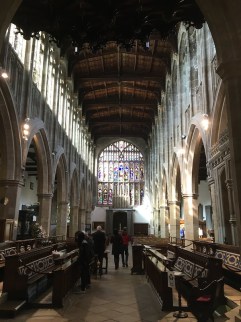
Holy Trinity StratfordDuring my recent trip to England and Scotland with students, we had the opportunity to spend some time in Holy Trinity Church in Stratford.  While the main reason for going in is seeing the place where Shakespeare is buried, it’s also a beautiful church in and of itself.  As I sat in the silence, I took out the pew-rack hymnal and came across this hymn:

“O Happy Band of Pilgrims” by St. Joseph the Hymnographer and J. M. Neale

1 O happy band of pilgrims,
If onward ye will tread
With Jesus as your fellow
To Jesus as your Head!

2 O happy if ye labour
As Jesus did for men;
O happy if ye hunger
As Jesus hungered then!

3 *The cross that Jesus carried
He carried as your due;
The crown that Jesus weareth,
He weareth it for you.

4 *The faith by which ye see him,
The hope in which ye yearn,
The love that through all troubles
To him alone will turn,

5 *What are they but forerunners
To lead you to his sight?
What are they save the effluence
Of uncreated light?

6 The trials that beset you,
The sorrows ye endure,
The manifold temptations
That death alone can cure,

7 What are they but his jewels
Of right celestial worth?
What are they but the ladder
Set up to heaven on earth?

8 O happy band of pilgrims,
Look upward to the skies,
Where such a light affliction
Shall win you such a prize!

It was, of course, a song appropriate to the moment, particularly as we were about halfway through our trip.  At the same time, the hymn speaks to the broader reality of the Christian journey.  You’ve got some Augustinian sense of Jesus as the Way in the first stanza and some solid reminders of how God works on this side of the journey in stanzas four through seven.  And all with the picture of pilgrimage.

You can learn more about the song here.

Posted in Faith, Music, Teaching, Travel | Leave a comment

Meet the Press

Last year while in Scotland, I got to enjoy the day-to-day life more than when traveling with a group.  Part of that meant enjoying shows on the BBC and ITV (which culminated in the first episode of the newest season of Doctor Who).  I got to watch one episode of the show Press, which tells the story of rival newspapers at a precarious time for print journalism.  A few days ago I learned that the show had finally made its way to PBS in America as part of Masterpiece on Sunday nights.  The second episode (of six) airs tonight.  Here’s the preview for the series as a whole.

I recently told a friend that I only do PBS for Sherlock and Downton Abbey, which means I don’t do PBS much at all these days.  This is a nice break with form for me.

Posted in Television, Travel | Leave a comment

Back from the Road

Yesterday was a day of airports and airplanes.  We left our hotel in Edinburgh at 6:45 in the morning and touched down in Honolulu around 10:30 last night.  Along the way we stopped in (and ran through) the airport in Philadelphia as well as LAX.  Besides some slight frustrations at each (well, that last sprint at Philly was more than just a frustration), the flights themselves went well: all arrived a little early, each fed us well.

The trip went well.  We had nice weather, at least while we were out and about at each site.  The rain tended to fall while we were in the bus.  The weather was cool to cold, with one or two days that were shorts-worthy.  We got to do most of our itinerary.  We weren’t rushed as much as we had been in the past.  Traveling with students in a large group is definitely different than traveling solo at your own pace.  We did get to retrace some of my itinerary from last year’s Scotland trip, particularly in visiting parts of Hadrian’s Wall at Steel Rig and seeing the Augustinian abbey in Jedburgh.  We also stopped at the Scottish border, which was cold and windy and wet, making it just right for the moment.

One of my personal goals was to track down the three Rivers of London books that I had not read yet.  One was a novel only available in hardback in the US at this point.  The remaining two were novellas.  I found the novel and one of the novellas at the Blackwell’s in Oxford.  When we got the hotel that night, I found that the novella (hardback) was actually signed by Aaronovitch as part of an independent booksellers promotion.  I found the other novella (paperback) at the Blackwell’s in Edinburgh.  Collection complete.  The bookseller there recommended another series in a similar vein.  I picked up the first book in that series.

I refrained from starting those books on the trip.  Instead, I finished Jamie Smith’s book on Augustine.  I also started reading through some of Augustine’s letters on my Kindle (where ancient texts are often free or cheap).  Beyond that, it was a trip of looking at landscapes and enjoying the countryside.  My downtime in the hotels was spent on paperwork, room checks, and regularly sifting through the purchases of the day.

Posted in Books, Teaching, Travel | Leave a comment

Thoughts from the Road

The traveling has gone well these last few days. While it’s been a little rainier than usual for us, we’ve still had more than our fair share of sun. We spent Monday in London, starting with the Globe and ending with dinner just beyond Trafalgar Square. We walked a lot.

Today was spent at Stonehenge (in the morning) and Oxford (for lunch and dinner). I was able to pick up a couple of Rivers of London novels (one as signed!). I also bought sodas for my group at the Eagle and Child, which was great as always.

I definitely feel like I’m showing my age on this trip. I’m a little more by-the-books and systematic (a trait that has been growing more and more these last few years). Having gone on the trip a number of time also changes the feel of things. There’s also something odd about being the one who is always trying to keep things on schedule. You hold it as best you can, of course: not too tightly, but also not too loosely. And there always has to be room for discovery. But you’ve also got places to go and promises to keep.

+ + + + + + +

These last few days of my Old Testament readings have come from the stories of Hegelian in both Kings and Chronicles. I found Chronicles’ retelling of Hezekiah’s reform to be quite moving. It’s easy to forget just how “far gone” the people had been prior to his kingship. Besides that, I found the Kings story of what happened after Samaria is resettled by Assyria … and I’m not even talking about the part with the lions. It’s about the inability of the people to understand and hold on to the faith. A very sobering passage to reflect on more.

+ + + + + + +

Tomorrow we make our way to Stratford-upon-Avon. The weather should be really nice. Hopefully, we’ll go boating on the river. We’ll end the day with a presentation of King John by the Royal Shakespeare Company. Hoping it’s good enough to keep us all awake!

Posted in Teaching, Travel, Uncategorized | Leave a comment

On the Road Again

I write this entry from the D terminal of Dallas-Fort Worth International Airport. After six hours flying from Honolulu to Texas and a good seven hours’ layover a few miles from Cowtown, my traveling group and I are ready to board our nine-hour flight to London.

Whether alone or with others, travel is a funny thing. It rubs you raw in odd ways, points out your flaws when you didn’t even ask for any kind of personal critique. My goal this time is to be open to the Spirit and learn from the frustrating moments.

Along the way, I’m going to continue reading Jamie Smith’s On the Road with Saint Augustine. It’s one of two books that I’ve brought along for the ride. Here’s a great quote from the section titled “Orientation”:

The key is to know where we are, and whose we are, and where we’re headed, and not to be surprised by the burdens of the road.

Smith is talking about the things we can learn from Augustine as we consider his personal travelogue. That paragraph from page 17 ends with this:

To know where you’re headed is. Not a promise of smooth sailing.

I’m trying to practice prayer as I walk and grace as I talk. I am hopeful about arriving, having left the idea of “the joy is in the journey” behind with other things that sound nice but just aren’t true.

Posted in Books, Travel | Leave a comment

Sunday’s Best: The WuMo Filter

This week’s “Sunday’s Best” is actually last week’s “Sunday’s Best.”  I did not get around to posting last week’s WuMo which did a great job of capturing something critical about our particular moment in time.

WuMo FilterI’ve found my use of social media continually on the slow-down.  It’s not just the posting, mind you; it’s also the reading and perusing.  I’d much rather blog, even if it is posting to the void for me.  I find that I just don’t have the personality for tweeting.  And I don’t have the consistency necessary for a real presence on Facebook.  Instagram is mostly for travel.  None of these things helps in good ways for me (except for Twitter, because that’s where some of my favorite thinkers and writers are present).

+ + + + + + +

The school year is already flying by.  September will be over in a snap, it seems.  The next three weeks are particularly crazy, with a social, a camp, grading, and final preparation for travel to England and Scotland.  Beyond that, I’m working hard at my new position at school, visiting teachers as they attempt “faith integration” lessons.  I’ve got a meeting with administration this week to check-in and articulate some plans and ideas for what is next.

+ + + + + + +

The bookshelf has been kind to me lately.  I’m currently reading the sixth Rivers of London novel: The Hanging Tree.  I’m amazed at how unique each of Aaronovitch’s novels ends up being . . . and all while building one large narrative.  After a novel set in the countryside, book six has Peter Grant back in London and working a case with the wealthy.  Beyond that, I just finished Faith for Exiles, the latest Barna book.  It’s a great read in the way that everything Barna does is great: it gives you permission for good but difficult conversations.  I’m just over halfway through The Outrageous Idea of Christian Teaching by Glanzer and Alleman.  It’s been a really good read for me, a good way to filter and add to my understanding of teaching from a faith perspective.

(image from gocomics.com)

Posted in Books, Faith, Teaching | Leave a comment

Birnam, Fangorn, and Ephraim

RivendellThese last few days I’ve been thinking how this time of year, this time of life, would be a great time for a nice visit to Rivendell, the Last Homely House East of the Sea.  Something about deep rest, I think.  Fireside and song and a kind of leisure often not found in the day-to-day.  As I was thinking about it, I looked back to The Hobbit to see what all had to be said of the place in Tolkien’s first published work: there really isn’t much, mostly just moon runes.  The House of Elrond gets a much fuller rendering in The Fellowship of the Ring.

+ + + + + + +

Something else Lord of the Rings came to mind this morning during my Bible reading.  It actually traces from Shakespeare’s Birnam Wood to Tolkien’s Fangorn Forest to a moment in the story of David from 2 Samuel 18.  At this point in the story, David has been exiled from Jerusalem.  Absalom is seeking to take over the kingdom fully and has decided to bring an end to his father.  Then this happens:

So the king stood beside the gate while all his men marched out in units of hundreds and of thousands. The king commanded Joab, Abishai and Ittai, “Be gentle with the young man Absalom for my sake.” And all the troops heard the king giving orders concerning Absalom to each of the commanders.

David’s army marched out of the city to fight Israel, and the battle took place in the forest of Ephraim. There Israel’s troops were routed by David’s men, and the casualties that day were great—twenty thousand men. The battle spread out over the whole countryside, and the forest swallowed up more men that day than the sword.

You just kind of want to imagine that the forest was more than just a location . . . that some kind of long-traveling band of Ents showed up in the shadows of the story of David bringing justice with their branches.  Ah well.

(Rivendell image from Tolkien himself)

Posted in Books, Faith | Tagged | Leave a comment