Strength for Today, and Bright Hope

How odd, writing about strength on a rainy Friday night at the end of a short but intense work week.  But that’s the way the essay-for-reflection falls.  And so the question of strength from Kevin Vanhoozer’s “The Drama of Discipleship.”

+ + + + + + +

For Vanhoozer, strength of “heart, soul, and mind” comes “by constantly practicing the presence (and activity) of Christ in the power of the Spirit.”  And things like vocation, formation, and culture are all connected to it.  “Everyday life affords plenty of opportunities to practice the way of Jesus Christ.”  And Scripture helps inform that.  I like how Vanhoozer brings back the triad of inform/form/transform throughout the piece.  He does it again when talking about the command to love God with all our strength, particularly as he completes the square with conforming:

The Latin conformare means “to make of the same form.”  This is precisely the vocation of the church: to make disciples, people who have the same “form” as Jesus Christ: that is, the form of a servant, the form of a son– not to mention the form of prophets, priests and kings, the offices that make up the holy nation.  In the final analysis, God is not shaping individuals only, but a people.

+ + + + + + +

What role, then, does Scripture play in the realm of strength?  Of the many things Scripture does, Vanhoozer adds that “Scripture’s role in the economy of revelation and redemption is that of finishing school.  It is the Spirit’s curriculum for imparting habits of right thinking and desiring, for cultivating the mind of Christ in his disciples.”  It is Scripture, then, that “communicates an extraordinary culture: a set of belief, values and practices that correspond to the new created order ‘in Christ.'”

+ + + + + + +

The section on strength feels a little slight when compared to the previous sections of the Great Commandment.  Perhaps strength is almost a picture of the other three (heart, soul, and mind) played out over a longer period of time.  And so strength is not just the lifting of a car to free someone trapped underneath.  It is the long haul, the spiritual stamina, that continues on past today.

Posted in Books, Faith, Scripture, Teaching | Tagged | Leave a comment

How the Mind Matters

The third component of the Old Testament Great Commandment is loving God with all of your mind.  As a teacher, I’d like to think that I think about thinking a lot.  Hopefully I’ve gotten a little better at it over time.

As with the previous section of “The Drama of Discipleship,” Kevin Vanhoozer spirals various ideas through one another, revisiting and building on them in good, generative ways.  As he does this, he also brings in concepts that bring depth to what some might perceive as well-worn topics.

In the case of the mind, Vanhoozer introduces the idea of sapience, a human trait which indicates “not simply sensation and feeling but also deliberation and wisdom.”  Spiritual formation, he asserts, “involves . . . the renewal of the mind to imagine the world as Scripture imagines it.”  Vanhoozer sees our human nature, gifted with sapience, requires some kind of “radical remedial education” which comes from Scripture and the Spirit.  As such, the Word and the Spirit attune our minds to the world the way Jesus through Scripture sees it.  This reading of the world through the lens of Scripture creates something called “canon-sense,” which is “our ability to indwell the richly patterned story-world of the canon, to imagine the world that Scripture imagines  and to mirror in our lives the reality that Scripture mirrors.”

And so, it seems, Christian must practice a “vocation of wisdom.”  From the essay:

Wisdom is the ability to see how Christ is the center of both the created and the renewed order, and thus to see the place of disciples in the grand scheme of things.  Being wise unto Christ involves not merely assenting to but practicing what we know.  It is a matter of practicing the premise, presence, and promise of God.

+ + + + + + +

One thing I like about Vanhoozer’s work is that it brings a number of threads together and adds a particularly Vanhoozer-like twist.  His constant return to Scripture is reassuring, particularly in a culture where religious text is often demoted to a collection of inspirational quotes.  And when it’s not about inspiration, it’s about something like rules and regulations.  But the imaginative aspect is critical and too easily overlooked.

How do we live well in the Story that we are in?  We start be seeing . . . by imagining it . . . rightly.

Posted in Books, Faith, Scripture | Leave a comment

Virtue is the Signal

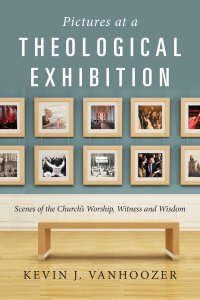
vanhoozer picturesOne of the interesting things about Kevin Vanhoozer’s “The Drama of Discipleship” essay in his Pictures at a Theological Exhibition collection is in how well it spirals.  In this case, spiraling is a good thing: it’s a pedagogical method where you revisit key concepts at different points.  And so when he moves through the Great Commandment from heart to soul, Vanhoozer revisits concepts like vocation, formation, and culture in good, necessary ways.

+ + + + + + +

Having established that “loving God with all your heart” means “sharing the passions of Jesus,” Vanhoozer moves to “loving God with all our souls.”  Instead of spending time writing a mini-treatise on the nature of the soul, he jumps right in with the idea of cultivating the virtues.  These he calls “the habits of Jesus’ heart.”  Virtue talk can be tricky, of course, as many evangelicals might view such things as somehow masking a works-centered salvation.  Beyond that, virtue language goes all the way back to Aristotle and ancient Greek culture, which can be off-putting to some.  “A spiritual virtue,” Vanhoozer asserts, “is a habit of communicative activity that is conducive to right relatedness to other persons, especially God.”  Jesus, of course, exemplifies this.  Which brings to mind Chesterton’s comment on Jesus and the virtues from Orthodoxy:

The modern world is not evil; in some ways the modern world is far too good. It is full of wild and wasted virtues. When a religious scheme is shattered…, it is not merely the vices that are let loose. The vices are, indeed, let loose, and they wander and do damage. But the virtues are let loose also; and the virtues wander more wildly, and the virtues do more terrible damage. The modern world is full of the old Christian virtues gone mad. The virtues have gone mad because they have been isolated from each other and are wandering alone.

+ + + + + + +

And so we are thrown back on knowing and becoming more like Jesus, which means we are thrown back on Scripture.  It is here, Vanhoozer asserts, that we learn “judgment” as a kind of practical decision-making skill.  “God gives us his Word and Spirit not simply to inform but to form and transform, to cultivate not only new thoughts but also habits of thought, a way of thinking in accordance with the gospel.”  And this adoption of virtuous habits ends up being a key part of the Christian vocation: “everything we say and do discloses the state of our soul.”  Vanhoozer concludes his section on cultivating virtue: “Christian character formation is a matter of becoming what one already is in Christ.”

+ + + + + + +

I’ve been doing more virtue talk these last few years (in various and sundry forms).  With underclassmen, we talk through the “Do Hard Things” ideas of the Harris brothers. With our school we talk about the “sensibilities” of humility, curiosity, love, and commitment.  With the seniors, we talk about the cardinal and theological virtues.  Something that I find odd is that virtue talk is relatively rare for them (at least from their perspective).  They understand hard work and getting-what-you-deserve.  And that’s mostly true for adults, too.  Which makes the question of creating a virtue-friendly culture paramount.  It’s something to lead with, not utilize as clean-up at the end.  But that’s a difficult skill and outlook to master, particularly under the “tyranny of the urgent” that so many of us face.

+ + + + + + +

We’ve started class the last two weeks with selections from the book of Proverbs, which is concerned with wisdom.  Wisdom, the fruit of a virtuous life, is a positive thing, something to be sought out and embraced.  It is good for you.  It brings health to the body and strength to the bones.  But even the quest for wisdom is diminished in our culture today.  We’d rather touch the hot stove and pay the price of experience than learn from someone or something beyond us.  What would it take, I wonder, to create a culture that thrives on a healthy cultivation if spiritually-grounded virtues?  How would it play out over the course of a year . . . or the course of a twelve-year education?  Scholars and theologians agree: the cultivation of any virtue takes years.  At what point, if any, is it too early to start?

(image from amazon.com)

Posted in Books, Faith, Scripture, Teaching | Tagged | Leave a comment

Love and the Story

The big question that goes unasked but is answered all of the time in churches throughout history is this: what do we do with Jesus?  I say unasked because our practices have often been “locked in” for some time.  That means something drastic has to happen to an individual or a church to get them to reconsider their basic presuppositions.

What do we do with Jesus?  We may preach him or teach him.  We may remember him or consume him.  We may dress him up in fancy robes or dress him down like a regular Joe in We may be as likely to invite him into our community as we are likely to ignore him when he is in our midst.  We might make him the center of our commitments, but we also might relegate him to the outer reaches of  our conversations.  Whatever we do, we reveal something significant about who we say we worship.

+ + + + + + +

Of the many things he has to say about Jesus in “The Drama of Discipleship,” Kevin Vanhoozer asserts that Jesus has something of significance for our hearts.  “Spiritual formation,” he asserts, “involves, first, coming to desire the same things that Jesus desired: sharing his passions.”  For the believer, this can happen on a deep level at conversion, is something the Holy Spirit works with a kind of immediacy.  And then the long road happens, the questions get difficult, the road gets narrower and steeper, and we do our best to protect the change the Spirit has brought.  So when Jesus reiterates the Old Testament Great Commandment, to love God with our heart, soul, mind, and strength, and when he recasts what that love looks like through a willingly sacrificial love, we ought to take notice.  All the preaching and teaching, remembering or consuming, inviting him or ignoring him pale in comparison to the call to become like him.  But we don’t hear much about that these days with our obsession and mastery over Everything Else.

+ + + + + + +

In my last post, I mentioned three terms that Vanhoozer uses throughout “The Drama of Discipleship” as touch-points: vocation, formation, and culture.  “Coming to desire the same things that Jesus desired” means engaging with the Scripture that speaks of him.  Vanhoozer asserts: “Scripture is more than informative.  It is formative and transformative, not least when it is a means of reordering our desires.”  At this point, Augustine and James K. A. Smith enter the picture: Augustine with his belief in rightly ordered loves and Smith with his work with habits and the spiritual life.  Vanhoozer weds Scripture with the role of imagination (in a nod to C. S. Lewis) as “the imagination allows us to taste with the heart what reason only sees in the mind’s eye.”  Drawing from the Apostle Paul, Vanhoozer concludes that “to let the Word of Christ dwell in us richly (Colossians 3:15) is to have one’s heart habituated in the way of Jesus.”  Beyond that, “to share Christ’s passion is to share Christ’s love for the world,” which ties back into the significance of vocation for Vanhoozer.  But what about culture?

+ + + + + + +

I move about almost daily in a world shaped by Scripture.  I read it in my quiet time.  I walk through it with my students.  I share it in chapel.  I hear it read at church.  Scripture has always been a good thing for me.  True: God uses it to point out my sin.  Also true: God uses it to remind me of His mercy and forgiveness.  But too often a Scripture-infused “culture” leads to a kind of weariness, a kind of jadedness, that I don’t quite know how to handle.  A good bit of it has to do with being around many who read the text without any sense of God having authority through the the text.  Another factor is that we all too often think that if we’ve heard it once we know exactly what is being said.  And who wants to make people feel that the sacred text is far from an easily-maneuvered thing.  Because sometimes it is easy to understand and grasp.  And it does shape our imagination.

I was recently conversing with friends who have embraced the Anglican tradition.  One person mentioned the funny thing of taking a Bible to service.  It’s funny because the Anglican service is saturated with Scripture; you just don’t really read it from your own Bible– you hear it or sing it or chant it.  One of the great blessings of my years attending evensong services downtown was the opportunity to hear Scripture being read aloud well without commentary.  The Story simply gets to be the Story.  How good it is to be reminded of the Story that we are in!  But I feel that I was able to engage with the text on that level because it was a Story I’d known for some time, a Story that I had been reading  and rehearsing since childhood.

+ + + + + + +

One of the first things I noticed about being a teacher 16 years ago was how quickly I came to care about the things that concerned or intrigued my students.  I would hear them talking about it before class.  Then, when I was walking through the mall or a store and I saw something mentioned, I would think about that previous conversation.  As much as I have loved movies, a lot of that love comes from dear friends in Texas who shared an even greater love of the medium with me.  You really do become a little more like the people that you love, that you spend time around.  And while simply being around them is something, it’s the love part that does the good and proper formation.  We are all of us, in some way, missionaries to one another.  And that is true about Scripture and about the God we read and hear about in Scripture.  We would be wise to step back and consider how well we are shaping and being shaped by it.

Posted in Faith, Scripture, Teaching | Tagged | Leave a comment

“Loving the Truth We Speak”

ConferenceOne thing the last 18 months of life and work have shown me is my need for wisdom.  Wisdom that is both deeper and wider than general life advice (though it would probably get there eventually).  But wisdom, it turns out, can be hard to find, particularly in a culture, religious and not, co-opted by programatic busyness and instrumentalization.  You have to do a lot of sifting to find wisdom, particularly in digital realms like Twitter, which has been come the instantaneous replacement for the reading of books for many of us.  Even still: wisdom.

Thankfully, I’ve been able to find a few sources of wisdom that weave the personal and professional together for me.  One such source is the work of Kevin Vanhoozer, if for no other reason that he has helped add some nuance and reinforcement to some thinking that N. T. Wright helped spur in me around my seventh year of teaching.  Like Wright, Vanhoozer has been a reliable guide whose writings, dense as they can be, have helped me navigate some potentially rough waters.

Something else the last 18 months of life and work have shown me is the need for individuals and for communities to do some deep presuppositional work on what they believe, why they believe it, and how those beliefs play out in a broader culture.  Too often, perhaps particularly in Baptist settings, we have lived off of the capital of our predecessors.  And now, to quote A. W. Tozer, we think we can produce a fruit similar to theirs without digging roots similar to theirs.  Wisdom, I think, is able to articular actions based on ancient truth in a contemporary setting in a way that points us beyond ourselves.  Too often we jettison the ancient for the contemporary (or vice versa) and end up with nothing much in general.  And so the need for some presuppositional “deep work” would be good for us, or at least for me.

+ + + + + + +

In the opening section of his reflection on the New Testament renderings of the Great Commission (which can be purchased here), Kevin Vanhoozer asserts that “Christian witness involves both speaking the truth in love and loving the truth we speak.”  I hear the “speaking the truth in love” on occasion, often referring to the hard things we think we need to say to one another and not just the Gospel truth that keeps us from being “tossed back and forth by the waves, and blown here and there by every wind of teaching and by the cunning and craftiness of people in their deceitful scheming” (Ephesians 4:14).  Truth, of course, is a funny thing.  Turns out that you can believe it and it not mean all that much to you.  Looking to the letter from James, where “even the demons believe,” Vanhoozer asserts that “the difference between a demon and a disciple, then, depends on God’s Word taking root in human hearts and bearing fruit in the work of love.”  Not just work, mind you: the work of love.

+ + + + + + +

As he lays the groundwork for his consideration of the Great Commandment, Vanhoozer puts at least three concepts into play: vocation, formation, and culture.  These are three concepts that have been key to my understanding of the last year-and-a-half (as it pertains to work, the last year as it pertains to being pastor-less at church).  Vocation, Vanhoozer asserts, is something deeper than simple career (the thing that most of us make our primary mode of identity).  “Our most radical identity,” Vanhoozer asserts, “the seat of our personhood, is rather a function of how we habitually respond to the call of God.”  (And if you’re going to talk habits, you’re eventually going to have to think through the work of James K. A. Smith, but more on that later in the week).  All of us, of course, respond to God each day, either by ignoring or embracing His breaking into our lives through the mundane and the mysterious.

Formation, then, is “that part of the process whereby our spirits– our habitual way of responding to the call of God and others on our lives– are formed into a particular identity.”  Vanhoozer is talking about our formation as spiritual beings and not simply as beings of flesh, blood, and brains.  He even tries to rehabilitate that trickiest of all concepts, spirituality, which he calls “a matter of the heart, a dispositional way of being.”  Our dispositions and hearts (our spirits) are always shaped by things beyond us.

And what lies beyond us is our culture.  “Indeed,” Vanhoozer concludes, “a culture is nothing less than a strategy for cultivating a particular shape of life, a means of spiritual formation.”  Culture, then, is a presuppositional plank on which much of our day-to-day lives are built.  Which means you have to attend to culture.  There was a time, at least it felt like there was a time, where we considered culture well (what we built, why we built it, how we built it).  We’ve been in the deconstruction and criticism part of cultural discussions for some time now (just spend two minutes on Twitter and you’ll feel the futility we have fed into).  And if we haven’t been doing that kind of demolition work, there’s a good chance that we haven’t been doing a good job of genuine maintenance and stewardship of the best of the culture that we’ve inherited, particularly as it applies to the care of soul and spirit (we’d like to think we’ve got the “body” part down).

It is into this mixture of things that Vanhoozer begins his look at the Great Commandment as a way of understanding and growth.  And it is this mixture of things that all of us live, move, and have our beings.  Because they can be “the air we breathe,” it might seem difficult to talk about them.  At the same time, some of us think about these things all of the time, particularly as we experience a real deficiency in our communal approach to them.

Tomorrow: The Desires of the Heart.

(image from readytalk.com)

Posted in Books, Faith, Scripture, Teaching | Tagged | Leave a comment

Res(e)t

The Queen"u2019s BathIt’s been a while since I’ve written anything particularly personal here, including any updates on the “temporary vocational stretch” that I’ve had the opportunity to have over the last 18 months.  The stretch continues, of course.  I still assert that it’s temporary, even though it may have some effect on how I do my basic work going forward.

The time has continued to be one of destabilization for me.  Moving through time has been wonky for me, particularly in how packed it can be on certain days and in certain weeks.  A couple of months ago I tried some course-correcting on that, trying to bring back in some habits and practices that had fallen to the wayside because of the mental exhaustion.  That adjustment has been really good for me.  One side effect of all of this, though, has been my commitment to getting good things posted to this site.  I hope to remedy that some over the next few weeks, even though the next two months are going to be its own brand of crazy-busy.

+ + + + + + +

Rest is an odd thing.  I think about it often, partly because it was a big part of the Laity Lodge retreat that I attended this past summer.  Sometimes I’ll take out those notes (or revisit a thorough transcript one of my Laity friends put together) and remember not just the sensation of being at such a great place but also being with such great people.  Rest, it turns out that Oliver O’Donovan was right, isn’t just a cessation of work.  It also has something to do with the presence of others.  Christmas break was good for me like that, as I was able to spend a larger-than-normal chunk of time with family while also visiting some formative friendships and favorite haunts.  The danger of any relationship, family or not, is the potential for instrumentalization, for turning people into pawns and personalities.  Getting away has been one way that I’ve tried to push back against the idea that people are primarily intended to be used and not loved.

+ + + + + + +

This weekend (today in particular) has been a bit of a rest and reset after a crazy first two weeks of the semester (classes, assemblies, professional development presentation, chapel, a grade-level camp).  It’s been a time to play some cards with friends, do some deeper reading, catch up on some missed television, catch a movie I’ve looked forward to for a long time, and do some necessary housework.  Plus I’ve tried to plan for a way to get back to writing more regularly here.

Starting tomorrow, I’m hoping to write my way through an essay from Kevin Vanhoozer concerning the Great Commandment as articulated by Jesus in the Gospels.  The plan is to tackle one of five sections from the essay each day through Friday and then wrap things up with a final reflection on Saturday.  From there, my hope is to try to post about three thoughtful pieces a week.  These will often be reflections rooted in the wisdom of others woven through my own experiences and thoughts.  I’ve actually got a stack of articles that I’ve been carrying around for a month now that I want to get to (including finally getting back to Peterson’s “The Unbusy Pastor” essay).  So it’s an attempt at a soft reset after some good moments of rest and reflection.  A palate cleanser, if you will.  I might work in a few more entries, too.  (I really need to get some thoughts down about Shyamalan’s Glass before I read the thoughts of others.)  It’s a tricky thing, trying to be a kind of tide pool in a cultural environment where the waves crash constantly into and over whatever your mind and heart construct for the sake of sharing over the course of a given day or week.  But it’s good work, if only for myself.

Tomorrow: The challenges of culture and formation.

(image of the Queen’s Bath from travelandleisure.com)

Posted in Faith, Teaching | 1 Comment

A Song from the Painted Desert

The second semester of the year is about to begin, which means that Christmas break is turning into some early January chaos.  Lots of things to take care of, for sure.

Here’s a recording of Andrew Osenga’s “Give Up” from The Painted Desert.  The album dropped in 2018 and is a real gem, a wonderfully personal look at a life of faithfulness.  This song builds well, reflecting on some of the struggles of contemporary life in a creative way.

Posted in Faith, Music | Tagged | Leave a comment

Bringing It All Together

I’m giving a “professional development” talk at work tomorrow.  Here’s my content:

I really hope things blend together well . . .

Posted in Books, Faith, Movies, Teaching | Leave a comment

“The Story We Carry in Our Bones”

One of my “best moments” in 2018 was the opportunity I had in the summer to “hang out” with James K. A. Smith for a while.  Not long, mind you, as there were a few dozen other people at Laity Lodge that long weekend.  Nevertheless, it was nice to have a quick conversation laced with gratitude while looking over the Frio River.

A few months ago, Smith spoke at Southeastern Seminary about “the good life.”  The talk, shared below, is a nice recapitulation of Smith’s thinking about cultural liturgies, particularly as it clarifies and maybe even “re-converts” the idea of the good life and the Christian faith.  It’s a great way to start the new year, I think, a talk that I hope to revisit often.

Posted in Books, Faith, Life in the Fifth Act | Tagged , , | Leave a comment

“We Want to Play the Music”

As the year comes to an end, I find myself with a short stack of articles and essays that I never quite got around to writing about here.  One of them was yesterday’s question of religious language through Jonathan Merritt’s New York Times article.  Another such piece of writing dates back to mid-October from N.T. Wright, who posed a number of good questions concerning the Gospel and the public witness of the church.  And while he was writing from a particularly British and Anglican perspective, he says things that are easily true about the best of conservative, evangelical Christianity in the states, too.  From the article posted to the Fulcrum website:

What has renewing the evangelical centre got to do with our witness to the nation? Might it not look like fiddling with in-house self-definition, copying the world in worrying about our own identity while the world itself hurtles towards new types of hell?  The gospel is never about defining a small group. Despite popular impressions, the evangelical centre ought to grasp what Lesslie Newbigin insisted on, the gospel as public truth.

Evangelicals haven’t always been good at this. A generation ago the two defining marks of evangelicals – ‘conservative’ evangelicals, no less – were the authority of scripture and the substitutionary death of Jesus. Those two have often been used within a turn away from the world, creating a private spirituality in the present and an escapist salvation in the future. But Scripture itself insists that the good news of Jesus, Israel’s Messiah and the world’s lord, is for all people, summoning the world to a new and transforming allegiance. Scripture itself insists, though this is more complex to explain, that the substitutionary saving death of Jesus serves, not a detached soteriology where saved souls fly away to heaven, but the kingdom-agenda of the gospels in which, precisely through substitution, Jesus wins the victory over all the dark forces that have enslaved people and nations and that still try to maintain that grip despite that victory.

Let me explain briefly. I have written about this elsewhere and can only summarize. First, the great story of scripture is about the creator and the cosmos, with humans called to be God’s image-bearers within it. God’s aim is to rescue, renew and unite heaven and earth: that’s what Jesus taught us to pray for, and what the New Testament insists has begun with his resurrection and ascension and the gift of the Spirit. If you say ‘authority of scripture’ but simply mean ‘as opposed to tradition or reason’, and merely regard scripture as the book in which you can look up the right answers to troubling questions such as the details of how to go to heaven, you are not allowing scripture itself to be itself. You are accusing God of giving us the wrong sort of book. No; if we invoke scripture, let us live by scripture. Scripture is the great drama in which we constantly re-learn ‘the story so far’, particularly where that story climaxed and where it’s supposed to land, so that we may act and speak wisely and truthfully in a world which lives by quite different stories. Like Micaiah ben Imlach in 1 Kings 22, we stand humbly in the council of God so that we may then stand boldly in the councils of the nations. To think of scriptural authority in terms simply of Christians looking up right answers to doctrinal or ethical questions would be like someone regarding a musical score as providing examples of harmonic theory. No: we want to play the music. The world needs to hear it.

Wright, of course, has his critics, particularly when it comes to his approach to soteriology and his too-often bringing-heaven-to-earth theology.  One of my goals for the new year is to read more about those positions (particularly by reading Michael Allen’s Grounded in Heaven).  And while Wright is often accused of misunderstanding or oversimplifying things with his “it’s Epicureanism!” assertions, I can give him the benefit of the doubt for trying to give us a good handle on things.

The rest of the article is worth a read, particularly as Wright does a great job juxtaposing two competing version of “the hinge of history,” either Jesus or the Enlightenment.  All the way through the article, you might get a better sense of what is at stake both in how we view the world and how we live by faith in it.

Posted in Books, Commonplace Book, Faith, Life in the Fifth Act | Tagged | Leave a comment