Res(e)t

The Queen"u2019s BathIt’s been a while since I’ve written anything particularly personal here, including any updates on the “temporary vocational stretch” that I’ve had the opportunity to have over the last 18 months.  The stretch continues, of course.  I still assert that it’s temporary, even though it may have some effect on how I do my basic work going forward.

The time has continued to be one of destabilization for me.  Moving through time has been wonky for me, particularly in how packed it can be on certain days and in certain weeks.  A couple of months ago I tried some course-correcting on that, trying to bring back in some habits and practices that had fallen to the wayside because of the mental exhaustion.  That adjustment has been really good for me.  One side effect of all of this, though, has been my commitment to getting good things posted to this site.  I hope to remedy that some over the next few weeks, even though the next two months are going to be its own brand of crazy-busy.

+ + + + + + +

Rest is an odd thing.  I think about it often, partly because it was a big part of the Laity Lodge retreat that I attended this past summer.  Sometimes I’ll take out those notes (or revisit a thorough transcript one of my Laity friends put together) and remember not just the sensation of being at such a great place but also being with such great people.  Rest, it turns out that Oliver O’Donovan was right, isn’t just a cessation of work.  It also has something to do with the presence of others.  Christmas break was good for me like that, as I was able to spend a larger-than-normal chunk of time with family while also visiting some formative friendships and favorite haunts.  The danger of any relationship, family or not, is the potential for instrumentalization, for turning people into pawns and personalities.  Getting away has been one way that I’ve tried to push back against the idea that people are primarily intended to be used and not loved.

+ + + + + + +

This weekend (today in particular) has been a bit of a rest and reset after a crazy first two weeks of the semester (classes, assemblies, professional development presentation, chapel, a grade-level camp).  It’s been a time to play some cards with friends, do some deeper reading, catch up on some missed television, catch a movie I’ve looked forward to for a long time, and do some necessary housework.  Plus I’ve tried to plan for a way to get back to writing more regularly here.

Starting tomorrow, I’m hoping to write my way through an essay from Kevin Vanhoozer concerning the Great Commandment as articulated by Jesus in the Gospels.  The plan is to tackle one of five sections from the essay each day through Friday and then wrap things up with a final reflection on Saturday.  From there, my hope is to try to post about three thoughtful pieces a week.  These will often be reflections rooted in the wisdom of others woven through my own experiences and thoughts.  I’ve actually got a stack of articles that I’ve been carrying around for a month now that I want to get to (including finally getting back to Peterson’s “The Unbusy Pastor” essay).  So it’s an attempt at a soft reset after some good moments of rest and reflection.  A palate cleanser, if you will.  I might work in a few more entries, too.  (I really need to get some thoughts down about Shyamalan’s Glass before I read the thoughts of others.)  It’s a tricky thing, trying to be a kind of tide pool in a cultural environment where the waves crash constantly into and over whatever your mind and heart construct for the sake of sharing over the course of a given day or week.  But it’s good work, if only for myself.

Tomorrow: The challenges of culture and formation.

(image of the Queen’s Bath from travelandleisure.com)

Posted in Faith, Teaching | 1 Comment

A Song from the Painted Desert

The second semester of the year is about to begin, which means that Christmas break is turning into some early January chaos.  Lots of things to take care of, for sure.

Here’s a recording of Andrew Osenga’s “Give Up” from The Painted Desert.  The album dropped in 2018 and is a real gem, a wonderfully personal look at a life of faithfulness.  This song builds well, reflecting on some of the struggles of contemporary life in a creative way.

Posted in Faith, Music | Tagged | Leave a comment

Bringing It All Together

I’m giving a “professional development” talk at work tomorrow.  Here’s my content:

I really hope things blend together well . . .

Posted in Books, Faith, Movies, Teaching | Leave a comment

“The Story We Carry in Our Bones”

One of my “best moments” in 2018 was the opportunity I had in the summer to “hang out” with James K. A. Smith for a while.  Not long, mind you, as there were a few dozen other people at Laity Lodge that long weekend.  Nevertheless, it was nice to have a quick conversation laced with gratitude while looking over the Frio River.

A few months ago, Smith spoke at Southeastern Seminary about “the good life.”  The talk, shared below, is a nice recapitulation of Smith’s thinking about cultural liturgies, particularly as it clarifies and maybe even “re-converts” the idea of the good life and the Christian faith.  It’s a great way to start the new year, I think, a talk that I hope to revisit often.

Posted in Books, Faith, Life in the Fifth Act | Tagged , , | Leave a comment

“We Want to Play the Music”

As the year comes to an end, I find myself with a short stack of articles and essays that I never quite got around to writing about here.  One of them was yesterday’s question of religious language through Jonathan Merritt’s New York Times article.  Another such piece of writing dates back to mid-October from N.T. Wright, who posed a number of good questions concerning the Gospel and the public witness of the church.  And while he was writing from a particularly British and Anglican perspective, he says things that are easily true about the best of conservative, evangelical Christianity in the states, too.  From the article posted to the Fulcrum website:

What has renewing the evangelical centre got to do with our witness to the nation? Might it not look like fiddling with in-house self-definition, copying the world in worrying about our own identity while the world itself hurtles towards new types of hell?  The gospel is never about defining a small group. Despite popular impressions, the evangelical centre ought to grasp what Lesslie Newbigin insisted on, the gospel as public truth.

Evangelicals haven’t always been good at this. A generation ago the two defining marks of evangelicals – ‘conservative’ evangelicals, no less – were the authority of scripture and the substitutionary death of Jesus. Those two have often been used within a turn away from the world, creating a private spirituality in the present and an escapist salvation in the future. But Scripture itself insists that the good news of Jesus, Israel’s Messiah and the world’s lord, is for all people, summoning the world to a new and transforming allegiance. Scripture itself insists, though this is more complex to explain, that the substitutionary saving death of Jesus serves, not a detached soteriology where saved souls fly away to heaven, but the kingdom-agenda of the gospels in which, precisely through substitution, Jesus wins the victory over all the dark forces that have enslaved people and nations and that still try to maintain that grip despite that victory.

Let me explain briefly. I have written about this elsewhere and can only summarize. First, the great story of scripture is about the creator and the cosmos, with humans called to be God’s image-bearers within it. God’s aim is to rescue, renew and unite heaven and earth: that’s what Jesus taught us to pray for, and what the New Testament insists has begun with his resurrection and ascension and the gift of the Spirit. If you say ‘authority of scripture’ but simply mean ‘as opposed to tradition or reason’, and merely regard scripture as the book in which you can look up the right answers to troubling questions such as the details of how to go to heaven, you are not allowing scripture itself to be itself. You are accusing God of giving us the wrong sort of book. No; if we invoke scripture, let us live by scripture. Scripture is the great drama in which we constantly re-learn ‘the story so far’, particularly where that story climaxed and where it’s supposed to land, so that we may act and speak wisely and truthfully in a world which lives by quite different stories. Like Micaiah ben Imlach in 1 Kings 22, we stand humbly in the council of God so that we may then stand boldly in the councils of the nations. To think of scriptural authority in terms simply of Christians looking up right answers to doctrinal or ethical questions would be like someone regarding a musical score as providing examples of harmonic theory. No: we want to play the music. The world needs to hear it.

Wright, of course, has his critics, particularly when it comes to his approach to soteriology and his too-often bringing-heaven-to-earth theology.  One of my goals for the new year is to read more about those positions (particularly by reading Michael Allen’s Grounded in Heaven).  And while Wright is often accused of misunderstanding or oversimplifying things with his “it’s Epicureanism!” assertions, I can give him the benefit of the doubt for trying to give us a good handle on things.

The rest of the article is worth a read, particularly as Wright does a great job juxtaposing two competing version of “the hinge of history,” either Jesus or the Enlightenment.  All the way through the article, you might get a better sense of what is at stake both in how we view the world and how we live by faith in it.

Posted in Books, Commonplace Book, Faith, Life in the Fifth Act | Tagged | Leave a comment

The Question of Religious Language

Let’s start with the classic Peanuts strip that ran at gocomics.com on Christmas day:

Linus at Christmas

Most of us, I think, would relate a bit more with Charlie Brown, who understands the Christmas story primarily through the main images of the gospels.  Linus, then, would be charged with unnecessarily complicating the Christmas story with issues of language and intertextuality.  On one side, you might have the average church-goer on Christmas day with the preaching pastor on the other.  Both are correct, of course.  But the strip also suggests some important things concerning communication and religious truth and what we can or cannot handle.

+ + + + + + +

One of our last assignments at school this last semester was to think through the assertions made by Jonathan Merritt in this New York Times essay about the decline in the use of particularly Christian/spiritual language.  Merritt’s argument is rooted in his own experience, moving from the Bible belt to a northern metropolitan area.  But it also led to working with the Barna group, which is no small thing.  From the article:

More than one-fifth of respondents admit they have not had a spiritual conversation at all in the past year. Six in 10 say they had a spiritual conversation only on rare occasions — either “once or twice” (29 percent) or “several times” (29 percent) in the past year. A paltry 7 percent of Americans say they talk about spiritual matters regularly.

But here’s the real shocker: Practicing Christians who attend church regularly aren’t faring much better. A mere 13 percent had a spiritual conversation around once a week.

For those who practice Christianity, such trends are confounding. It is a religion that has always produced progeny through the combination of spiritual speech and good deeds. Nearly every New Testament author speaks about the power of spiritual speech, and Jesus final command to his disciples was to go into the world and spread his teachings. You cannot be a Christian in a vacuum.

+ + + + + + +

Back in November, I mentioned a list of terms that I wanted to hover around for a while ruminate on, because they kept popping up in my mind or being evidenced in my interaction with others.  One of those words was “constraints.”  The term can easily apply to multiple dynamics in life.  If Merritt is right, one of those constraints involves our language . . . and by easy extension . . . our relationships and communities.  We are limited in vocabulary and by thought (because you need to be able to connect thoughts with words).  So Merritt is correct in asserting that we have a problem of rhetoric on our hands.  But it also reveals a loss in the grammar of the faith and shows a lack of thoughtfulness with the grammar we do have access to.  And that’s why we too often find ourselves with a faith vocabulary that involves the instrumentalization of others.

How do we navigate well between parish and program life in churches when we have lost the good practice of communicating Gospel truth well amongst ourselves?  How do we revive the language of real connection and community when it has been replaced with the institutional and instrumentalized?  How do we take self talk and shop talk and redeem them with soul talk?  How do we accomplish this task amongst ourselves, those walking in the faith, in a way that helps articulate what we know to those on the periphery?

+ + + + + + +

Perhaps we are entering a time where even Charlie’s “all I ever knew about was the stars and the sheep on the hillside” no longer communicates what we assume it does.  That’s a sobering thought.  But it’s also a thought we should entertain with hope, as it presents the opportunity of communicating well truths we too often take for granted.

Posted in Faith, Friendship, Life in the Fifth Act, Teaching | Leave a comment

Chesterton and “the World’s Inn”

The season of Christmas continues for many even as others see it as three-days gone.  Here’s another Chesterton poem for the season from The Spirit of Christmas.  It’s an interesting thought, really, that places the Christ Child at a particular theological/historical moment (at least how I read it).  I also quite like the third stanza.  Chesterton’s “A Child of the Snows” as found at the American Chesterton Society:

There is heard a hymn when the panes are dim,
And never before or again,
When the nights are strong with a darkness long,
And the dark is alive with rain.

Never we know but in sleet and in snow,
The place where the great fires are,
That the midst of the earth is a raging mirth
And the heart of the earth a star.

And at night we win to the ancient inn
Where the child in the frost is furled,
We follow the feet where all souls meet
At the inn at the end of the world.

The gods lie dead where the leaves lie red,
For the flame of the sun is flown,
The gods lie cold where the leaves lie gold,
And a Child comes forth alone.

Posted in Commonplace Book, Faith | Tagged , | Leave a comment

Reflecting on John

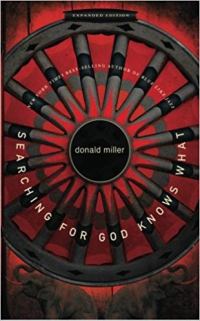
SearchingToday many Christians around the world spent time reflecting on the life of John the Evangelist, the apostle who penned a gospel and three letters found in the New Testament.  John is a fascinating figure on multiple levels, particularly with what he “brings to the table” as the one non-synoptic gospel.

One of my favorite reflections on John is found in Donald Miller’s Searching for God Knows What.  In the book’s fourth chapter, Miller reflects on some of the biblical writers that he connects well with.  Here’s what he has to say about John:

The next guy I like is John the Evangelist. That’s what they called him back in the day. I like John because when he wrote his biographical essay about Jesus, he kept putting himself in the story; only he didn’t call himself John, he called himself the one whom Jesus loved. You figure if a guy gets tortured and beat up and thrown in prison, he might start wondering whether God loves him anymore, but John didn’t. And when John wrote his book he was always taking the camera to the outcasts, into the margins, showing how Jesus didn’t demonstrate any favoritism. He showed how Jewish leaders ridiculed Christ, and he was fearless in exposing the hypocrisy of the ones who led with their heads, not their hearts. At the end of his essay, he captured an amazing conversation between Jesus and Peter. Jesus keeps saying to Peter, “Do you love Me?” And Peter keeps saying, “Yes, yes I do; You know that I do,” but Jesus doesn’t believe Peter and keeps asking him the same question again and again. It is quite dramatic, really.

The way John writes about Jesus makes you feel like the sum of our faith is a kind of constant dialogue with Jesus about whether or not we love Him. I grew up believing a Christian didn’t have to love God or anybody else; he just had to believe some things and be willing to take a stand for the things he believed. John seemed to embrace the relational dynamic of our faith. And he did so in an honest tone, not putting a spin on anything. He revealed how none of the disciples truly understood Jesus and how they were all screwups, and he didn’t make himself look good, either; he just told it exactly as it was. That’s guts, if you ask me. And then, not unlike Paul, John closed his book with a lot of sentimental talk, very to the point but charged with meaning. He ended his book by telling the reader he was going to die. There were some people around back then who wondered if John was ever going to die because they had overheard Jesus say John would live forever, and because John got tortured and should have died early on, a lot of people assumed Jesus was saying John was going to live forever on earth.

This is beautiful and meaningful because John wrote his essay a long time after Christ had left so he was very old, probably nearly ninety years old, and this was back when communities loved old people. They didn’t put them in homes to watch television; they gathered around them because they represented a kind of gentle beauty and wisdom. This was back when you didn’t have to be all young and sexy just to be a person. And it makes you wonder if John sat and wrote that he was going to die knowing within a few days, a few weeks, a month of gentle good-byes, he was going to go home and leave all his friends, and he didn’t want any of them to be surprised or scared.

When you read the book you start realizing that people who were very close to John read this essay and got to the end and started crying because John was telling them he was going to leave,and then I’ll bet at his funeral everybody was standing around thinking about how John knew he was going to die and told them in his book. And I’ll bet they sat around that night at somebody’s house, and somebody who had a very good reading voice lit a candle, and they all lay on the floor and sat on pillows. The children sat quietly and the man with the voice read through the book, from beginning to end, and they thought together about Jesus as the man read John’s book, and when it came to the end where John says he is going to die, the person who was reading got choked up and started to cry. Somebody else, maybe John’s wife or one of his daughters, had to go over and read the end of it, and when she was finished they sat around for a long time and some of the people probably stayed the night so the house wouldn’t feel empty. It makes you want to live in a community like that when you think about the way things were when Jesus had touched people.

A community like that might sound far-fetched, but when you read through John’s other books, the short ones, all he talks about is if you know Jesus, you will love your brother and sister, and anybody who talked that much about loving your brother and sister was probably the most beloved person in their community, and when he died people would have felt a certain pain about it for a long, long time.

I’ve been a fan of that passage for over a decade, and it still resonates with me, a reminder of the nerve that Miller often struck so well with his readers.  Maybe, in that way, he had his own John-like moment.

(image from amazon.com, where you can also purchase the book: it’s under $4 for Kindle right now)

Posted in Books, Commonplace Book, Faith, Friendship, Life in the Fifth Act | Tagged | Leave a comment

Season’s Readings: 2018 Edition

the-spirit-of-christmasOne thing I’m trying to do a little more of as I get older is to establish some set “reading patterns” for different parts of the year.  Holidays are often geared that way, of course.  Then you work in classics like The Lord of the Rings or something from Lewis, and you have a nice rhythm of significant literature to reflect with at key moments in the year.

On Monday, I mentioned Fleming Rutledge’s Advent as a source of guidance for the weeks prior to Christmas.  Over the last few weeks, I’ve also been doing a slow read of W. H. Auden’s Christmas oratorio, For the Time Being.  The book is edited by Alan Jacobs, whose The Year of Our Lord 1943 included Auden as a key figure.  The poem is a good stretch for me.  I like some of the rhythms that Auden establishes with repeated words and phrases.  While I still lack to sections being done, “The Temptation of Joseph,” “The Summons,” and “At the Manger” have been particularly meaningful to me.  From the end of “At the Manger”:

O Living Love replacing phantasy,

O Joy of life revealed in Love’s creation;

Our Mood of longing turns to indication:

Space is Whom our loves are needed by,

Time is our choice of How to love and Why.

With Advent’s end, I’m also finally turning my attention to Chesterton’s The Spirit of Christmas, a collection of poems, stories, and essays that I ordered in November 2017 but that didn’t arrive until a good bit into 2018 (ah, ordering used books and getting them shipped to Hawaii!).  The book goes in a kind of chronological order, with some early works that predate Chesterton’s strong turn towards Catholicism.  Here’s the first poem in the collection, which I quite like:

Good news: but if you ask me what it is, I know not;

It is a track of feet in the snow,

It is a lantern showing a path,

It is a door set open.

Posted in Books, Commonplace Book, Faith | Tagged | Leave a comment

Advent Waiting, Christmas Celebrating

AdentAnd just like that the Advent season comes to an end.  It was a good and challenging Advent season for me.  We spent the weeks between Thanksgiving and exams thinking about Advent in chapel.  My guide through much of that time was Fleming Rutledge through her collection of sermons and essays titled Advent.  From the book’s introduction:

Of all the seasons of the church year, Advent most closely mirrors the daily lives of Christians and of the church, asks the most important ethical questions, presents the most accurate picture of the human condition, and above all, orients us to the future of the God who will come again.

“Advent calls for a life lived on the edge,” Rutledge asserts, primarily because it orients us to God’s intent for our future: the second coming of Jesus.  Yes, we remember His first arrival, His incarnation.  But we are, at this point in the story, called to be mindful about His pending return.

+ + + + + + +

The Daily Office readings for Advent have been a nice reminder of the waiting Jesus requires of us.  It’s been good to see the words of Jesus recorded by Luke as well as Paul’s thoughts on the Second Coming as found in his letters to the church in Thessalonica.  And then there has been the beautiful words of hope from the prophet Isaiah.  From this morning’s reading from Isaiah 35:

And a highway will be there;
     it will be called the Way of Holiness;
     it will be for those who walk on that Way.
The unclean will not journey on it;
     wicked fools will not go about on it.
No lion will be there,
     nor any ravenous beast;
     they will not be found there.
But only the redeemed will walk there,
     and those the Lord has rescued will return.
They will enter Zion with singing;
     everlasting joy will crown their heads.
Gladness and joy will overtake them,
     and sorrow and sighing will flee away.

A road that leads up now to the celebration of Christmas and all that has happened in our world as a result.

Ah, Advent’s waiting . . .

Posted in Faith, Scripture, Teaching | Tagged | 1 Comment