
 And just like that the Advent season comes to an end. It was a good and challenging Advent season for me. We spent the weeks between Thanksgiving and exams thinking about Advent in chapel. My guide through much of that time was Fleming Rutledge through her collection of sermons and essays titled Advent. From the book’s introduction:
Of all the seasons of the church year, Advent most closely mirrors the daily lives of Christians and of the church, asks the most important ethical questions, presents the most accurate picture of the human condition, and above all, orients us to the future of the God who will come again.
“Advent calls for a life lived on the edge,” Rutledge asserts, primarily because it orients us to God’s intent for our future: the second coming of Jesus. Yes, we remember His first arrival, His incarnation. But we are, at this point in the story, called to be mindful about His pending return.
+ + + + + + +
The Daily Office readings for Advent have been a nice reminder of the waiting Jesus requires of us. It’s been good to see the words of Jesus recorded by Luke as well as Paul’s thoughts on the Second Coming as found in his letters to the church in Thessalonica. And then there has been the beautiful words of hope from the prophet Isaiah. From this morning’s reading from Isaiah 35:
And a highway will be there;
it will be called the Way of Holiness;
it will be for those who walk on that Way.
The unclean will not journey on it;
wicked fools will not go about on it.
No lion will be there,
nor any ravenous beast;
they will not be found there.
But only the redeemed will walk there,
and those the Lord has rescued will return.
They will enter Zion with singing;
everlasting joy will crown their heads.
Gladness and joy will overtake them,
and sorrow and sighing will flee away.
A road that leads up now to the celebration of Christmas and all that has happened in our world as a result.
Ah, Advent’s waiting . . .
 Somewhere along the way, from some book I no longer remember, I learned that faith and imagination are intimately tied together. And that’s not just the “artistic” idea of the imagination. It’s something like Charles Taylor’s “social imaginary” idea: the way you perceive and sense the world to be, the way you understand it working or not. As a Christian, my belief in things I cannot see, that have been passed down by those who saw and heard and touched, that have been confirmed in odd but comforting ways in my own experience, requires a constant act of imagination, to believe things are a particular way even when there can be little or no evidence for it in the moment.
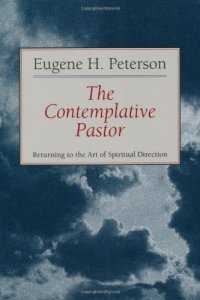 These last few weeks have been a reminder of the frustration that comes with being busier than you ever intended to be. In the midst of it all came news of the death of Eugene Peterson, who has probably shaped more of my understanding of church work than anyone else (he gives hands and feet to things that you get a sense of from thinkers like Nouwen or Bonhoeffer). One of Peterson’s best short pieces (and there are many) is “The Unbusy Pastor,” which I read in The Contemplative Pastor and which started making the rounds again online in the wake of Peterson’s passing. It’s a convicting piece that I’d thought I’d gloss on some over the next few days.
 I don’t remember how I found the works of Eugene Peterson, but I’m glad I did. Peterson joined Tozer, Bonhoeffer, and Buechner in what I would call the first reading trajectory that took me beyond what was popular at the area Family Christian story. I remember two of his books in particular: The Contemplative Pastor and Subversive Spirituality. It was Peterson who introduced me to the idea of “spiritual direction,” something I still consider vital (and too infrequent) today. His ideas of “subversiveness” and the “apocalyptic” really helped open my eyes to an itch I was feeling about church work that was good to have scratched.
 Yesterday professor and author James K. A. Smith announced his move from Comment Magazine to Image Journal. Smith was a big draw to Comment for me, so his loss there is significant. At the same time, I’m curious to see what he does at Image, which “was founded in 1989 to demonstrate the continued vitality and diversity of contemporary art and literature that engage with the religious traditions of Western culture.” It should be a good fit for Smith, particularly as it seems like a number of other new faces are joining the journal.


 Space Enough, and Time