
Personalization Possible?

This recent Q Ideas presentation by Andy Crouch has been making the rounds recently.  Crouch speaks with a reassuring authority, which is good.  And he brings a concern that many have been thinking about for a while to the forefront of the conversation.  It’s 18 minutes well-spent.

I’ll be curious to see if churches think through this issue well at all.  The kind of depersonalization that comes from instrumentalization is present in today’s church, mostly as a way of doing good “for the kingdom of God.”  Instead of asking important questions about programs, we would rather plug people in under the guise of spiritual wisdom, which could potentially do more harm than good for those involved.  Institutionalism and instrumentalization together will ultimately wear a church down and leave the whole system (if not the whole congregation) broken or running elsewhere for relief.

Posted in Faith | Tagged | Leave a comment

Beyond the Babel Moment

Mumford & Sons “Babel” moment feels like a million years ago: that sweet spot when Sigh No More was comfortable ensconced in the collective conscience and Babel took things to some kind of next level, banjo and all.  Now, on this side of Wilder Minds, we might have something of another good Mumford moment.  If “Guiding Light” is simply the tip of an iceberg, we’re at a  great place.  It’s just dense enough: an odd (but Mumford-normal?) mix of pseudo-religious phrases thrown together in blended and poured out with some musical sincerity.  Here’s a recent late-night performance of the song.

Posted in Music | Tagged | 1 Comment

Conversationally Speaking

ConversationProfessor and author Alan Jacobs recently posted his thoughts on conversations.  On one level, that sounds kind of funny (as conversations are supposedly easy things to do).  And yet, as he points out in his criticism of the thoughts of others, there are definitely some things to keep in mind when reflecting on and “practicing” conversation.  Jacobs writes:

If someone were to ask me “How can I become a better conversationalist?” my first thought would be a question: “Why do you want to know?” Because if what you want is popularity or productivity, then conversation is no more than a means to some other end and maybe not even an especially useful means.

Genuine conversation, it seems to me, is not something that one can aim directly at. (In this sense it’s like happiness.) Genuine conversation happens not when you’ve decided you want to have some conversation but when you’re actually engaged with another person. Conversation emerges from a degree of leisure, from patience, and from the trust that enables people to be truly present with each other and to be well-disposed to each other. Rather than asking “how can I have good conversations” or (worse) “how can I be a good conversationalist,” I think we’d all do better to ask this: How can I live in such a way that conversations naturally emerge from my form of life?

Sobering and insightful, I think.  Definitely something about instrumentalism at play, since good conversation might not come from a kind of productivity standpoint. But leisure, patience, and trust aren’t all that easy to come by, either.  But Jacobs’ closing question is a good one, something solid to consider.

(image from eslgold.com)

Posted in Friendship | Leave a comment

The Reason is Friends

I’ve got a couple or three shows returning to the airwaves this week.  The Good Place is the one I’m looking forward to most.  The show takes turn after turn that makes things even more interesting even as the characters go deeper into the mystery that is attempting to live the virtuous life.

I’ve spent the last couple of days rewatching season two, and recently watched the episode where things starts to fall apart, but structurally for the Place and relationally for the people . . . and Michael and Janet.  It’s interesting: the clip is all about friendship, but the title given by NBC has to do with love.  We would all do well to remember the connection, I think.

The Good Place returns with two episodes this Thursday night.

Posted in Friendship, Television | Tagged | Leave a comment

Being Benedict or Daring Daniel?

Daniel by ReviereIt’s always good to hear that Rod Dreher’s “Benedict Option” still hangs in the religious consciousness, if only amongst those on Twitter or fortunate enough to the Dreher speak.  Leah Libresco has a great new book on the concept, giving it some hands and feet (and a nice personal narrative) that makes it a little more tangible for some.  More often than not, it seems, those who write about it continue to get it wrong (or just wrong enough).  Alan Jacobs, most recently of The Year of Our Lord 1943, recently responded to a review of Patrick Deneen’s Why Liberalism Failed that ties in Dreher’s The Benedict Option by Adrian Vermeule for the American Affairs Journal.  The issue, as is too often the case, boils down to misunderstanding the Benedict Option as withdrawal from broader culture versus finding some way to more effectively engage the culture.  Vermeule would like to see more examples like “Esther, Mordecai, Joseph, and Daniel” and others like Paul.  Jacobs wonders if that’s even possible given the current state of Christianity in our culture.  From Jacobs’ blog:

This is a powerful and in many ways beautiful vision. Perhaps the most attractive element of it, to me, is the commendation of limited goals on our part — the mere “attempt to ensure the survival of [our] faith communities in an interim age of exile and dispossession” — that may, in the providential wisdom of God, lead to something much greater: the transformation of a “decaying regime” into a “great instrument with which to restore a substantive politics of the good.” One should never expect something like that but it is meet and right to hope for it.

But I think Vermeule’s vision is missing one absolutely essential element. My question for him is: Where will these Josephs and Mordecais and Esthers and Daniels come from? . . .

So a key question arises: If you need people who are sufficiently skilled in negotiating the liberal order to work effectively within it, but also committed to its transformation, and who can sustain that difficult balance over decades, you have to figure out how to form such people. And it is just this that the churches of the West – all the churches of the West — have neglected to do, have neglected even to attempt. With the (in retrospect quite obvious) result: the accelerating collapse across the board of participation in church life.

What is required, in the face of a general culture that through its command of every communications medium catechizes so effectively, is the construction of a powerful counter-catechesis. Who will do that, and how will they do it? The likely answer, it seems to me, brings us back to the very localism that Deneen and Dreher advocate and that Vermeule rejects.

There’s more to it than that, of course.  And Jacobs’ post deserves a longer, more intentional reading.  I highly encourage it.

It think, obviously, that Jacobs’ points are valid.  What is sobering is that some of the best examples that might exist of such “Daniels” will probably/ultimately find themselves at odds with the very foundational communities that nurtured them (case in point? someone like Russell Moore, a bastion of Baptist thoughtfulness for some, a picture of liberal heresy for others).  And that can be an awfully lonely place.

This issue, on some level, also has roots in and adds color to many people’s understanding of youth ministry, where young Christians are “prepped to engage” the culture around them in their high schools.  Too often the “counter-catechesis” Jacobs would like to see starts way-too-late to be “high school effective.”

Definitely something to consider as culture marches on (and too much healthy Christian culture seems to continue to recede.)

(Briton Riviere’s Daniel in the Lions Den from fineartamerica.com)

Posted in Books, Faith, Teaching | Leave a comment

A Key with Which to See

key in doorWhat I appreciate most about Oliver O’Donovan’s Self, World, and Time (which I have mentioned here and here) is its assertion that the way we live life matters.  This, I imagine, sounds like a no-brainer to most.  Ours is a culture obsessed with living particular ways of life.  It is perhaps the other end of the telescope for identity politics: this is not just who I am, this is also how I understand an authentic life to be lived.  We may not necessarily have a smorgasbord to choose from, but we do have a confusing collection of ways to navigate.  O’Donovan asserts:
Alas, it is the doom of modernity to be bound up in an over-simple knowingness about itself! Our own age is the hardest of all ages to understand.

If he’s right, then our reflections on the way we live life matters deeply.  Our understanding of the world we wake-up to matters deeply.  O’Donovan adds:

I find myself poised between the saving and losing of my soul.  The summons to wakefulness confronts me with the menacing possibility of failure to realize myself: “Awake!  Keep hold of your clothes!”

The “clothes” exclamation is, of course, connected to the New Testament pictures of preparedness in light of the coming of Jesus and God’s kingdom.  It is clear, though, that O’Donovan understands the stakes well: that practical reason, the way we understand and make our way through the world, truly matters.  And with his “inductive” intent throughout Self, World, and Time, he paints broadly and yet with the eye of a realist.

Without a key to the world’s meanings we shall never be able to sift through the complex of information we receive about, and through, the world, and bring it to some kind of order . . . Practical reason looks for a word, a word that makes attention to the world intelligible, a word that will maintain the coherence and intelligence of the world as it finds its way through it, a word from God.

Such a word from God, I believe, is possible.  What I find most interesting about O’Donovan’s approach is that it speaks so easily of “Christian Ethics” (or ethics in general), that one forgets that he isn’t simply talking about the Christian life.  And while many of us would not say the two are synonymous, there is a sense that there is a deep interchangeability between the two.

And so, O’Donovan claims, we “wake up” to find a self, a world, and a time, all unique and yet all part of a larger picture, a broader tapestry, that require no small amount of reflection that can lead to positive action.  The call of Christ, from beginning to end, demands it.

(image from locksmithracine.co)

Posted in Books, Faith, Teaching | Leave a comment

O’Donovan and the Good Place

Back in June I posted a couple of entries having to do with the opening pages of Oliver O’Donovan’s Self, World, and Time, which is the first entry in his “Ethics as Theology” series.  I finally finished the trilogy and have been spending some time re-reading and annotating sections.  It’s a good and interesting work for me, particularly as it stretches the reader in ways that are both deeply theological while totally grounded in day-to-day living (in ways that don’t quite feel like the norm for most theological or ethical writing).

As I mentioned in June, O’Donovan’s opening image of “waking up” really struck me as appropriate on multiple levels.  So much, really, that I decided to weave it into my first “ethics” lesson when our second semester starts this school year via the first three minutes of the pilot episode of LOST, where Jack Shepherd “wakes up” on the island.  Another, more recent, use of the opening-scene-wake-up is The Good Place, which is an amazing opportunity to talk ethics.  Here’s a preview of the show’s first episode back, when its third season premieres next week.  Of course, spoilers.

That first few seconds: a perfect O’Donovan moment.

Over the next few days I hope to get some thoughts down here based on Self, World, and Time.  And since it’s almost TV season, I’m sure there will be some previews and trailers to post, too.

Posted in Faith, Teaching, Television | Tagged | Leave a comment

A Song Worth Sitting With

The latest album from Death Cab for Cutie has been out for a few weeks now.  It’s the kind of album that draws you to the lyrics more than the music, which is always something that Ben Gibbard and company does well.  Here’s a song from Thank You for Today, “60 & Punk.”  Definitely a song worth sitting with for a while.

Posted in Music | Tagged | Leave a comment

Like It’s 1943

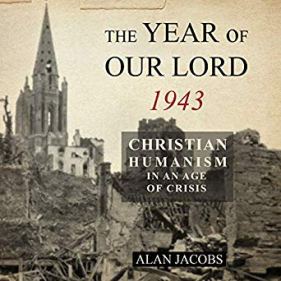
1943This weekend I finally finished The Year of Our Lord 1943 by Alan Jacobs.  In the book, Jacob traces the war-time thinking of thinkers like Simone Weil, Jacques Maritain, W. H. Auden, T. S. Eliot, and C. S. Lewis, particularly as each of them worked to articulate something like a Christian understanding of that particular moment in world history (in the hopes of setting the stage for how life might be lived once the war was over).  It’s an interesting read and a wonderful weave of five disparate threads (much like Elie’s The Life You Save May Be Your Own).  Jacobs handles the historic interplay well, moving both thematically and chronologically through each thinker’s life and thought.

In the end, the book is not particularly hopeful.  But it is helpful.  It’s helpful in showing us another period of (relatively) recent history where the stakes were high and where Christians could or should have said or done more.  While the five thinkers Jacobs chooses have a good bit of philosophical overlap, there’s enough that is unique to each that you find new surprises every few pages.  I found Weil’s reticence with the organized (Catholic) church interesting, particularly as she took a different but sincere approach to the questions posed by cultural power.  The book also humanizes Lewis some, as it weaves in personal anecdote to quotes from essays like “Learning during War-Time.”

The book comes to something of an abrupt ending, and that without his main protagonists.  Instead, Jacobs opts to bring in a sixth thinker, Jacques Ellul (who I first encountered in college through Steve Garber’s Fabric of Faithfulness).  And while there’s something frustrating about the shift, it also makes sense, as Ellul’s though often epitomizes a particular strand of post-war thinking.  That strand, at least as Jacobs teases it out, involves technology.  In particular, it’s the thread of how democracy inadvertently gave way to a kind of technocracy.

The question the book poses, in the end, is this: how late is too late?

It’s something sobering to think about.

+ + + + + + +

Jacobs recently did an interview with The Point about the book.  Appropriately titled “When the Ship Has Sailed” (remember: helpful, not hopeful), Jacobs gives a good summary of the approach of the five thinkers in general.  From the interview:

They don’t offer the same prescription, but to speak very generally, the older figures (Maritain, Eliot, Lewis) tend to believe, or at least hope, that it’s possible to rebuild and renew Christendom—to have a Western European society that is grounded in Christian tradition, though without any mandated acceptance of Christianity. (Their views are not altogether unlike those of Viktor Orbán in Hungary today.) Roughly speaking, Maritain hopes to draw and keep the attention of heads of state (including his own head of state in exile, Charles de Gaulle); Eliot hopes to influence the influencers, the people who worked behind the scenes in the various halls of power; and Lewis seeks to address a large public directly via talks, journalism, books and radio broadcasts. All of them count on an audience that had received some degree, however imperfect, of Christian formation, and could perhaps be persuaded to deepen their own interest and then infiltrate either the halls of power or their own neighborhoods with a body of Christian thought and practice.

For the younger figures, Auden and Weil, the ship of Christendom has sailed; for them, the chief question is the place that Christian ideas can find in societies that structurally reject them. They’re more likely to ask whether Christianity can be made intelligible, especially as something relevant to the whole social order, to people for whom it is a foreign language or sheer nonsense.

Don’t take this distinction as absolute, but in general terms it’s correct, I think.

I think those few paragraphs sums up so many different contemporary takes of the place of Christianity in contemporary culture.  The question for many, in the end, is whether or not the ship has already sailed.  And if it has, what next?

You can read the entire interview here.  And you can order the book here.

(image from amazon.com)

Posted in Books, Faith, Notes for a World's End | Tagged | Leave a comment

Further into the Great Degeneration

DegenerationBack in 2012, I read a little book by Niall Ferguson called The Great Degeneration.  I didn’t know much about Ferguson (and still don’t, really), but I found his book about the great, pending crisis concerning the decay and death of institutions and economies sobering and challenging.  Now, six years later, it (re)reads more and more true.

In the book, Ferguson charted what he saw as the degeneration of four key areas of contemporary life, what he called the four black boxes: the breakdown of inter-generational partnership in democracy, a free/regulated economy, the rule of law, and the evacuation from what was once a more civil society.  These four things pop up often in contemporary thinking.  And the ideas of institutions is always a horizon we see around us.  There are other black boxes, one might say, black boxes tied more closely to our day-to-day lives: institutions like families, churches, schools, communities.  Spend enough time on Twitter or reading contemporary journals and you’ll see that these institutions, too, have been degenerating for some time.  This is one reason why I keep something like a “Notes for a World’s End” tag in place: this is the world we are only beginning to navigate.

The institution being talked about the most these days is the Catholic church.  The last week or so has been a particularly tumultuous time for Catholics as they attempt to make sense of their leadership amidst a number of major crises.  And while I’m not Catholic, I have great respect for their heritage and thinking.  And I also know that Baptist life in many ways is a smaller mirror reflection of Catholic life . . . at least in a kind of systemic sense.  Both, honestly, have seen better days.  And while tomorrow I’ll get to a recent article by Michael Brendan Dougherty of the National Review, I’d like to point out some recent thinking from Alan Jacobs about the Catholic church (and the American presidency) as potential stand-ins for many other degenerating institutions.  From Jacobs’ blog:

Norms are created by institutions, and we live in an age of weak and despised institutions. This is how populist leaders arise: when a great many people believe that institutions exist merely to serve themselves, they come to despise not just those institutions but also the norms associated with them, and applaud leaders who scorn and seek to tear down the whole edifice. And if those leaders make their disdain known in sufficiently charismatic ways, few will notice when they are guilty of the very sins they decry. Moreover, when people see the sheer size of the institutions at which they’re so angry, they despair of any real change happening, and are content with listening to leaders who channel their own frustration.

General contempt for our institutions, government and church alike, makes them too weak to enforce their norms, which first enables corruption — the kind of corruption American Catholic bishops and members of the Congress of the United States are guilty of — and then produces populist figures who appear to want to undo that corruption. But the institutions are too weak to control the leaders either, so those leaders are empowered to do more or less whatever they want to do. This is the case with Trump, who will surely last at least until the 2020 election, and also, I think, with Francis, who will probably last until he dies or chooses like his predecessor to resign.

Moreover, since neither Trump nor Francis is interested in doing the work needed to repair their corrupt institutions — they don’t even have any incentive to do so: the ongoing presence of “swamps” is what lends them such legitimacy as they possess — all the products and enablers of corruption are safe.

Repair, of course, is what we are to be about, I think.  Shoring up, reconstructing, re-instituting, as the case may be.  But all too often it can feel like Noah, divinely commissioned to build an ark for a world where storms are too easily accepted or ignored.  Surely the “great degeneration” can be turned into a “great regeneration,” right?

Jacobs, by the way, has a great “sequel” to the excerpt above where he writes about recency bias.  It’s quite interesting and a good companion post to his other work in How to Think.  Maybe I’ll get my students to read it for class, too.  You can read that here.

(image from goodreads.com)

Posted in Books, Notes for a World's End | Leave a comment