On Some Fundamental Presuppositions

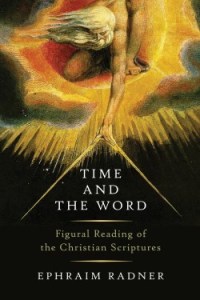
Radner_Time and the Word_wrk02.inddThe folks over at Eerdman’s just posted a nice interview with Ephraim Radner, whose latest book drops this week.  Radner has been interesting to me over these last few months, both in his posts over at First Things and in A Time to Keep.  He seems to have a good grasp on some of the vital parts of “being human” that many of us don’t articulate well when talking about faith over time.

His new book, Time and the Word, takes on the concept of the figural reading of Scripture. When asked about why he researched and wrote such a book:

Contemporary Christians are forgetting how to read the Bible. The main question driving everything else remains the modern one, “did it happen?” Obsessively answering that has taken us out of the Bible, not into it. It’s misguided: past, present, and future—our era’s critical categories—are simply insufficient to engage the realities of creaturely existence that derives from God, who creates and recreates. Why would God’s Word be captive to time? I have been prodded to rethink all this in part by my work within non-Western churches and societies—filled with people who are educated, read newspapers or watch TV, and are hardly historically naïve (as some Westerners like to think). But they have grasped how their lives are “given” by God to such a radical extent that their conformance to the details of Scripture is an obvious promise, not a problem to be argued for. Most Christians, over the centuries have intuited this: Scripture, as God’s Word, is what structures the world, not the other way around. Things happen because Scripture, the Word of the Creator, speaks them; Scripture doesn’t speak them because they happen. This is the fundamental presupposition of figural exegesis, which my own book explores: it is a discipline whereby we read the text in order to see how divine words structure events, and how experienced time reveals the experiences of every Scriptural moment. Just to think about this is liberating.

I feel the tension of Radner’s observations almost every day in my classroom, with students on all ends of the belief spectrum.  I’m curious, then, to see where his explorations have led him.

It’s a fun little interview really, moving from his writings to what kind of books he prefers reading at 2 in the morning.  I particularly liked his closing comments  about advice to those striving to think along biblical lines.

You can read the whole interview here.

(image from eerdword.com; hat tip to my Twitter feed)

Posted in Books, Faith, Internet, Teaching | Leave a comment

Waiting Out the Storm

This week I’m posting performances from the 25th anniversary writers-in-the-round event at the Community Coffeeshouse in Danbury, CT.  Today’s clip is of Jill Phillips singing “It Will Pass” from her Mortar & Stone album.

Like so many of her musical peers, Jill Phillips takes time to craft songs about the ups and downs of daily life.  This song is more about pressing on when the downs of daily life just won’t seem to let go, like a storm that settles right above your house.  How good it is to be reminded that even those storms will eventually pass.

Posted in Faith, Internet, Music | Tagged | Leave a comment

Letting Yourself Be Loved

One of Andrew Osenga’s contributions to the 25th anniversary show at the Community Coffeehouse was “I’m on Your Side,” a song I more than likely have shared here before.  I like how Osenga introduces the song, particularly in its performance context.  “An evening about community,” he said.  Once again, a beautiful thing to see so many great musicians playing and singing along.

I think a lot about community, particularly the Christian kind.  I’m at odd places these days concerning work and church, often feeling unsure about how to relate, to contribute, without playing some game.  “Are there words I could say that would let your heart believe me?”  That’s the question a true friend would ask.

Posted in Faith, Internet, Music | Tagged | Leave a comment

I Can, I Am, I Will

One thing you hear a lot growing up is the idea that “relationship is the most important thing,” that it matters how you treat others and how others treat you.  You hear it a lot, I suppose, because relationships are so difficult to nurture and grow.  Rarely is the space enough (and time) to be as present as many people need.

At the recent 25th anniversary of the Community Coffeehouse in Connecticut, Andy Gullahorn performed “I Will,” a solid song about the wide range of situations in life that require a faithfully human response.

Posted in Faith, Internet, Music | Tagged | Leave a comment

Song for the Roads

I’ve been wondering for a while if the folks over at Creator Arts would post any clips from the 25th anniversary concert of the Community Coffeehouse in Danbury, Connecticut.  I wondered because four of my favorite musicians all played for the event.  A few songs were posted a few days ago, so I thought I’d pass them along, starting with this performance of “Many Roads” by Andrew Peterson.

How great it is to see an introduction by Andy Gullahorn and hear harmonies from Jill Philips with some extra guitar by Andy Osenga!

As with so much of his music, this song by Peterson blends sentiment and hope and the rigamarole of the day-to-day into a nice, ad-libbed musical moment.

Posted in Faith, Internet, Uncategorized | Tagged , , , | Leave a comment

Here Comes the Future?

future-pastMuch has been written and said about this presidential election.  I have absolutely nothing to add on a personal note. (Well, that’s not totally true.  I’ve got something lined up for tomorrow, but more on that then.)

Tomorrow was the topic, though, of a recent article at The Week by Michael Brendan Dougherty.  The article, “The Election That Forgot About the Future,” almost plays out like a riff on Yuval Levin’s thesis from The Fractured Republic.  Dougherty begins:

America used to be obsessed with the future. But, perhaps predictably in a campaign led by two baby boomers, this campaign has been about the past.

He then makes connections to different aspects of the past as embodied by our two candidates (just like Levin traced the nostalgic trajectory of the two parties through the last half of the 20th century).   We have forgot about the future, it seems.

Our politics have ceded the future to the market and Silicon Valley. The question of social organization, presumably, has been mostly solved by the wonks. Liberal democracies are increasingly convinced that there is no innovation in political thinking allowed. We simply adjust the levers of policy at appropriate times, and focus on atoning for past sins. The global elite is converging on economic integration, low trade barriers, universal benefits, light regulation, and the cultivation of a global class of politicians and plutocrats who socialize and groom each other and their children for continued benevolent rule. Sometimes, in their darker moments, they cede the future to China, thinking that some kind of autocratic capitalism might produce better trains and faster growing cities.

And whatever hope we have for thoughtful pushback doesn’t seem to exist:

A normal age would produce a culture of letters that recognizes this for what it is: exhaustion on a deep level.

Our politics are obsessed with the past because we aren’t invested in the future the way a normal society should be. So we hardly imagine what we might build. We live on credit in the somewhat secure knowledge that our creditors can’t collect even if they were to rob our graves. Like the Clintons, our elites live with dual incomes and one kid. And we search for ways to do good, when the getting’s good for us too. Like Donald Trump, we’re hoping to stick some nameless others with our moral and financial debt.

This pattern of life — a life oriented to no future at all — will end soon, because it is unsustainable. And because, if we can bear to look, it disgusts us.

You can read the whole article here.

(image from physicsworld.com)

Posted in Books, Internet | Leave a comment

Doctor Strange: Apologist for the Transcendent Frame

Caught a Thursday night showing of Doctor Strange, the latest entry in Marvel Studio’s ever-expanding cinematic universe.  It was a great experience, hitting all of the right notes with storytelling and visual cues.

Doctor Strange tells the story of a pompous surgeon brought to a point of existential desperation after a car accident leaves his hands beyond repair.  He finds a world full of possibilities when he travels to Kathmandu to seek out healing from the ancient one.

The movie is beautifully shot and wonderfully acted.  It moves quickly through the early origin story of the character while also making a couple of nice nods to the broader cinematic universe.  The humor is spot-on, even while the plot takes a number of somber turns.

But it’s the philosophical conversations underlining the story that made the movie for me.  In class, we talk about the nature of the world and the nature of people and the deeper point of things.  This can be particularly daunting when you encounter a strange brew of belief and skepticism.  Consider this clip:

While the language might be frustrating to some, it was nice to hear a movie character of some weight talking convincingly about the nature of humanity and the potential of “spirit.”  A bridge builder, for sure.

There are a number of good, smart moments like this that reinforce the stakes in having a fuller understanding of ourselves and the universe in which we live, even if those stakes are drawn on a comic book canvas.

I can’t help but highly recommend the movie.  Doctor Strange is easily up there with The Avengers, Winter Soldier, and Ant-Man.  I’m looking forward to a second viewing.

Posted in Faith, Internet, Movies, Uncategorized | Leave a comment

“Every Man’s Hat”

wittenburgYesterday marked the 499th anniversary of the beginning of the Protestant Reformation.  The folks at First Things posted a great article by Timothy George about one of the phrases often associated with the “movement,” the concept of the “priesthood of the believer.”  I’d go so far as to say that of all the phrases, “the priesthood of the believer” has been the one I’ve heard most often as a Baptist.  Mr. George asserts that we’ve gotten it wrong.

Building off of Luther’s thinking:

All baptized believers are called to be priests, Luther said, but not all are called to be pastors.

George goes on to say:

While the priesthood of all believers was used by the reformers to buttress an evangelical understanding of the church over against the clericalism and sacerdotalism of medieval Catholicism, the ecclesial context of this Reformation principle has often been eclipsed within major sectors of the Protestant tradition. In my own Baptist family, for instance, it became common in the nineteenth and early-twentieth centuries to speak of the “priesthood of the believer.” The reformers, however, spoke instead of the “priesthood of all believers” (plural). For them it was never a matter of a lonely, isolated seeker of truth, but rather of a band of faithful believers united in a common confession as a local, visible congregatio sanctorum. The best interpreters of the Baptist tradition have always recognized how devastating the attenuation of this principle has been for Baptist ecclesiology.

One of those “best interpreters of the Baptist tradition, George asserts, is Winthrop S. Hudson.  Hudson asserted that

To the extent that Baptists were to develop an apologetic for their church life during the early decades of the twentieth century, it was to be on the basis of this highly individualistic principle. It has become increasingly apparent that this principle was derived from the general cultural and religious climate of the nineteenth century rather than from any serious study of the Bible. … The practical effect of the stress upon “soul competency” as the cardinal doctrine of Baptists was to make every man’s hat his own church.

And in doing so, we Baptists more fully bought into an individualistic approach to the faith that has potentially done as much harm as it has done good.

Imagine that, being priests to one another and to the world!  That is, of course, the thrust of the biblical story, particularly in the thinking of Peter and of John.  And it is more than a thick metaphor: it is a clear picture of what God expects from those led by the Spirit in following Jesus.  “A kingdom of priests” indeed.

You can read Timothy George’s piece in its entirety here.

(image from sophiesworld.net)

Posted in Faith, Internet | Leave a comment

The Monster and Dr. Wells

One of the more interesting and unexpected curve-balls thrown at viewers in the most recent episode of The Flash was the team’s decision to recruit a Dr. Harrison Wells from another Earth to replace the Wells from Earth-2 (who became a vital part of Team Flash in season two).  Now we’re left to wonder if the “monster” talked about in the trailer for next week’s episode might be the good doctor himself.

Posted in Internet, Television | Tagged | Leave a comment

“You All Loved Him Once”

I’d heard that Conor Oberst had recently released a new album, but I hadn’t given much thought to checking it out until last night.  I started with “You All Loved Him Once.”  What a brutally poignant song about what we do with our heroes (often musicians and artists) when we are all but done with them.  Here’s the song recorded at a concert this past summer.

Posted in Internet, Music | Leave a comment