Singular Song

I started the week with my favorite song from Steven Curtis Chapman’s new album, Worship and Believe.  Thought I’d close out the week in a similar fashion.  Here’s “One True God,” a song that retells the biblical story and points us in that story’s direction.  The album version includes Chris Tomlin, but this video is all Steven Curtis Chapman.

Posted in Faith, Music | Leave a comment

Taking a Dip in Myth

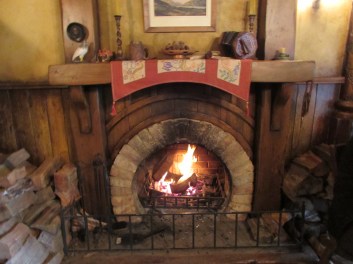
IMG_0718Lewis continued his discussion of The Lord of the Rings as myth in “The Dethronement of Power,” his review of The Two Towers and The Return of the King that appeared in the October 1955 issue of Time and Tide.

‘But why’, (some ask), ‘why, if you must have a serious comment to make on the real life of men, must you do it by talking about a phantasmagoric never-never land of your own?’ Because, I take it, one of the main things the author wants to say is that the real life of men is of that mythical and heroic quality. One can see the principle at work in his characterisation. Much that in a realistic work would be done by ‘character delineation’ is here done simply by making the character an elf, a dwarf, or a hobbit. The imagined beings have their insides on the outside; they are visible souls. And Man as a whole, Man pitted against the universe, have we seen him at all till we see that he is like a hero in a fairy tale?

. . . The value of the myth is that it takes all the things we know and restores to them the rich significance which has been hidden by ‘the veil of familiarity.’ The child enjoys his cold meat (otherwise dull to him) by pretending it is buffalo, just killed with his own bow and arrow. And the child is wise. The real meat comes back to him more savory for having been dipped in a story; you might say that only then it is the real meat. If you are tired of the real landscape, look at it in a mirror. By putting break, gold, horse, apple, or the very roads into a myth, we do not retreat from reality, we rediscover it. As long as the story lingers in our mind, the real things are more themselves . The book applies the treatment not only to bread or apple but to good and evil, to our endless perils, our anguish, and our joys. By dipping them in myth we see them more clearly. I do not think he could have done it any other way.

Oh to see the world as it really is!  But that would mean being willing to recast it by reminding ourselves of the bigger story in which we find ourselves, the bigger story we often reduce to our own size.

(photo taken June 2014 at The Green Dragon in Hobbiton)

Posted in Books | Tagged , | Leave a comment

Nostalgia and Narsil

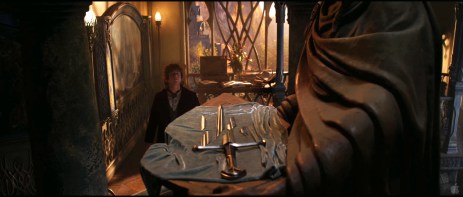
Bilbo_narsilIn his review of The Fellowship of the Ring, Lewis tackles the charges of “fiction as escapism or nostalgia” head-on.  We saw hints of it in yesterday’s excerpt.  We get an even better sense of it in the selection below.  As with so many other things, Lewis does a great job of adding a “twist” to our understanding of what’s going on.

Nostalgia does indeed come in; not ours nor the author’s, but that of the characters. It is closely connected with one of Professor Tolkien’s greatest achievements. One would have supposed that diuturnity was the quality least likely to be found in an invented world . . . But in the Tolkienian world you can hardly put your foot down anywhere from Esgaroth to Forlindon or between Ered Mithrin and Khand, without stirring the dust of history. Our own world, except at rare moments, hardly seems so heavy with its past. This is one element in the anguish which the characters bear. But with the anguish there comes also a strange exaltation. They are at once stricken and upheld by the memory of vanished civilizations and lost splendour. They have out-lived the second and third Ages; the wine of life was drawn long since. As we read we find ourselves sharing their burden; when we have finished, we return to our own life not relaxed but fortified.

Lewis is, of course, making mention of Tolkien’s creation of a world with depth in all directions.  It’s a well-worn world, with a (hi)story beneath every stone.  And that’s why the loss in the story is so palpable: it’s felt on multiple levels.  We feel loss.  We feel the characters’ immediate loss.  We feel the characters’ deep and lasting loss, too.  “Our own world, except in rare moments, hardly seems so heavy with the past,” Lewis asserts.  That might even feel more true half a century later.

I like Lewis’s final comment a lot, that we leave Tolkien’s world “not relaxed but fortified.”  That should be its own genre of literature, really.  Definitely a list worth making.

(image from lotr.wikia.com)

Posted in Books, Faith | Tagged , | Leave a comment

Middle Earth as Myth (not allegory)

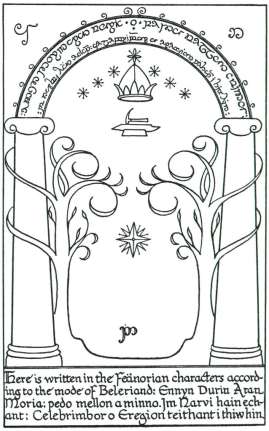
Doors of DurinOne of the things you hear most when reading Tolkien (or reading about Tolkien) is whether or not The Lord of the Rings is an allegory.  Tolkien, of course, flatly denied the charge, but that hasn’t kept decades of readers from speculating about the atomic bomb and world wars and the effects of the industrial age.  Lewis picks up on the possibility, too, but quickly dismisses it in his review of The Fellowship of the Ring.  Consider:

What shows we are reading myth, not allegory, is that there are no pointers to a specifically theological, or political, or psychological application. A myth points, for each reader, to the realm he lives in most. It is a master key; use it on what door you like. And there are other these in The Fellowship equally serious.

That is why no catchwords about ‘escapism’ or ‘nostalgia’ and no distrust of ‘private worlds’ are in court. This is no Angria, no dreaming; it is sane and vigilant invention, revealing at point after point the integration of the author’s mind. What is the use of calling ‘private’ a world we can walk into and test and in which we find such balance? As for escapism, what we chiefly escape is the illusion of our ordinary life. We certainly do not escape anguish. Despite many a snug fireside and many an hour of good cheer to gratify the Hobbit in each of us, anguish is, for me, almost the prevailing note. But not, as in the literature most typical of our age, the anguish of abnormal or contorted souls: rather that anguish of those who were happy before a certain darkness came up and will be happy if they live to see it gone.

I love the image of myth-as-key, that a myth “points the reader to the realm he lives in most.”  It’s a “master key,” almost like the elvish word of entry to Moria or the way into the Lonely Mountain.  And that is why, in Lewis’s estimation, the story of Frodo and Sam, Aragorn and Arwen, Gandalf and Galadriel, is more than just escapist literature.  More on that tomorrow.

(image of the Door of Durin by Tolkien from lotr.wikia.com)

Posted in Books, Movies, Uncategorized | Tagged , | Leave a comment

“When the Gods Returned to Earth”

IMG_0674One of the things you find on almost every copy of J. R. R. Tolkien’s The Fellowship of the Ring is a quote from C. S. Lewis.  “Here are beauties which pierce like swords or burn like cold iron; here is a book that will break your heart,” the copy reads.  Those words are from the Lewis-penned review of FOTR that was published in the August 1954 issue of Time and Tide under the title “The Gods Return to Earth.”  I finally got a copy of the review as an entry in Image and Imagination, a Canto Classics collection of Lewis’s literary pieces.  And while the reviews aren’t the books themselves, they’re pretty darn close.

*****

What Lewis most appreciates about The Fellowship of the Ring (it seems) is something that is an almost-instant turn-off for newbies to the novel: the long introduction “concerning hobbits.”  In Lewis’s estimation, the long description of “the life and times of hobbits” is essential to the story.

Yet there were good reasons for such an opening; still more for the Prologue (wholly admirable, this) which precedes it. It is essential that we should first be well steeped in the ‘homeliness’, the frivolity, even the (in its best sense) the vulgarity of the creatures called Hobbits; these unambitious folk, peaceable yet almost anarchical, with faces ‘good natured rather then beautiful’ and ‘mouths apt to laughter and eating’, who treat smoking as an art and like books which tell them what they already know. They are not an allegory of the English, but they are perhaps a myth that only an Englishman (or, should we add, a Dutchman?) could have created. Almost the central theme of the book is the contrast between the Hobbits (or ‘the Shire’) and the appalling destiny to which some of them were called, the terrifying discovery that the humdrum happiness of the Shire, which they had taken for granted as something normal, is in reality a sort of local and temporary accident, that its existence depends on being protected by powers which Hobbits dare not imagine, that any Hobbit may find himself forced out of the Shire and caught up into that high conflict. More strangely still, the event of that conflict between strongest things may come to depend on him, who is almost the weakest.

Readers of the books (not so much viewers of the movies) know that the Shire plays a major role in the stories last major movement.  All of that unambition, peace, and good-naturedness gets put to the test in a way that Frodo and friends are more than prepared to deal with.

It’s interesting to think of the peace of the Shire as “a sort of local and temporary accident.”  The world beyond its protected borders, though, is full of “high conflict.”  For sure the Shire is there for contrast, but I can’t help but think there’s more going on than simply saying “here’s life at its simple best.”  Lewis mentions the “myth” aspect of the story early in the review, something that comes up often in the rest of the review (and which we’ll see more of tomorrow).

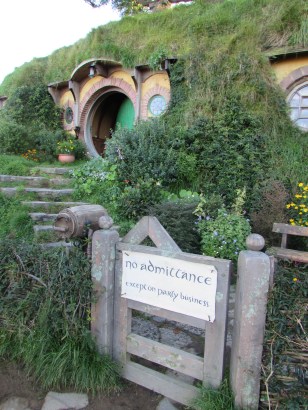
(image taken in Hobbiton in New Zealand, summer of 2014)

Posted in Books, Movies | Tagged , | Leave a comment

Who You Say We Are

This past weekend saw the release of Steven Curtis Chapman’s latest, a worship album called Worship and Believe.  The two terms in the title hang together awkwardly.  We might think that the reverse is the appropriate order: believe and worship.  We may even think of them as discrete units: worship here and believe there, but not both at the same time.  Early in the album, though, you get the sense that the two go hand-in-hand all of the time.

My favorite track from the album is a great example of this.  “Who You Say We Are” has a simple lyric that expresses a profound truth well.  And that profound truth, that God declares us to be sons and daughters, is something we believe and that informs our worship.   As the song says, the most we can say is “thank you.”  Check out the song in this Essential Music “song session.”

It is this simplicity of lyric that I like the most about the album.  Too often we sing songs of worship that are overly and unnecessarily complicated.  We get lost in trying to get the melody and the meaning down at the same time.  Maybe it is enough, for at least a time, to songs over and reflect on the most basic implications of our faith’s truth claims: that Jesus the Son brings us back to the Father, that we are indeed His sons and daughters, and that the most we can say is “thank you.”

The rest of the album is solid.  You’ve got your crowd-pleasing fast tracks (“Amen” and “We are More than Conquerors”).  You’ve got songs that I would call more “obvious” in terms of worship stuff like “King of Love,” “One True God,” and “God of Forever.”  But for me, for now, it’s the simple moments of “Who You Say We Are” and “Hallelujah (You Are Good”) that give me the most traction (and some wonderfully simple and hummable melodies).  Or maybe I just like the great use of the criminally-underused hallelujah.

Posted in Faith, Internet, Music | Tagged | Leave a comment

Closing the Door on Downton Abbey

This Sunday sees the final episode of PBS’s Downton Abbey.  While the show never quite lived up to its first season promise, it was an enjoyable weekly visit to another time and another place.  The episode airing Sunday night is the show’s “Christmas Special,” which is a great part of British culture that also shows up with Doctor Who.

PBS has put together a number of “montage” pieces to celebrate the full run of the show.  Here’s one of my favorites: for your amusement, indeed.

Posted in Internet, Television | Tagged | Leave a comment

Formation and What You Love

These past few weeks I’ve had the opportunity to work through the concept of formation with some of my peers.  It’s been an interesting journey made even more interesting by the thoughts of James K. A. Smith.  Smith’s new book, You Are What You Love, drops on April 5th from Brazos Press.  Here’s a clip based on the book.

Even as I was finally getting my mind around worldview talk on a high school level, Smith challenged me to think about thinking and feeling on an even better, richer level.  I’m looking forward to what he has to say in his new book (and in sharing it with others).

Posted in Books, Faith, Internet, Teaching | Tagged | Leave a comment

Bouncing Back with the Agents of SHIELD

It feels like forever-and-a-day ago since the mid-season finale of Marvel’s Agents of SHIELD.  The first half of the season was a great example of accelerated story-telling, with a number of major twists and turns taken in what would take an entire season years ago.  Now we’re got lots of Inhumans, an angry Coulson, and an intergalactic alien inhabiting a definitely-deceased Agent Ward.  Here’s the extended trailer for next week’s spring premiere.

Posted in Internet, Television | Tagged | Leave a comment

Dwelling and Indwelling

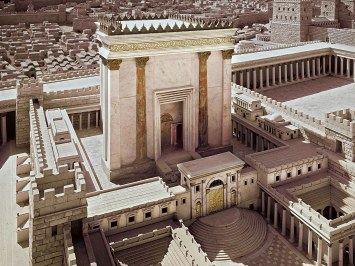
Scale model of Jerusalem and the second templeOne of the things I like most about N. T. Wright’s image of the biblical story like a five-act play is how it holds the story together while also emphasizing the underlying connective tissue.

One such tissue is found in the God who makes something (someones) with or in which to dwell.  Peter Leithart recently wrote about this in his First Things article, “You Are a Temple,” which begins:

Yahweh descended from Sinai to take up residence in the tabernacle, to make His home in the midst of His people. Though access to His house was limited, He intended the tabernacle to be a house of hospitality. In the house were a table of showbread for food, a lampstand to shed light, an altar of incense that represented prayer. Bread, light, and incense are God’s gifts to Israel.

He then traces that thread succinctly through Jesus and Paul’s thinking.  It is an interesting and necessary balance between holiness and hospitality, two things that are often hard to come by in the rough-and-tumble of culture today.  Leithart adds:

When Paul tells the Corinthians that they are temples of the Spirit, he emphasizes the restrictions: Because they are holy space, claimed by God in the Spirit, they are not to use the members of their bodies in ungodly ways. They are not to join the members of Christ to prostitutes, but to remain in one Spirit with Christ (1 Corinthians 6:12-20).

But the entire theology of the sanctuary comes into play. When the Spirit consecrates an individual as a temple of the Spirit, that person becomes a locus of hospitality – offering the bread, light, incense, and all the other gifts of the sanctuary to his neighbors. When a household is indwelt by the Spirit, it is remade into an image of God’s own house, a place of hospitality, prayer, light, life. When a church receives the Spirit, it is opened as God’s house to offer Christ the Bread, Christ the Light, Christ the intercessor to the world.

How humbling and exciting to think that we might be, as Leithart puts it, “God’s own house.”

You can read the rest of Leithart’s article here.

(image from media.tcc.fl.edu)

Posted in Faith, Internet | Leave a comment