The One Where We All Got a Life?

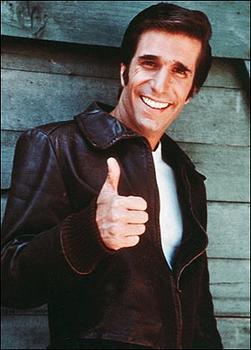
The FonzLong before the internet meme, there was the catch phrase.  The Fonz with his thumbs-up “hey” or Joey Tribiani’s “how you doing?”  The Full House “how rude” or the Family Matters “did I do that?”  Catch phrases showed up in TV, radio, and (perhaps especially) commercials.

Some phrases, though, resided primarily in the conversational lexicon more than on the TV screen.  A great example: get a life.  We all said it.  We all thought it.  And, according to Douglas Coupland, it’s a phrase you don’t here at all these days.  He writes about in the broader context of boredom (or our lack of it in the 21st century).  From his recent Financial Times column:

In the 1990s there was that expression, “Get a life!” You used to say it to people who were overly fixating on some sort of minutia or detail or thought thread and, by saying “Get a life!”, you were trying to snap them out of their obsession and join the rest of us who were still out in the world taking walks and contemplating trees and birds. The expression made sense at the time but it’s been years since I’ve heard anyone use it anywhere. What did it mean then, “getting a life”? Did we all get one? Or maybe we’ve all not got lives any more — and calling attention to one person without a life would put the spotlight on all of humanity and our now full-time pursuit of minutiae, details and tangential idea threads.

It’s an interesting question to pose: did we stop saying it because we followed our own advice?  Or have things gone the other way?  I think it’s definitely worth thinking about and most assuredly worth casting some kind of vision for.

You can read the rest of Coupland’s article here (though the site might ask you to answer a question or two before reading).

Posted in Internet, Television | Leave a comment

The Muppets and America’s Best Broadcasting Company?

I don’t make my way to ABC much these days, primarily for Marvel’s Agents of SHIELD.  That could change at least a little bit this fall thanks to this trailer for a new show with the Muppets.


There’s a part of me that shares Gonzo’s cynicism on this, but I think the concept should be good for at least a season.  I’ll let them light the lights first; then I’ll decide.

Posted in Internet, Television | Leave a comment

Better Busking through Disguise

Last week Jimmy Fallon and U2 caught some riders of the NYC subway system by surprise.  The band started in costume with a rendition of “I Still Haven’t Found What I’m Looking For.”  Then, sans disguise, the band brought in the good harmonies of “Desire.”  Here’s the video.

Posted in Internet, Music, Television | Leave a comment

Reactivated Acceleration

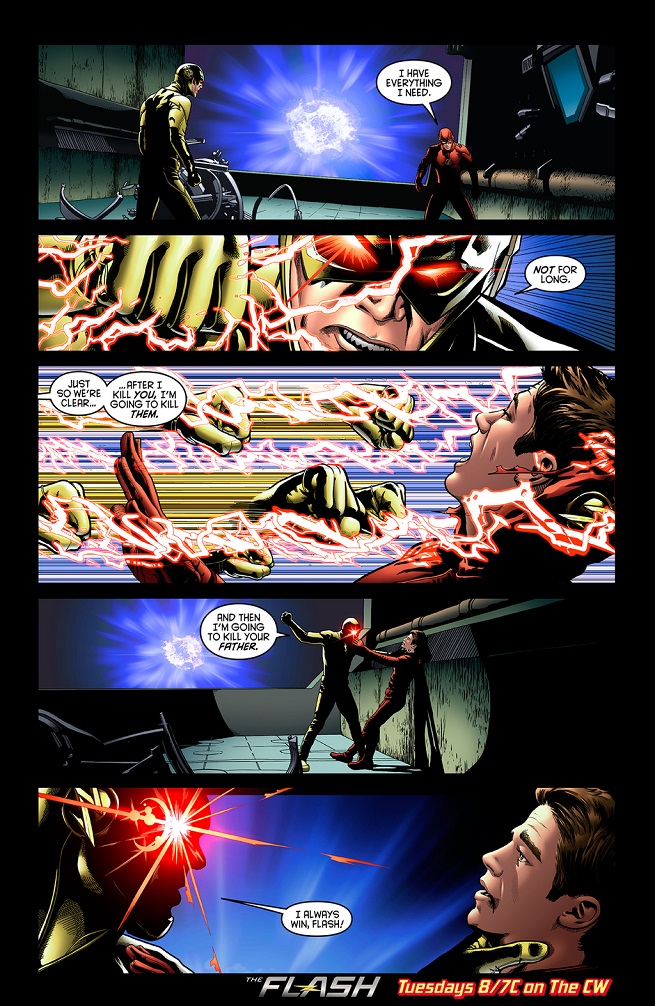
Between the two-hour season finale for Marvel’s Agents of SHIELD and the penultimate episode of The Flash, this Tuesday evening has shaped up nicely.  The CW has taken an interesting approach to its teasers: short teaser after the current episode and then a double-sized trailer a few days later.  Here’s the one-minute preview of Tuesday’s episode of The Flash.  I kind of knew that putting all those villains in one place was a bad idea . . .

Posted in Internet, Television | Leave a comment

Still Looking for Them

Came across this video last night while reflecting on the day.  It started early and was full of classes and calls and conversations, so it was nice to find a breath of fresh air from what feels like a long time ago.


I’m always amazed at SCC’s songwriting ability, how he can almost transfigure (in a way) a mundane thing, like crayons and plastic space men.  It’s a great gift to have and skill to craft.

Posted in Faith, Internet, Music | Leave a comment

Up Through the First Joke

JackdawFrom The Magician’s Nephew by C. S. Lewis:

The Lion, whose eyes never blinked, stared at the animals as hard as if he was going to burn them up with his mere stare.  And gradually a change came over them.  The smaller ones– the rabbits, moles, and such-like– grew a good deal larger.  The very big ones– you noticed it most with the elphants– grew a little smaller.  Many animals sat up on their hind legs.  Most put their heads on one side as if they were trying very hard to understand.  The Lion opened his mouth, but no sound came from it; he was breathing out, a long, warm breath; it seemed to sway all the beasts as the wind sways a line of trees.  Far overhead from beyond the veil of blue sky which hid them the stars sang again; a pure, cold, difficult music.  Then there came a swift flash like fire (but it burnt nobody) either from the sky or from the Lion itself, and every drop of blood tingled in the children’s bodies, and the deepest, wildest voice they had ever heard was saying:

“Narnia, Narnia, Narnia, awake.  Love.  Think.  Speak.  Be walking trees.  Be talking beasts.  Be divine waters.”

It was, of course, the Lion’s voice.  The children had long felt sure that he could speak: yet it was a lovely and terrible shock when he did.

Out of the trees wild people stepped forth, gods and goddesses of the wood; with them came Fauns and Satyrs and Dwarfs.  Out of the river rose the river god with his Naiad daughters.  And all these and all the beasts and bords in their different voices, low or high or think or clear, replied:

“Hail, Aslan.  We hear and obey.  We are awake.  We Love.  We think.  We speak.  We know.”

“But please, we don’t know very much yet,” said a nosey and snorty kind of voice.  And that reall did make the children jump, for it was the cab-horse who had spoken . . .

“Creatures, I give you yourselves,” said the strong and happy voice of Aslan.  “I give to you forever this land of Narnia.  I give you the woods, the fruits, the rivers.  I give you the stars and I give you myself.  The Dumb Beasts whom I have not chosen are yours also.  Treat them gently and cherish them but do not go back to their ways lest you cease to be Talking Beasts.  For out of them you were taken and into them you can return.  Do not so.”

“No, Alsan, we won’t, we won’t,” said everyone.  But one perky jackdaw added in a loud voice, “No fear!” and everyone else had finished just before he said it so that his words came out quite clear in a dead silence . . . The Jackdaw became so embarassed that it hid its head under its wing as if it were going to sleep.  And all the other anumals began making various queer noises which are their ays of laughing and which, no one has ever heard in our world.  They tried at first to repress it, but Aslan said:

“Laugh and fear not, creatures.  Now that you are no longer dumb and witless, you need not always be grave.  For jokes as well as justice come in with speech.”

So they all let themselves go.  And there was such merriment that the Jackdaw himself plucked up courage again and perched on the cab-horse’s head, between its ears, and clapping its wings, and said:

“Aslan! Aslan!  Have I made the first joke?  Will everybody always be told how I made the first joke?”

“No, little friend,” said the Lion.  “You have not made the first joke; you have only been the first joke.”  Then everyone laughed more than ever . . .

Posted in Books, Commonplace Book | Leave a comment

On Goofy, Mountains, and Magic

One of the most interesting distinctions that Matthew B. Crawford deals with is the ascendancy of the virtual world as the “real” world for so many.  He uses the “Handy Dandy Machine” from Micky Mouse Clubhouse as a modern counterpoint to what feels like the now-ancient misadventures of Goofy. Unlike the cartoon characters of today, Goofy could not simply press a but or summon a computer to solve his problem in the abstract.  He has to deal with things head-on (at least in cartoon terms).  Consider:


For all of the fanciful ups and downs of the short clip, Goofy still has to deal with the reality of the mountain.   From Crawford’s The World Beyond Your Head:

The appeal of magic is that it promises to render objects plastic to the will without one’s getting too entangled with them.  Treated from arm’s length, the object can issue no challenge to the self.  According to Freud, this is precisely the condition of the narcissist: he treats objects as props for his fragile ego and has an uncertain grasp of them as having a reality of their own.  The clearest contrast to the narcissist is the repairman, who must subordinate himself to the broken washing machine, listen to it with patience, notice its symptoms, and then act accordingly.  He cannot treat it abstractly; the kind of agency he exhibits is not at all magical.

If we are not careful, Crawford seems to be saying, we will fool ourselves into believing that we truly are living in a magical world.  And there are many wizards more powerful than you and me.

Posted in Books, Television | Leave a comment

“That Lack of That Next Big Glorious”

The Space ShuttleThe Telegraph recently posted an article/interview with Dave Eggers, who I write about here as often as I can.  It’s a good article, focusing primarily on Eggers’ last three novels.  The article is mostly couched in Eggers’ take on technology, which is most seen in The Circle.  But the article also makes decent use of the most recent (and under-discussed) book by Eggers, Your Fathers, Where Are They? And Your Prophets, Do They Live Forever?  One image that inspired that book is something potent for many who grew up in the 90s: the NASA shuttle program:

Fathers was so odd,” he admits. “I wrote it on and off for about a year, but in a fury each time.” Even more than Alan Clay in A Hologram for the King, Thomas is a figure of dispossession adrift on America’s post-industrial landscape. He yearns obsessively for the time when America blazed a trail with the Space Shuttle programme.

“Half the people I grew up with wanted to go up in the Space Shuttle,” Eggers replies when I ask about this. “It was one of the most central images of our childhood and teenage years. I went to the last Shuttle launch in 2011. It made me feel incredibly patriotic and proud, and really sad. There were so many of these old-timers who have been at NASA from the beginning and they knew it was ending. Astronauts were going to have to ride on Russian rockets to get to the space station.

“It was crushing. Everyone was crying. The Shuttle was such a powerful emblem of a sense of optimism and a can-do spirit. I think this is what Thomas in Fathers is suffering from and Alan too in Hologram. That lack of that big next glorious communal mission, whether it’s the opening of the West or the transcontinental railroad or the Panama canal or Apollo or the Shuttle.”

But it’s talk of the internet and data and privacy that takes up the rest of the article.  Instead of technology that directs us truly beyond ourselves, we have apps where “they’re all more intrusive, they all reach through” into the personal areas of our lives.

You can read the whole article here.  It’s a worthwhile read and a healthy perspective.

Posted in Books, Internet | Leave a comment

The Professional Necessity of Others

From Matthew B. Crawford’s The World Beyond Your Head:

For experiences to become part of the secure, sedimented foundation of a skill, they must be criticized.  Otherwise people (and the resources of language) are indispensable.  Without them, your experiences are partial, and may sediment as idiosyncratic bad habits.

The power of these conversations to clarify your experience, rather than introduce fresh confusion, depends in part of the dialectical abilities of your colleagues.  They have to be able to interrogate their own experience into the conversation in such a way that their initial interpretation of it is put at risk.  They have to be capable of offering it up, without undue attachment, to the shared enterprise of trying to understand  structure fires.  In other words, they must have the art of philosophical conversation (which is a kind of moral accomplishment).  I believe the most competent people in any field do have this art to some degree, though they probably wouldn’t name it as such.

Getting things right requires triangulation with other people . . . It typically happens in conversation– not idle chitchat, but the kind that aims to get to the bottom of things.  I call this an “art” because it requires both tact and doggedness.  And I call it a moral accomplishment because to be good at this kind of conversation you have to love the truth more than you love your own current state of understanding.  This is, of course, an unusual priority to have, which may help to account for the rarity of real mastery in any pursuit.

Posted in Books, Commonplace Book, Teaching | Leave a comment

Having Your Attention (and eating it, too?)

Yesterday’s classic Calvin and Hobbes also reminded me of something Andy Crouch recently said about technology and the attention our screens demand from us (connected to Calvin and his appliances).  From “Small Screens, Big World”:

Our screens, increasingly, pay a great deal of attention to us. They assure us that someone, or at least something, cares. The mediated world constantly falls over itself to tell us, often in entirely automated ways, that we matter every bit as much as we secretly hope we do. They tell us we are liked, retweeted, favorited—that we are significant, useful, and urgently needed. Every generation of devices gets better at this, becomes less a persnickety, recalcitrant technician (does anyone remember the exacting syntax of command-line interfaces?) and more and more an utterly dedicated, ingratiating concierge for our preferred future.

The unmediated world does not flatter us in this way. Stand on a deserted seashore and the creation pays you no evident attention, except perhaps for a few creatures that alter their paths to keep a safe distance. Even our fellow human beings rarely flatter us with the attention we think we deserve. Walk down a street in Hong Kong or Phnom Penh or London or Rome, and unless you are young and beautiful, or possibly rich, no one will pay you the slightest heed. And youth and beauty, even wealth, are fleeting things. I never was beautiful, but I have had some success, enough to know that even at the heights of attention, when the whole room is looking at you, smiling at you, standing and applauding you, the overwhelming experience of life as a human being is smallness and disregard. There is a hunger for attention that all the selfies in the world will never fill, a hunger that only grows as our mediated world breathlessly offers more and more ways to call attention to ourselves.

So the real gift of my absence from screens was that nothing was paying attention to me. Of course my wife and children and friends did, graciously, continue to attend to me (along with gracious hosts in the countries I visited over the past few weeks). But not in the relentless, addictive way that devices do. And in the absence of that constant digital flattery, feeling much smaller and less significant, I was more free to pay attention to the world I am called to love.

The whole essay, which talks about Crouch’s digital sabbatical over Lent, is a great read.  You can read all of it here.

There really is so much great thinking going on these days, especially by thoughtful Christians trying to make sense of the world around them as it changes at such a great pace.  This is just one quality example of that.

Posted in Commonplace Book, Faith, Internet | Leave a comment