In But Not Of, Teaching and Learning Edition

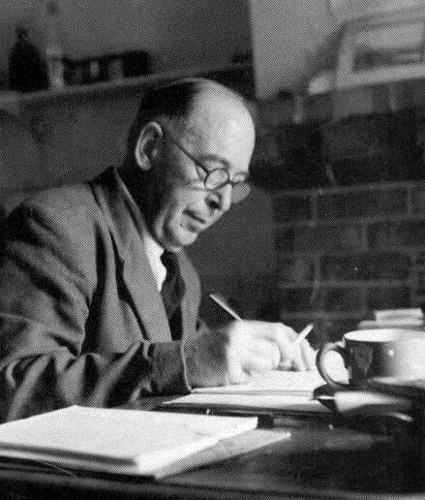
C. S. Lewis WritingReading Alan Jacobs’ biography of C. S. Lewis, I couldn’t help but imagine what it must have been like to listen to the man lecture.  Then I couldn’t help but remember how far most academic institutions have moved from a lecture environment.  Times change, or time changes things.  I feel it a bit myself every year when I find myself caring less about understanding the pop culture references (or lack thereof, oddly enough) of my students.  For writers like Lewis and Tolkien, the divide was much greater.  Lewis tried to acknowledge this in his first lecture at Cambridge.  From that lecture by Lewis, quoted in The Narnian:

I myself belong far more to that Old Western order than to yours.  I am going to claim that this, which in one way is a disqualification for my task, is yet in another a qualification.  The disqualification is obvious.  You don’t want to be lectured on Neanderthal Man by a Neanderthaler, still less on dinosaurs by a dinosaur.  And yet, is that the whole story?  If a live dinosaur dragged its slow length into the laboratory, would we not all look back as we fled?  What a chance to know at last how it really moved and looked and smelled and what noises it made?  And if the Neanderthaler could talk, then, though his lecturing technique might leave much to be desired, should we not almost certainly learn from him some things about him which the best modern anthropologist could never have told us?  He would tell us without knowing he was telling.  One thing to know: I would give a great deal to hear any ancient Athenian, even a stupid one, talking about Greek tragedy.  He would know in his bones so much that we seek in vain.  At any moment some chance phrase might, unknown to him, show us where modern scholarship had been on the wrong track for years.  Ladies and gentlemen, I stand before you somewhat as that Athenian might stand.  I read as a native texts that you must read as foreigners. . . .  It is my settled conviction that in order to read Old Western literature aright you must suspend most of the responses and unlearn most of the habits you have acquired in reading modern literature,  And because this is the judgement of a native, I claim that, even if the defence of my conviction is weak, the fact of my conviction is a historical datum to which you should give full weight.  That way, where I fail as a critic, I may yet be useful as a specimen.  I would even dare to go further.  Speaking not only for myself but for all other Old Western men whom you may meet, I would say, use your specimens while you can.  There are not going to be many more dinosaurs.

Posted in Books, Commonplace Book, Teaching | Tagged | Leave a comment

Goodbye, Glee

Somewhere in the transition between the first and second hour of Glee‘s two-hour finale I had a C. S. Lewis thought, a thought that was confirmed when the show’s second hour started with Will Schuester’s high school glee club coach reminding them that glee club wasn’t about winning something like nationals.  In the end, the coach said, glee club was about “being open to joy.”  That’s something that Lewis understood for most of his life.  And while most of what I saw from my time watching Glee wasn’t about joy, it still had its moments.

Like most viewers of the show, I started losing interest in the show during season two and mostly lost track of things throughout season three.  The show’s weaknesses were evident almost from the start, as this article from Vox asserts confidently.  But when I heard that the show was in its final, shortened season a few weeks ago, I thought I’d pay it the respect that I must admit it deserves.  Let’s face it, Glee holds a particularly weighty place, a particular moment, in our accelerated culture (remember when its covers of old songs topped the iTunes chart along with American Idol?  yeah.  You don’t see that happening anymore on either account).  The show was much like I left it: muddled, misdirected, and scattershot.  Its political agenda was stronger than ever.  And it had eschewed attempts at making the show about any new cast of characters (though the final set of new students wasn’t all that bad).  But the promise of an actual ending is always a draw for those of us who love story.

The finale was more Parks and Recreation than How I Met Your Mother or Lost: it gave long-time viewers what they most wanted.  The evening’s first episode was a flashback recounting how many of the first cast actually met.  It rightfully ended with “Don’t Stop Believing” from the pilot episode.  The second episode of the night was a flash-forward to how most of the original cast turned out, and things turned out well for pretty much everyone.  Everyone got a moment to shine.  After it all, it was a world of piano-band-back-up-choir on demand and the use of slightly awkward songs to convey particular emotions regardless of said awkward content.  How could that world end sadly?

It will be interesting to see how the show is remembered in the long run.  Like the author of the Vox article suggests, “The general consensus is that Glee‘s best season was its 22-episode first season, which is true. But I would go further than that. The best “season” of Glee is actually its first 13 episodes, produced in one chunk, before the last nine episodes of season one were produced later.”  Season two definitely had some good moments (I grow more and more fond of the “Grilled Cheesus” episode each time I watch it).  Still, as the article suggests, it was a show where “sacrifice was only illusory at best.”  If nothing else, it will remind us of just how good singing can be and how, regardless of the moment, maybe we can find some way to be open to joy, even if its seems illusive in a 44-minute network dramedy.

Posted in Internet, Music, Television | Leave a comment

Barry Allen: Time Lord

This week’s episode of The Flash was a doozy.  Over the course of two or three scenes, it moved the story of Barry Allen forward dramatically.  Cisco shot.  A tsunami poised to smash Central City.  Barry and Iris making peace with their feelings.  And the solution to that pending tsunami?  Run back and forth fast enough to stop it from hitting shore.  How fast?  Fast enough for Barry to make his first (and accidental) trip through time.  How far back?  To earlier in the episode.  And what a brilliant episode it was.

Time travel, as any fan of Doctor Who can attest, is a funny thing.  “Time can be rewritten” is a familiar refrain to fans of the Doctor.  Now we get to see if the same is true for the Flash.  I’m hoping that time travel doesn’t become a constant in Allen’s adventures.  I also hope it doesn’t become the easy way out for the writers, a way to have the cake and eat it, too.  Time reboots ultimately become plot cop-outs if they aren’t used wisely.  I think Barry will feel the weight of what he experienced but no one can remember much more heavily than a centuries-old Time Lord.  Here’s the preview for next week’s episode, “Rogue Time.”  Doctor Who, alas, won’t return until the fall.

Posted in Internet, Television | Tagged , | Leave a comment

On Reading the Bible

C. S. Lewis started his lecture, “De Audiendis Poetis,” with the assertion that “there are more ways than one of reading old books.”  What Lewis said to be true of many works of medieval literature is also and ultimately true of the Bible.  Consider this short clip featuring author Eugene Peterson:


I remember talking to a student just last year about how I had hopes that of all the books she had read in school, the one we hoped she would read again and again would be the Bible.  She laughed and said that once would be enough for her.

Reading the Bible is an odd thing.  I know many Christians who, assuming they read it, don’t talk about it very often.  And yet many get up in arms either defending it or their particular view of its nature without giving any real sense of its significance in day-to-day life.  I get asked about the particulars of the Bible occasionally (it’s part of my job), but I’d much rather talk about the stories and letters than particular words or phrases or interpretations (though I have started talking Hebrew terms with my Old Testament class, if only to remind them that the text itself is ancient and its culture different from our own).

I am convinced that we are on the verge of a Bible-less Christianity here in 21st century America.  The more culture shifts, the less we know what to do with it, which really is a shame.  I can’t help but believe that God has an awful lot to say with it, if only we would read and listen.

Posted in Books, Faith, Teaching | Leave a comment

Rebuilding Community

Community is a tricky thing, both fictitious and real.  Just ask the makers of NBC-now-Yahoo’s Community, starting its sixth season today with Yahoo’s Screen service.  If it happened to still be on NBC, it would be the final remnant of it’s Thursday night comedy block (at times with The Office, Parks and Recreation, and 30 Rock).  The show has basically been cancelled twice, lost its show-runner once, and had to deal with losing three original cast members.  Somehow, though, it has survived to have a season six (could a movie be next?).  The first two episodes are available now for free (and legally) here.  The show is still good, slightly crazed and meta.  We’ve got two new characters (“this is the new Shirley”), who might just be different enough to fit in well (and Abed’s take on that possibility is enjoyable to watch).  Both episodes hit the 25-minute mark, which is nice but could work against it, as the show works best when it is punchy.  Here’s the opening scene from the episode:


As always, Andy Greenwald has written a great piece about the new season.  He’s been a fan of the show for a long time and always brings a good critical eye to things.  You can check out his article here. And if you want to see how far the show has come (or gone astray, depending on your perspective), here’s a great scene from the show’s very first episode.  Like too much of life, when the clip goes too long, things just fall apart, the profound moment digresses into crass reality.

Posted in Internet, Television | Leave a comment

Spring Break Reading: 2015 Edition

BookshelfSpring break has sprung again, and I’ve got a nice stack of books to read through.

I’m one chapter shy of finishing Alan Jacobs’ biography of C. S. Lewis, The Narnian.  I’ve enjoyed the book quite a bit, though how it weaves in and out of events makes it feel a little less like a traditional biography.  It definitely has made me want to check out Lewis’ letters as well as revisit The Magician’s Nephew.

My non-fiction reading for the next bit includes Chip Dodd’s The Voice of the Heart (I quoted his thoughts on anger last week) and Wesley Hill’s Paul and the Trinity.  I’ve also started a slow read of Larry Crabb’s 66 Love Letters, which was actually the first book in about a decade that I didn’t read by Crabb. I’ve also got Putnam’s Bowling Alone on the back burner.  Not sure I’ll get far into it.

At some point this week I plan on getting back into Tolkien’s The Silmarillion.  That on requires real chunks of time that I’m hopeful the break will allow for.  I also just started Tom McCarthy’s Satin Island.  Reviews on the book have been good (I also read his Remainder years ago in a book group).  Jonathan Lethem also just released a collection of short stories that I thought I’d give a try.

Add in the Gospel of John and some rereads from a couple of books from earlier in the year, and we’ll see where the break takes me.  This list should make for a good couple of weeks.

Posted in Books | Leave a comment

Saturday Song: Listen to a Brand New Song

Posted in Faith, Internet, Music | Leave a comment

Quarter’s End, Find a Spot

The third quarter of the school year comes to a close today.  Time flies regardless of whether you’re having fun or not (and I’ve definitely enjoyed this semester).  If all goes well, I’ll get to leave the classroom today and my gradebook will be complete, which is a great thing.  And while I have a good bit of work to do over the break, I am looking forward to doing it at a different pace and in a different place.  I’ve got lots of little things lined up: dentist, dermatologist, and the like.  Hoping for lots of sleep, lots of reading, and working towards a sweet spot of rest and inspiration.  That hope reminded me of this scene from Zach Braff’s Wish I Was Here, which I still haven’t written about much.  This is a wonderfully-shot scene from early in the movie.  It’s about finding a spot.  Epiphanies, of course, are never guaranteed.  Sometimes, though, you find something even better.


I’ll share another scene from the movie next week. I’m still getting my ducks in a row about a topic near and dear to me that I hope to dive into soon.  For now, though, it is enough that the quarter, as good as it has been, is coming to an end.

Posted in Internet, Movies, Teaching, The Long Story | Leave a comment

The Difference Between Temporal and Eternal Things

From Augustine’s On Christian Teaching:

So there are these three things which all knowledge and prophecy serve: faith, hope, and love.  But faith will be replaced by the sight of visible reality, and hope by the real happiness which we shall attain, whereas love will actually increase when these things pass away.  If, through faith, we love what we cannot yet see, how much greater will our love be when we have begun to see!  And if, through hope, we love something that we have not yet attained, how much greater will our love be when we have attained it!  There is this important difference between temporal things and eternal things: something temporal is loved more before it is possessed, but will lose its appeal when attained, for it does not satisfy the soul, whose true and certain abode is eternity.  The eternal, on the other hand, is loved more passionately when obtained than when desired.  No one who desires it is allowed to think more highly of it than is warranted (it would then disappoint when found to be less impressive); but however high one’s expectations while on the way, one will find it even more impressive on arrival.

Posted in Commonplace Book | Leave a comment

Paging Bruce Banner

A friend recently shared with me some thoughts on anger from Chip Dodd’s The Voice of the Heart.  I’ve not quite thought about anger in this way before, but I like it:

Authentic anger is a caring feeling, telling us that something matters.  in fact, the energy of compassion is rooted in anger, the desire to make the pain we feel and see come to an end.

Anger exposes what we value and expresses our willingness to do what is required to reach that value.  It allows us to stay with our values, take sides, and even die for what we believe in.

Jesus, who turned the tables over in the temple and drove out thieves from a sacred place, experienced true anger.  He showed the vulnerability of full passion and compassion, the desire to make what had become rotten pure again.

Dodd has a lot more to say about anger, its roots, fruits and what happens when it is “impaired.”  As I read about anger, I couldn’t help but remember one of my favorite scenes from The Avengers concerning Bruce Banner.  I quote his line more than I probably should, but it’s a good one.

Posted in Books, Faith, Internet, Movies | Leave a comment