
Reflections on Mortal Goods by Ephraim Radner, Part Five
About a month ago, back with The Lord of the Rings was back in the theater, I posted some thoughts about the place of metaphors (a piece also inspired by something posted over at Mockingbird). A big part of what Radner is doing with Mortal Goods is attempting to present a constellation, perhaps, of guiding metaphors for Christians in the 21st century trying to live faithfully and, ultimately, politically. The post a month ago mentioned the metaphor of the pilgrim. Radner embraces pictures of the sojourner, the peasant, and the one who gives back to God what comes from Him, one who offers.
One thing I like about Radner’s disposition in the book is that he knows that being a sojourner, a holy peasant, one who offers, is not something that comes naturally: it must be taught. Radner often places himself at some level of opposition to Augustine in his thinking, but he does find a solid point of agreement with him in this:
This is where Augustine rightly focused his concerns as his pastoral career unfolded, even as the social scaffolding of his world began to crumble about him: one must teach offering; one must learn it. If the church has a peculiar political vocation, one that is just hers alone, perhaps it is this teaching and learning.
Radner sees this as a key part of pastoral work, but it is therefore more broadly to be true of the church in general: to teach and learn what it means to offer back to God these things He has given us.
And this is where Radner turns back to a wider swath of Scripture, particularly the Old Testament and New Testament narratives, which are full of people like (and unlike) you and me. (This is also a point where I feel a strong connection between Radner and the thoughts of N. T. Wright and Kevin Vanhoozer, who assert that Scripture teaches us how to live fittingly in God’s story.) And so we see what God has said through the lives of Adam and Eve, Moses and Miriam, Deborah and David, warts and all. Because (channeling early 21st century Donald Miller) that’s also the way story works. You see the struggle of the good and bad, you almost unconsciously put yourself in their places, put on their lives and decisions, and see what could and should have been done (and how God can use every last bit of it). Radner again:
We live among and as a set of mortal forms that are simply given us by God, and it is these we feebly order or are ordered by. The interplay between the two— God’s giving and our ordering— is disproportionate.
And (one of my favorite lines in the book so far:
. . . a beautiful life is one that the Scriptures somehow utter and whose utterances the human creature gratefully assumes.
Here Radner echoes the thoughts of Augustine:
. . . the truly good life of any Christian, navigating the miseries of this world as a pilgrim, lies in obediently ordering the love of God and neighbor in the course of mortality’s pinching environment.
The good life is a rightly ordered life, one whose affections have been adequately calibrated to God and everything that He has given.
The contemporary church, by the way, is full of guiding metaphors and mission and vision statements. And that’s “above and beyond” their confessions and creeds. At their best, these churches ask a certain kind of “ordering of life” from their congregants. Expressive individualism makes that tricker than it used to be, I imagine. And the explosion of a business/marketing mindset can also make a rightly ordered life trickier (particularly in the dynamic tension between God and the church, if that makes sense). Seeing Radner trying to help us slow down and understand our place in the bigger story is a good thing, a helpful way for us to make sense of the metaphors we live by.
 I do think it is a step, not quite a leap, to go from being somewhere to heading somewhere on Radner’s part, as he is particularly concerned with the here-and-now. But (he is aware that) the Biblical Story is full of movement: Abraham and Canaan, Moses and the Promised Land, a faithful family on the way to Jerusalem for a feast. So even in a stationary life, there is a pull of some kind of movement. Radner points to the Christian tradition’s image of “sojourning” as a way of understanding this movement, a way that is “both direction and posture, both of which are determined by a director and a form.”
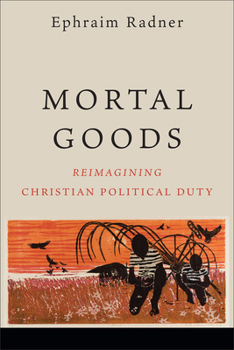 That thread from The Lord of the Rings is what comes to mind as I think about the first half of Ephraim Radner’s Mortal Goods. It is a book about knowing what you are fighting for, especially when there are competing scopes of importance. Radner suggests that the important things are the “mortal goods” of life, and that they are the things that proper politics should be about. Over these next couple of weeks of “ordinary time,” the plan is to write through some of Radner’s points from the book’s first half, which is all about “the good life.”
 As I mentioned earlier, this past weekend was a Lord of the Rings weekend. Regal at Dole Cannery was showing new remastered versions of the extended editions of the trilogy. While not my my first time seeing the extended editions in the theater (they finally released the extended The Return of the King last year, if I recall), it was my first time to see them all in succession in a theater. And it was highly enjoyable. Some thoughts about the extended movie trilogy as seen in theaters:


 Space Enough, and Time