Concerning Mortal Goods

Reflections on Mortal Goods by Ephraim Radner, Part One

The most unfortunate (but also necessary) cut that Peter Jackson’s team made to the cinematic version of The Lord of the Rings is, without a doubt, the scouring of the Shire.  In Jackson’s version of the LOTR ending, Frodo and his companions return to the Shire one year after their journey began, all clad in the refinement of the outside world.  They are met at first with odd glances but seem to assimilate easily back into daily life (with the exception of Frodo).  In Tolkien’s novel, the hobbits return only to find that Saruman and his henchmen have made an industrial wasteland of the Shire, leaving Frodo and his companions to lead a rebellion to save the Shire.  The whole tale, on could say, was to prepare the halflings for this final, home-front battle.

That was, after all, what the hobbits had left the Shire for in the first place.  And while the length in space and time of their journey grew, their hearts were never far from home.  That’s why Sam tries to remind Frodo of so many good, small things as they attempt to climb Mount Doom . . . and why it is tragic that Frodo has lost such memories because they have been displaced by Sauron’s Eye.  And while Jackson tried to make nods to the scouring (as with the mirror of Galadriel scene), it was just too much for the end of an already-long movie.  So some things that should not be forgotten can be lost, depending on the medium and how you understand what is important in life. To have saved the world and lost the Shire would have been too much for our heroes.  Those were always the stakes; the novel just reminds us how very real those stakes were.

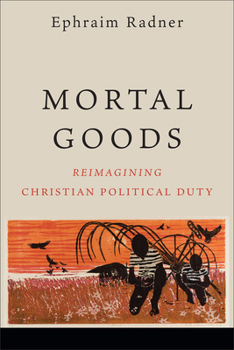
Mortal GoodsThat thread from The Lord of the Rings is what comes to mind as I think about the first half of Ephraim Radner’s Mortal Goods.  It is a book about knowing what you are fighting for, especially when there are competing scopes of importance.  Radner suggests that the important things are the “mortal goods” of life, and that they are the things that proper politics should be about.  Over these next couple of weeks of “ordinary time,” the plan is to write through some of Radner’s points from the book’s first half, which is all about “the good life.”

Radner’s book begins with age, illness, and Covid, which had become something of a great equalizer for most of us.  He found himself wanting to write a letter to his children that would communicate “a sense of what makes life valuable.”  He calls these things “goods that are part and parcel of mortal life, the life God has given us and that, in a sense, must be who we are if we are not to be God.”  These things, Radner asserts, demand our tending, even if we don’t quite know how.  Radner acknowledges that for many people throughout history, the arena of politics has been a way of caring for such things, at least until recently, when the aim of politics seems to have changed greatly.  The book’s argument seems simple:

If “politics,” in a general way, refers to the deliberate judgments and decisions ordering our corporate existence, then our Christian calling is to limit our politics to the boundaries of our actual created lives and to the goods that stake out these limits: our births, our parents, our siblings, our families, our growing, our brief persistence in life, our raising of children, our relations, our decline, our deaths.  These mark the goods of our lives along with the acts that sustain these good, like toil and joy, suffering, prayer, and giving thanks.  Christian politics is aimed at no more and no less than the tending of these “mortal goods.”

It’s worth noting that Radner sees two kinds of “big picture” politics.  The first is normal politics, which he defines as “playing one’s role in whatever system of governance one finds oneself living within, according to the rules of the system.”  This sounds to me like “peace-time politics.” The second is abnormal politics, when there is a threat that stands opposed to a system of “mortal goods.”  Such politics “is almost always engaged in the midst of and through the means of catastrophic realities.”  One could argue that we live in an era of abnormal politics, where catastrophe is experienced all the time by everyone, which is why it feels like everything is always up for grabs (and therefore we remain in panic mode).

As I mentioned earlier, the first half of Mortal Goods focuses on the context and scope of “the God-given good life.”  And while Radner deals regularly with New Testament texts and contexts, much of his overall argument is rooted in an interesting reading of the Old Testament, particularly with the Israelites between Egypt and the Promised Land.  While I don’t agree with everything Radner asserts, I do believe he has something important to say, if only to remind us, like Bilbo reminds Gandalf in the cinematic version of the story: “it is no bad thing to celebrate a simple life.”

Posted in Books, Church, Faith, Life in the Fifth Act, The Long Story | Tagged , | Leave a comment

Technology and Trust in the Classroom

While I am grateful for a break from school, my heart and mind are never far from the classroom.  As the teachers-only portion of the school year ended, I was already brainstorming ways to encourage students to as (better) questions.  Earlier this week, on getting a better sense of what my fall line would look like, I started imagining better ways to frame the content of a course I have not taught in some time.  And yesterday my mind turned to my junior-level class, which includes the reading of How to Think by Alan Jacobs.

Jacobs occasionally writes for The Hedgehog Review, which makes a point of reflection on contemporary culture.  And that often includes things at the intersection of technology and education, which Jacobs has said a lot about.  Yesterday’s post by Jacobs had to do with student writing and the technological advances that make writing with integrity difficult.  Such technologies, chatbots in particular, are inspiring a greater and greater “vanishing of trust” between teachers and students, something he as tried hard to work against:

I don’t like this collapse of trust; I don’t like being in a technological arms race with my students. So over the years I have developed a series of eccentric assignments. These days I rarely assign the traditional thesis essay—an assignment I always hated anyway, because it makes both the writing and the grading utterly mechanical—but instead assign dialogues between two literary theorists, or an imaginary correspondence between two novelists, or just an old-fashioned textual explication: Take this passage and explain to me, I ask them, without paraphrase, what it’s doing, what’s going on in it. And those assignments have, as it were, taken us back in time, back to the time when commissioning was expensive and therefore rare: the online paper mills, after all, don’t have a stack of conversations about The Brothers Karamazov featuring Dostoevsky and Jane Austen. It’s been a very successful strategy… until now.

I have thought deeply for some time now about how I encourage students to read (both How to Think junior year and then Mere Christianity in senior year) and reflect on what they have read.  The struggle has included making most of the reading take place in class and then having students complete reading journals in class.  Sometimes it works; sometimes it becomes oddly burdensome for everyone, especially when students are absent.  And while I don’t think my students are yet prone to use outside AI programs for the readings, it’s always a possibility (which is why the paraphrase thing is both necessary and tricky).

I do like Jacobs’s idea of “eccentric assignments,” though I often use those more for lecture material than for reading assignments.  Maybe there’s something to be said for putting those two parts of the course into greater contact with one another?

The piece ends with two possible ways forward.  The first is where many of us in education are currently landing (for good and bad).  The second is more hopeful but also more of a challenge:

The second possibility requires great courage, a courage I am not sure I possess. I am moved to consider it by reflecting on something T. S. Eliot wrote in 1944, a sentence I often have reason to quote: “Not least of the effects of industrialism is that we become mechanized in mind, and consequently attempt to provide solutions in terms of engineering, for problems which are essentially problems of life.” With this sentence in mind—or rather, with the evident truth the sentence points to in mind—I could simply make the assignments that I believe best suited to what I want my students to learn, and then turn to them and ask: “What are the ‘problems of life’ that incline so many of you to turn to the chatbots rather than do these assignments?” If I could get honest answers to that question, then we all might be in deeper waters than we’re prepared for. But maybe the deeper waters are precisely what university education should be aiming for.

You can read all of the post here.  And you can follow Jacobs’s blog here.

Posted in Books, Internet, Teaching | Tagged | Leave a comment

On Space and Time

Every now and then, things line up and I come across different internet posts that deal with the topics mentioned in this site’s title: space and time.

Seth Godin recently shared his thoughts on the difference between a boundary and a limit.  (It’s always interesting to see where people draw lines with similar concepts.)  Godin asserts that the two concepts “serve different purposes.”  He writes:

Boundaries can give us room to innovate and thrive. Budgets, schedules and specifications all exist to show us where the safe areas are.  Sure, go to the edges and challenge the boundaries, that’s why they’re there.

But limits aren’t boundaries. Limits are the end, the danger zone, the thing to avoid.

I like the distinction.  “Limit” has a bite to it that “boundary” doesn’t.  The potentially frustrating thing is when communication is lacking and boundaries and limits are blurred and you are punished for pushing a limit that you thought was a boundary.  It would be an interesting thought exercise for those in leadership to think through the distinction in concrete ways.

In his June 16, 2024 “Notebook” entry titled “Having Time,” Bishop Erik Varden shared a quote from Mother Maria Gysi about time:

Time is so little connected with actual work. It is something quite different, I believe. It is the absence, or relative absence, of pressure on the mind.’

Varden agrees, saying that “the secret is to learn to resist the pressure, or to let it, I suppose, just pass through one.”

I like the thought.  Because it really is the “pressure on the mind” that you feel that makes the work work.  I suppose things done as a result of procrastination are good pictures of this.  To be able to work without that pressure may be a rare gift.

Posted in Internet, Organizations and Institutions, Teaching | Leave a comment

Just As I Am [June 17, 2024]

I’m about a week and a half into summer break.  I try to do the sensible, mature thing and use this kind of time for responsible things like medical appointments and such.  Today was my visit to the optometrist, where everything was fine- no reading glasses yet, though it’s closer now than last time.  Last week was an oil change for the car and a doctor’s visit and bloodwork.  I’ve tried these last two years to be more intentional about these things (previously I’ve been most consistent with dermatologist and dentist- it was time to expand, I think).

Beyond that, I’ve tried to maintain some kind of routine with some success.  Most weekday mornings I go to the gym just like during the school year.  Come home, clean up, and then head out for a simple breakfast and quiet time before heading over to the state library to do some reading and writing.  I try to hit my favorite downtown spots for lunch during break, as they aren’t really options during the school year.  Today it was the chicken salad sandwich at the Hulu Deli down by the main post office.  The afternoons have been for errands or more writing.  Some of that writing includes note-taking from recent non-fiction.

I decided last week to listen to whole albums as I walk downtown each morning.  I decided to start with the music of Andrew Peterson since it is well-known and appropriately upbeat and thoughtful for the season.  I was once again reminded of this wonderful song from his 2003 album, Love & Thunder. The song title, also the title of a great hymn, will now be used for these more “week-in-review” type posts.

Other than that, I’ve been rewatching the short-lived sci-fi western Firefly on Hulu and Spaced, one of my all-time favorite sitcoms now on Roku.  I did finish Moonbound by Robin Sloan.  It is a wonderful book that turns left when you often think it will turn right.  Sloan really has created a modern sci-fi masterpiece with the adventure of Ariel de la Sauvage in a world 11,000 years in the future.

I have been called back into work a couple of times since the last day of the semester.  Mostly interview stuff with some department business mixed in.  Hoping to get most work stuff taken care of before heading to the mainland in a couple of weeks.

Posted in Just As I Am | Leave a comment

One More LOTR Post for the Week!

I did not plan on there being so much Lord of the Rings content on the site this week, but I’ve got one more LOTR post to round things out.  A few weeks ago, Amazon dropped the teaser trailer for season two of The Rings of Power.  I wrote a bit about it here.  I finally got around to watching the Nerd of the Rings breakdown of the trailer (who knew you could say so much about so small a thing?).  It’s a fascinating watch. Spoilers, obviously.  

It is worth reiterating the point made in the video that a number of these scenes could come from visions and dreams, which mean they don’t necessarily reveal much at all.  I agree with the creator: let’s not make the Stranger Gandalf.  There are other, more interesting, stories to tell at this point.  I get the sense, though, that they are going to do their best to pack a lot into this season.  I’ve half a mind to go back and watch season one before the August drop-date for season two.  We’ll see.

Posted in Uncategorized | Leave a comment

Revisiting the Ring

LOTRAs I mentioned earlier, this past weekend was a Lord of the Rings weekend.  Regal at Dole Cannery was showing new remastered versions of the extended editions of the trilogy.  While not my my first time seeing the extended editions in the theater (they finally released the extended The Return of the King last year, if I recall), it was my first time to see them all in succession in a theater.  And it was highly enjoyable.  Some thoughts about the extended movie trilogy as seen in theaters:
+ The Fellowship of the Ring is still the best.  The extended scenes flow perfectly.  Granted, this is the extended version that I’ve seen the most.  I also take some joy in seeing movie locations that I visited years ago while in New Zealand that only appear in the extended version.

+ It was interesting to watch FOTR post-Rings of Power season one.  While I don’t think it’s necessary to see ROP Galadriel as the same as the one in Peter Jackson’s work, seeing Blanchett’s moment at the Mirror with Frodo did have more “historical” depth than I had expected.

+ The extended edition of The Two Towers makes for a better story, but not necessarily a better movie.  The additions of the struggle in Rohan add some great context.  The Fangorn Forest additions are nice and welcome, as are the extended scenes with the elves.  I got a better sense of what Jackson was going for by adding the elves to Helm’s Deep.  It’s funny, though: in the theatrical release, I felt like everything was too Helm’s Deep-centric.  This time, it felt like way too much time was spent actually getting to that final battle.

+ I’m not a big fan of Arargorn’s arc in TTT, particularly after he is dragged off the cliff.  But I will say that this clip with Eowyn (and Gimli) is still hilarious all these years later:

+ I did think the Faramir additions in the last half of the movie were nice additions, even though I do think they get Faramir almost completely wrong.  I had forgotten how much of this material was added into the extended edition.  And we even get a pre-ROTK appearance from Denethor, which I had forgotten about.

+ By the time watching The Return of the King rolled around, I found myself most interested in paying attention to the pacing of the story, especially how Jackson toggled between events inside and outside of Mordor.  The pacing held up really well.  And I didn’t mind the slower cadence of Aragorn and Frodo in the closing scenes.  In fact, the whole unending-epilogue feeling of previous viewings was lessened overall, which was nice.

I did have one recurring thought throughout each viewing: that Peter Jackson did so well with so much of the material is utterly amazing.  So many great shots that have become iconic.  So many great visuals that toggled from broad vistas to character close-ups.  So many things were put together perfectly.  It’s funny, I felt that instantly about Avengers: Infinity War (which never should have worked out as well as it did) and then again with Avengers: Endgame (to a lesser extent).  But this just confirmed that Peter Jackson did it first and best.

It will be interesting to see how often movie theaters brings these movies back. Harry Potter shows up every few years.  I get the sense that might happen often with some Marvel movies (particularly Spider-Man).  I can’t imagine the Hobbit movies will ever get this treatment (and I firmly believe the extended versions make those movies better, too).  But I think once every five or ten years would be great for these movies.  Time will tell.  It really was nice, though, getting to revisit the ring like this.

Posted in Movies | Tagged | Leave a comment

Lord of the Metaphors?

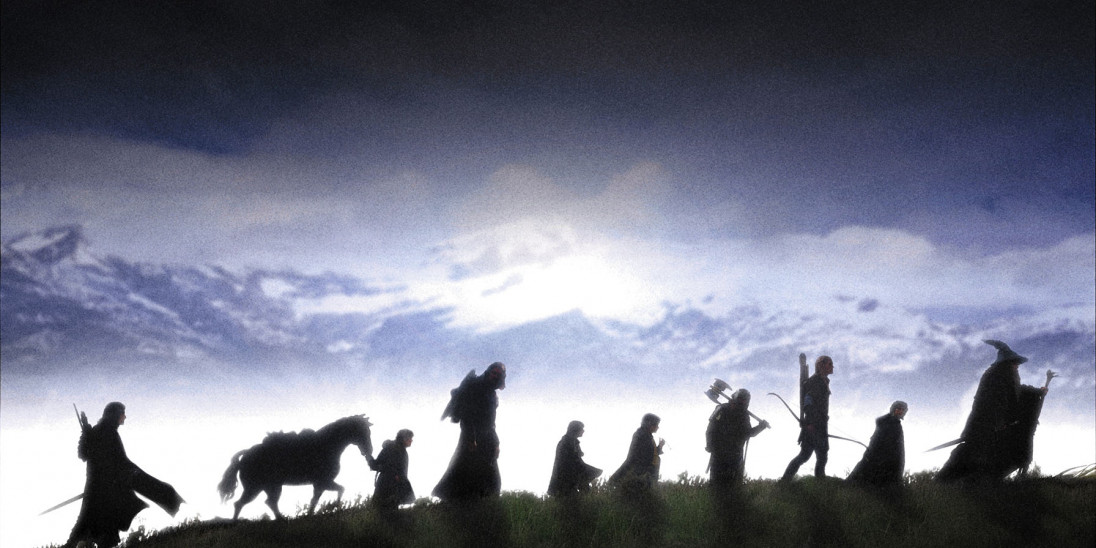
FellowshipIt’s been a Lord of the Rings weekend here, as the Cannery has been playing the extended versions of the trilogy one per day.  And while I have thoughts on watching the series again, I think the timing of the screenings match up nicely with this piece by Sam Bush over at Mockingbird about the life-as-journey metaphor (since it name-checks the story).

Metaphors are, of course, a big deal.  There’s a nice chunk of How to Think by Alan Jacobs that speaks to the significance of unacknowledged metaphors and their power over us (just as they also give us power to make sense of life).  Bush’s concern is that we have bought too much stock from the “life is a journey” metaphor, Christians as much as anyone else.  After mentioning John Bunyan as “the progenitor of the Christian faith narrative,” Bush writes:

For instance, many Christians today view their own sanctification as a long process in which, over time, virtues are cultivated through the work of the Spirit. Call it a “journey of justification,” if you will. As you traverse through the perilous Valley of Adolescence and through the wicked city of College, you are expected to come out unscathed or at least find your way back to the trail. Just pray that you don’t get lost in the Desert of Doubt, where many people don’t make it out alive.

Christians, therefore, have fallen prey to the pitfalls of the journey story as much as the rest of the world. If the task, as pilgrims, is to read the road signs and make the right choices, we are no different than the weight loss gurus and influencers offering to guide you through their journey of spa vacations.

Warning acknowledged, though I do think those considering themselves “pilgrims” are looking out for something other than gurus and spa vacations.

One of the best bits of the essay is given in the title and then not mentioned again until the end of the piece.  After mentioning the changing metaphors used when describing cancer, Bush notes:

In the words of Paul Zahl, life is not a journey, but a train wreck. We may buy ourselves a ticket, climb aboard, and imagine the distant places of our dreams, but we are almost always derailed.

Definitely a true statement, an apt metaphor.  He then debriefs the assertion with the reminder of our need for rescue in the Christian story.  It’s a good reminder of where we started and the landscape of where we have to go in our mortal lives.

While I appreciate the piece, I’m not totally sold on ditching the journey metaphor.  If anything, perhaps, it needs rehabilitation.  My least favorite take on life-as-journey is when someone says “it’s about the journey, not the destination.”  That’s pure hogswallop.  That’s wilderness without Promised Land and a mark of rebellion.  I think, in the long run, we are all of us looking for a guiding metaphor that takes in both the train wreck and whatever forward motion we get after the rescue.  Rescue is there, for sure, but there is also the drudge, trudge, and even joy of the road before us.

(image from mavnewspaper.com)

Posted in Books, Faith, Movies, The Long Story | Tagged | Leave a comment

Parting Glances, Parting Shots

I celebrated the first official day of summer vacation yesterday by . . . going to work.  There was an almost-last-minute request to sit in on some interviews that I couldn’t/shouldn’t turn down.  In a way, interviews are always interesting to me.  I did walk away from yesterday’s time thinking that everyone should have to re-interview for their own job every few years, if only to try and speak more clearly and honestly than the constant forward motion of the regular year allows.

+ + + + + + +

I’m not sure how I would describe this school year.  Not bad, for sure.  There were a few unanticipated things that shaped the year, that were really threads more than specific moments.  I decided this morning to keep a simple “work journal” in Google Docs, because I do want to learn from my experiences.  I definitely enjoy the classroom most.  When that goes poorly, nothing goes well.

+ + + + + + +

These last few weeks I’ve been slogging through The Diary of a Country Priest by Georges Bernanos.  Somehow I came across a copy of it a few years ago but never got to it.  I thought it might be a fitting read for the beginning of “ordinary time.”  And while I still hold to that, it’s definitely slower than I anticipated.  Lots of long speeches from various figures in the villages the lead character serves as priest.

This morning I came across something that points to why I acquired/kept the book for so long.  It’s mentioned in passing in Ephraim Radner’s A Time to Keep, which I was thinking about before diving deeper into his most recent book, Mortal Goods.  The name-drop happens in the chapter titled “The Arc of Life,” which I also revisited this week in preparation for a meeting with the English department because of how Radner’s brings in the “all the world’s a stage” speech from As You Like It as a way of thinking about, well, the “arc of life.”

+ + + + + + +

In preparation for that meeting with the English department (my own department had our final meeting earlier in the week), I ended up tracking down work from the faith and literature class I taught a couple off times about a decade ago.  It was a brief-but-fun revisit that reminded me of some of the deep threads in my own life with it comes to literature and faith.  Some of the books and passages I taught in the class are still amongst my favorites.  Part of me would love to teach the class again; part of me knows that now is not the time for that.

+ + + + + + +

I’m grateful for this now-closed school year.  The trip to England and Scotland back in October feels like a million years ago.  It’s a trip that I love that I will likely never run again.  And I had a good (in my opinion) semester with my seniors.  I think I can trace some of the work of God throughout these last few months, as much in “clearing the table” for me as in “setting the table” for whatever is next.

I’ve already set my “out for the summer” email response, a reminder to myself (if no one else) that there is a time and place for everything and that all time is not work time.  But I will think about work some, will likely even visit my classroom a few times to make sure some things are in place for the end of July, which feels like it comes earlier every year.

Posted in Books, Faith, Teaching | Leave a comment

In the Middle

I’ve been thinking about this recent post from Seth Godin a good bit for the last few days.  I’ve even referenced it once or twice with friends.  It’s not a particularly new thought, but I agree with Godin that we’re seeing something on a larger, more significant scale for our culture than we’re used to.  And as someone who loves going to the movies (and loves browsing “record stores”), I feel the loss and the bewilderment.  The thing is, there are other major cultural shifts happening at the same time, which can make it doubly frustrating.  Because “digital native” is only one major shift, one perspective that can catch many of us off our guard.  

What it means to navigate culture in general is getting trickier and trickier.  And even though the internet makes it seem like things last forever, things still won’t quite be the same.  One danger is that you start sounding like the proverbial “old fogey.”  One hope is that maybe those who come after us will understand, appreciate, and even revitalize older ways of being.  But that will likely only happen in pockets, since the broader culture has no brake system and limited steering.  

Posted in Internet, Movies, Television | Leave a comment

“A List of Non-Negotiables”

Speaking of television anticipation, we’re just a few weeks away from the third season of The Bear.  Anxiety-inducing television has never been so beautiful, I think.  At its best in season two, the show rivaled and maybe surpassed Ted Lasso at its best (and Ted Lasso got lots of moments right).  This season looks to be the same.  Check out the trailer below.

Posted in Television | Leave a comment