Parks and Remembrance: Catching Your Dream

Leslie Knopes’ 2012 campaign was one of the storyline highlights for Parks & Recreation.  Thankfully, Andy’s band, Mouse Rat, was there to write and perform the campaign anthem.  Here’s the video for the song, which includes some nice moments from the campaign.


Shackle it to your heart, indeed.

Posted in Internet, Television | Leave a comment

Parks and Remembrance: Relational at the Core

A few weeks ago I mentioned a moment from this season of Parks & Recreation that captured something vital to understanding culture, community, and relationships.  NBC made that particular scene available on YouTube.  I thought I’d share it in light of the show’s series finale coming up this Tuesday.  It’s a great picture of the relationship that really was the heart of the show, that of optimistic Leslie Knope and crotchety Ron Swanson.

Posted in Internet, Television | Leave a comment

Saturday Song: “We are people born of sound . . .”

I recently started a reread of Tolkien’s Silmarillion.  The first section, which recounts the creation of the world, is beautiful.  It involves the creation of all things through music.  Genesis 1 also speaks of the creation of the world, this time with the inspired image of creation through a spoken word from the Creator.  Then, in Genesis 2, we get an inspired picture of mankind created from dust and full of the breath of life which comes from God alone.  So when I heard U2’s “Breathe” again a few days ago, the listening experience was much richer than the last time.  Here’s the song as the band played it for Letterman back in 2009.

Posted in Books, Faith, Music | Leave a comment

Your Friday Afternoon Moment of Culinary Zen

I’m a sucker for the Muppets and things connected with Jim Henson, so I was intrigued by a recent post to Relevant Magazine concerning Cookie Monster and “food epiphanies.”  It was put together with Mashable and reddit.  As the title suggests, it is “simply delicious.”  “The sushi of desserts,” indeed.

Posted in Internet, Television | Leave a comment

Holding It Together

Scary Close CoverIt can be a strange thing, being a Christian among Christians.  Christianity seems to mean something different to everyone I meet these days.  And if it means something similar, there’s no guarantee that similar meaning will also have similar expression.  This is one reason, I think, why I read books about the faith: to find some handle or common language that can be used in the community I find myself in (which is interesting because the New Testament is full of quality wording, but I digress).

So I was really surprised at how moved I was by the penultimate image in Donald Miller’s Scary Close when it comes to talking about the faith.  I know he’s using the image in connection with his wife.  But anyone who’s read something from C. S. Lewis knows that it’s bigger than that, that’s it’s really something deep and supernaturally human about longing.  From Miller:

What differentiates true Christianity from the pulp many people buy into is that Jesus never offers that completion [a “you complete me” type scenario] here on earth.  He only asks us to trust him and follow him to the metaphorical wedding we will experience in heaven . . .  The more I thought about it, the more the Bible made sense.  Early followers of Jesus experienced pain and trial and frustration, hardly the romantic life.  But they consoled each other and took care of each other and comforted each other in the longing.

It’s the longing created by and met by Jesus that we hold between us.  And it is that common experience, that common hope, that common longing, that we hold together . . . and that ultimately holds us together.  Church talk and missions talk and vocation talk and education talk, as important as they may be, can only hold things together for so long.  They are weak sauce compared to the love and longing for Jesus.  Miller understands that as central to his own experience and has chosen his wife to share it with.

Which is great . . . but I don’t think it’s a spouses-only phenomena.  Because in theory, at least, it is a key part of all Christian experience.

* * * * * * * * * *

I’m thinking that I didn’t do Miller’s latest book much justice in these post for the last two weeks.  I think, though, that it’s given me fodder and encouragement enough move on with a bit of confidence in the ways that God is leading me these days.  I’m sure I’ll revisit many of Miller’s thoughts (both mentioned here and not) later on.  It’s the kind of book that sits with you for a while.  If you happen to read the book, let me know what you think.  It would be nice to hold that together for a while.

Posted in Reading Scary Close | Leave a comment

Risky Business Revisited

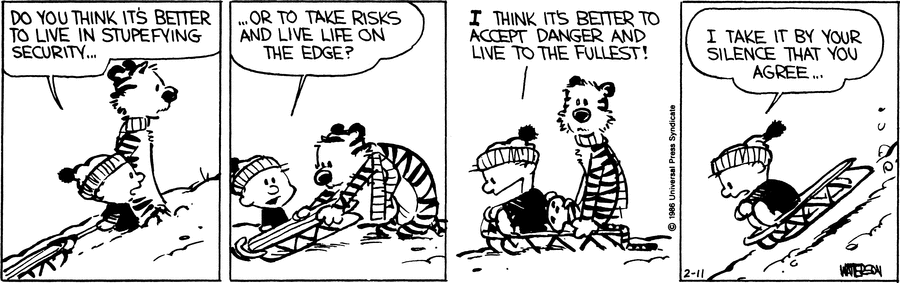
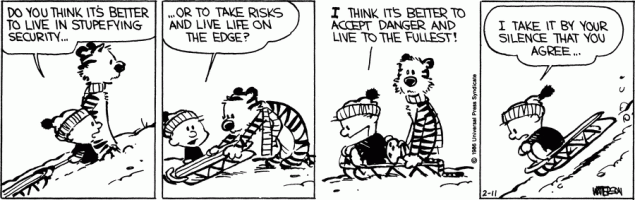
Calvin on RiskOne of the things that I’ve had to keep in mind while reading Donald Miller books over the years is that as a writer, he often works alone.  I know that’s not totally true, though.  He has editors, first readers, critics, and fans that he probably has a strong sense of responsibility for or connection to.  I also know that it’s a little different when you work in a place with dozens  . . . or even hundreds . . . of people, often over the course of each day, and five days each week.  It does something to you, living and working as part of an organization or institution.  I’m keenly aware of the fact that I have become much more of an institutionalized self over the last few years.  So I read Miller’s chapter on “the risk of being careful” with great interest and a strong sense of culpability.

Miller writes of the time he spent in Washington, DC, and how he found himself interacting with others in a way that went against the grain of the culture: “I always felt two whiskeys in while everybody I talked to was as polished as a news anchor.  I kept looking for cameras.”  That’s not an easy thing to handle when you’re used to a certain amount of vulnerability and candidness.  But when you live under a microscope, or when you come to be a representative for something bigger than yourself, the freedom to take risks diminishes.  Too much seems to be at stake.  And so play it safe, and safe has a way of scaling.

Miller writes of the time where he decided, after honest words with a friend, to write again with a sense of risk.  And I remember those moments on his blog where he said controversial things (like his discussion about church-going).  And I read the flak that he got in the comments section . . . and the support he received.  And while I may not always agree with him (or anyone else, for that matter), I have come to a better understanding of (1) the fluid nature of blogging [where everything is always in process] and (2) the fact that we as individuals can always be in process.  As such, we can’t be afraid to risk.  We should always strive to try.  Miller decided to write “as though God thought [his] voice mattered.”  He even made a list of a few things he wanted to feel more freedom in as he worked: the willingness to sound dumb, be wrong, and to express a theory are a few excerpts from the list.

It’s strange, the relationship between identity, institution, and predictability.  You can often be welcomed into the fold of a group or organization because you bring something new or different to the table.  Over time, though, the new and different becomes the predictable and expected.  It’s an inadvertent complacency.  To break out of that odd rut is no small thing (and potentially not something to be undertaken lightly or glibly).  It’s something I’m working on, something hopefully evidenced in a renewed commitment to post something on this site regularly . . . and with something more personal than just a comic strip or video.  I hope to show you evidence of some of my most recent “theories” next week.  But tomorrow will bring my last official “Reading Scary Close” post, my thoughts on the last main image from the book.  Good stuff.  Thanks for reading!

Posted in Reading Scary Close | Leave a comment

Catching Up with Yourself

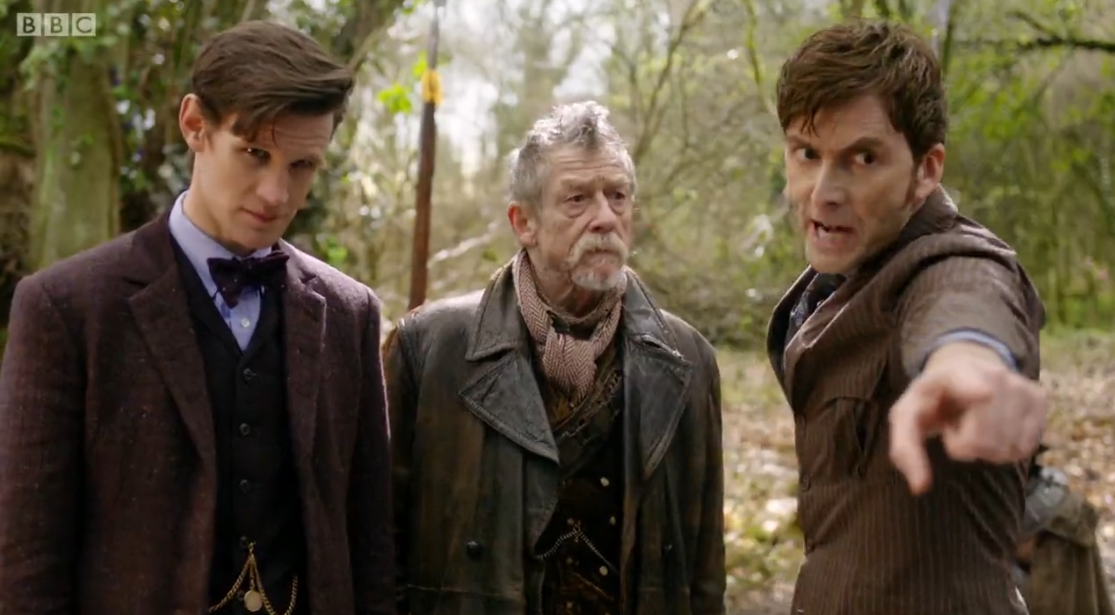
Three DoctorsOne of my favorite “story cycles” in Scary Close begins in the chapter wonderfully titled “Everybody’s Got a Story, and It’s Not the One They’re Telling.”  That part of the book deals with Miller’s struggles with childhood insecurity and self-preservation as he makes peace with his younger self.  It’s an odd mix for Miller, who realizes much of what he has become was a means of protecting that part of himself that first felt shame (“a dog peed on my coat”) while also realizing that for years he had been “sending a nine-year-old out to do all [his] performing.”  People really are amazing complicated, aren’t they?

It’s an interesting question: what do we do with our (many) selves?  We have them based on age, on interests, on geographical location.  I’ve even noticed that I have a differently nuanced self for each class that graduates (if that makes any sense).  And it’s easy to lose yourself in the mix.  I don’t mean “true self” necessarily.  But I do mean that deep and untouchable you, untouchable except for the God who made you.  That part of you that is “hidden in Christ.”  I can’t help but think of one of my favorite fictional characters, the Doctor.  From the moment we meet him (in his 9th incarnation, at least), he is on the run: from his enemies, from his recent past, and from himself.  It really isn’t until the 50th anniversary special, The Day of the Doctor, that he (quite literally) catches up with himself.  The moment is significant and amazing.

From Miller on making peace with that nine-year-old performing self:

The moment was powerful for me.  I’d completely disassociated from the kid who had taken apart his tape recorder.  I hardly knew him.  I’d not raised him to maturity and he’d spent the last thirty years lonely and desperate for attention.  It’s no wonder I hid from the world.  It’s not wonder parties made me tired or I got exhausted after I spoke.  It’s not wonder criticism made me angry or I overreacted to failure.  I think the part of me I sent out to interact with the world was, in some ways, underdeveloped, still trying to be bigger and smarter as a measure of survival.

Heaven help us catch up with ourselves, not to leave our selves behind.  And thank you, Jesus, for reconciling all things.

Posted in Reading Scary Close | Leave a comment

Safe People, Risky Business

Katniss in Mockingjay for NYTimesOne of the benefits of reading is that it helps you find yourself, identify yourself through what you read. Here’s a point where I identified with Miller early in Scary Close:

At some point, I just stopped trusting people. I began to believe everybody viewed life as a contest, a subtle version of the Hunger Games. And to some degree I bought into the lie.

One of the things that angers me (rightly) about The Hunger Games is the sense of implication you get from every single person in the story. Striving to do good means selling out in some way. That includes me. The struggle, then, becomes extricating yourself from the “game” and moving to a better disposition.

Miller spends a good amount of time talking about manipulative people: scorekeepers, judges, false heroes, fearmongers, and floppers. If you’re anything like me, you are one of those each day of the work-week. Then Miller turns his attention to the better way to be: the safe person. These people, like Miller’s wife and friend David, are “truth tellers,” they offer grace, “the kind of grace in which they assume I’m a really great guy who’s just trying to figure things out, and they politely show me the error of my ways.” A safe person, Miller says through the view of authors Cloud and Townsend, is “somebody who speaks the truth in grace.”

I’m still trying to move away from a Hunger Games version of life. I’ve got my own idea of that that kind of life can look like, and I’ll get around to sharing it next week. When your implicated in a rigged game, and the Hunger Games view of life is definitely rigged, it takes both subtle and bold moves to get to a healthier place. That’s something reading Scary Close has reminded me of.

Posted in Reading Scary Close | Leave a comment

The Present Form of the Future

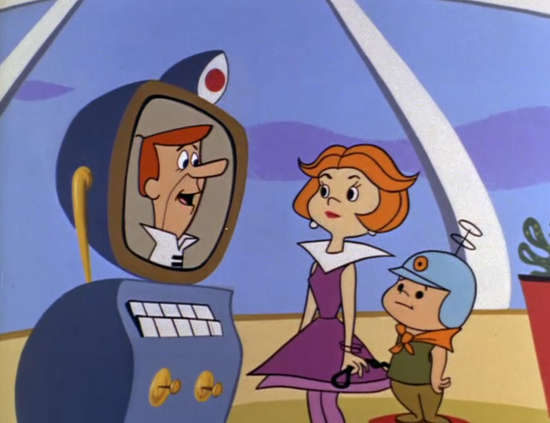
Jetsons from Smithsonian MagazineIt often seems like Douglas Coupland feels things before we do and finds some way to name things well.  From his most recent Financial Times essay:

I’ve spent much of my life waiting for the future to happen, yet it never really felt like we were there. And then, in this past year, it’s become almost instantly and impossible to deny that we are now all, magically and collectively, living in that far-off place we once called the future — and we all know we’re inside it, too. It’s here, and it feels odd. It feels like that magical moment when someone has pulled a practical joke on you but you haven’t quite realised it yet. We keep on waiting for the reveal but the reveal is never going to happen. The reveal is always going to be imminent but it will never quite happen. That’s the future.

I think there are other things that nudge me into feeling that I’m part of the future, usually things like environmental, public health, and cultural concerns, which may mean that I’ve spent too much time in imaginary worlds.  And yet.

But here we are, walking around with super-powered phones, flying across oceans frequently, living is a way-too abstract world.  And, for Coupland at least, it’s a world that is always just about to emerge.  From near the end of the essay:

I try to imagine a world without a present tense — the millennial world where time is a perpetual five seconds from now — and, if I squint my brain (for lack of a better analogy), I can almost sort of get it right. I suspect that abandoning one’s pre-internet brain is the only intelligent adaptive strategy necessary for mental health in the world of a perpetual future.

I’m not sure how I feel about Coupland’s conclusion, but then I’m not sure how much of that is up to me.  I suppose the future is here whether I like it or not.  I wouldn’t necessarily go so far as to say that I just have to live with it, but I definitely have to live in it.

You can read the entirety of Coupland’s essay here.

Posted in Internet | Leave a comment

Saturday Song: Brother’s Keeper

This week I’ve been listening to Rich Mullins’ Brother’s Keeper.  The title track is succinct and wonderfully pointed at something I find extremely difficult but somehow necessary.  “Unless you’re pointing to the truth,” indeed.

Posted in Faith, Music | Tagged | Leave a comment