Peter’s Clarifying Question

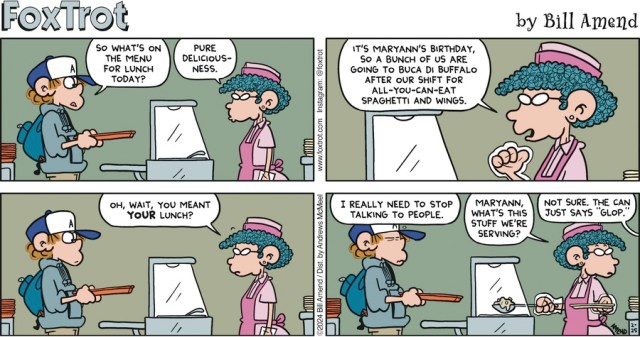
Ah, Peter.  It is always good to be specific when you ask a question that is easily misinterpreted!  Otherwise, a clarifying question is necessary.  This Sunday’s FoxTrot by Bill Amend:

FoxTrot Clarifying Question(image from gocomics.com)

Posted in Uncategorized | Leave a comment

Wilderness Training

The first (and perhaps primary) image of Lent is of Jesus’s temptation in the wilderness.  It’s a moment in time that three of the four Gospels capture, a hinge moment between Jesus’ baptism by John and the beginning of His ministry.  Unlike the Matthew and Luke, Mark keeps it brief:

At once the Spirit sent him out into the wilderness, 13 and he was in the wilderness forty days, being tempted  by Satan. He was with the wild animals, and angels attended him. [Mark 1:12-13]

Hans Boersma recently posted a piece about Jesus’ time of temptation in the wilderness.  He starts:

It is meet and right that Lent should start with Matthew 4. Its first sentence sums up not just Lent but the entire Christian life. “Then was Jesus led up of the Spirit into the wilderness to be tempted by the devil” (Matt. 4:1). We may apply this to ourselves: “Then was I led up of the Spirit into the wilderness to be tempted by the devil.” Our brief span of life is the wilderness. The Spirit himself has led us here. His purpose is that we be tempted by the devil.

From the get-go, Boersma pulls no punches: that last sentence feels a little reductionistic to me.  But then he unpacks things a bit more:

This sentence contains a great mystery: Why would God himself—the Holy Spirit—lead us into this world so that we might be tempted by the devil? I cannot solve this mystery, for God’s mysteries are not like puzzles. They cannot be solved; they are meant to be lived instead.

I like that last sentence much more.  It reminds me of a quote from somewhere in my past, when someone suggested that we live out lives as answers to the big questions.

Following the lines of Matthew and Luke, Boersma brings in the three temptations Jesus faces: provision, protection, and power, or as he later paraphrases for us: My bread, my safety, my status.

The whole piece by Boersma is worth the read.  It’s a sobering reminder that life in the wilderness is a picture of life in this world including but beyond a season like Lent.  And he reminds us that Jesus is in the wilderness with us.  I would add that, in this part of the Biblical Story, we are in this wilderness world together, which is no small thing either.

A closing line from the piece:

Letup comes only after the forty days are over—at the end of our worldly wilderness. This is the last verse of the temptation narrative: “Then the devil leaveth him, and behold, angels came and ministered unto him” (Matt. 4:11). Yes, temptation will give way to consolation, the wilderness will make room for paradise, and the devil will shrink back when angels come to minister. This is the great promise that the story holds out to us: Temptations will certainly end.

Later this week I’ll post my second reflection on Varden’s The Shattering of Loneliness as the season leading up to Easter continues.

Posted in Church, Faith, Life in the Fifth Act | Leave a comment

Doubts and Ladders

This week my department started discussing Matthew Lee Anderson’s Called in Questions, which is about the importance of asking questions in the Christian life.  We had a good conversation about the first chapter or so, with opinions about the place of questioning in and of the faith covering the spectrum.

This week over at Christianity Today, Brad East (of Abilene Christian University) posted a piece about doubt and the asking of questions that has been a nice continuation of the conversation for me.  East builds a great “argument” about the odd place of doubt in the life of the church and faith and does a quality redirect asserting another way to think about the issue: not just faith but faithfulness to a person, Jesus.  A quality quote:

What makes Christianity hard is faith, albeit not in the sense many of us expect. For too many Christians raised in the church, faith means mental and emotional certainty, and so the Christian life is defined as believing as hard as you can in difficult things. In this model, when a feral question nudges its nose into the tent, you’re left with only two options: Kick it out by somehow believing harder or accept that your faith is fraudulent and give it up. Having faith means I must work myself into a lather believing weird things that “modern” people in a “scientific” age find incredible. With that as the alternative, no wonder doubt looks attractive!

But faith is not this desperate maintenance of internal certainty. It is just as accurately (maybe even better) translated as faithfulness. To have faith is to keep faith, to maintain fidelity to God, to trust him and become trustworthy in turn. What is universally hard about being a Christian is being faithful to the Lord no matter one’s circumstances.

As always, the whole piece is worth a reading.  It’s both clarifying and encouraging.

Posted in Church, Faith, Life in the Fifth Act, Teaching | 1 Comment

Getting Somewhere Together

Besides the song that I shared yesterday, there’s been one other song that’s been on my mind.  And it’s a song that has been around for most of my life.

I remember when Tracy Chapman won a Grammy for “Fast Car” back in 1989.  It was odd seeing a not-#1 song by a new artist win a Grammy (at least for me).  But the song was catchy . . . so catchy that it’s stuck around radio and in my head these last three decades.  I don’t watch the Grammys anymore, and I only listened to country music when my former neighbors had it on in the background when we were playing cards.  I knew that Luke Combs had done a cover of the song and that it had done quite well.  When I heard that Chapman and Combs had performed it on this year’s Grammys, I was interested in seeing the performance, which (until recently) couldn’t be found as a well-edited, entire-song piece.  A few days ago, the Grammys finally released it:

I’m not the first to comment on being moved not only by the song but also the joy at seeing Chapman perform and the joy at seeing another artist play and sing along with her.   The look on both their faces (and of many in the audience) is amazing and probably the best any artist could ask for.  Quite the quiet but powerful moment, really.

Posted in Music, The Long Story | Leave a comment

“Where My Feet Are”

I discovered this recently recorded song by Andrew Peterson thanks to the comments section for this article from Mockingbird.

A few years ago, I started encouraging our students with “wherever you are, be all there,” especially if we were at camp.  I can’t remember the source of the saying, but I’m grateful for wherever it came from.  This song is that statement as a prayer.

P.S.  The Mockingbird article is good, too.  Maybe I’ll get around to saying more about it soon.

Posted in Faith, Life in the Fifth Act, Music, Teaching, The Long Story | Tagged | Leave a comment

Remembrance Part One

Varden LonelinessErik Varden’s The Shattering of Loneliness begins with a Lenten reflection.  The book consists of six pieces, with each piece focusing on a different truth that Christians are called to remember.  The first ties into Ash Wednesday: remember you are dust.

The call to remember that we are dust is one of the best places to start any journey towards Easter.  It is a callback to the beginning of Genesis and therefore to the beginning of all things, ourselves included.

Then the Lord God formed a man from the dust of the ground and breathed into his nostrils the breath of life, and the man became a living being. [NIV]

It also acts as a thread that carries over into the “second act” of the Biblical Story, where Adam and Eve eat the fruit and realize they are naked and then are told by God that

19 By the sweat of your brow
you will eat your food
until you return to the ground,
since from it you were taken;
for dust you are
and to dust you will return.” [NIV]

Ash Wednesday, which begins the Lenten season for many Christians, is a call to remember that we are dust but should also remind us that we are oh so much more, which is by the design of our Creator.

+ + + + + + +

Varden has a lot to say about our “dusty disposition” that’s worth a read.  All of it is good encouragement to remember something significant about the human condition.  He writes:

This sentence is sometimes called “the curse of Adam.”  It is a misnomer.The Lord’s words do not condemn. They simply state a fact.By acting as he did, disregarding the precept, Adam preferred his criteria to those of his Maker.  He, who, at first, had stood face to face with the flaming countenance of God, whose being reflected God’s glory, yielded to presumption. He thought he subsisted at God’s level by some quality intrinsic to himself . . .  He forgot that his spiritual nature was given him by grace, the biblical word for a gift that is gratuitous and free, which no effort or deserving can obtain. (15-16)

He has much to say about the linguistic connection with being from the earth and the virtue of humility.  He reminds the reader that “For a Christian, spiritual growth presupposes rootedness in matter” (19-20).  Our tall towers and planet-leaving imaginations must and should always be brought back “down to earth” in a way.  And yet our “dusty disposition” calls us to something greater in another way:

Dust though we are, we can never find rest in being nothing but dust, having known the gentle touch of God’s fingers. (21)

Such a great image, both humbling and uplifting!  One other thought for now about being dust and knowing the “gentle touch of God’s fingers”:

A human being is dust called to glory.  To remain in that tension is a challenge.  It takes time and strength of purpose to be reconciled to it.  To accept that my nature is defined by a sense of incompletion so vast that it cannot be repaired within the order of creation— not by any possession, any accomplishment, any relationship— is to embrace radical poverty.  I know the the fulfillment of my being can only come from outside myself, as a gift. I cannot heave myself up to the heights I long to reach.  But I can be carried there. (21-22)

+ + + + + + +

One of my goals for the next few weeks is to post a weekly reflection on each chapter of The Shattering of Loneliness, which should lead up nicely to Easter.  I should’ve written and posted this entry earlier, but the end of last week was busier than I had anticipated.  I’ll likely revisit some of what Varden said about “our dusty disposition” in the second post.  He has much more to say about God’s goodness and human nature: he does an impressive job weaving in thoughts and reflections from literature, the visual and performing arts, and the lives of various saints, monks, and nuns.  Remembering that we are dust touched by glory, though, is a great place to start.

Posted in Books, Faith, Holidays, Scripture, The Long Story | Tagged | Leave a comment

On Ash Wednesday

The first section of T. S. Eliot’s “Ash Wednesday” in honor of the day and the beginning of the Lenten season.

Because I do not hope to turn again
Because I do not hope
Because I do not hope to turn
Desiring this man’s gift and that man’s scope
I no longer strive to strive towards such things
(Why should the agèd eagle stretch its wings?)
Why should I mourn
The vanished power of the usual reign?

Because I do not hope to know
The infirm glory of the positive hour
Because I do not think
Because I know I shall not know
The one veritable transitory power
Because I cannot drink
There, where trees flower, and springs flow, for there is
nothing again

Because I know that time is always time
And place is always and only place
And what is actual is actual only for one time
And only for one place
I rejoice that things are as they are and
I renounce the blessèd face
And renounce the voice
Because I cannot hope to turn again
Consequently I rejoice, having to construct something
Upon which to rejoice

And pray to God to have mercy upon us
And pray that I may forget
These matters that with myself I too much discuss
Too much explain
Because I do not hope to turn again
Let these words answer
For what is done, not to be done again
May the judgement not be too heavy upon us

Because these wings are no longer wings to fly
But merely vans to beat the air
The air which is now thoroughly small and dry
Smaller and dryer than the will
Teach us to care and not to care Teach us to sit still.

Pray for us sinners now and at the hour of our death
Pray for us now and at the hour of our death.

(from famous poetsandpoems.com)

Posted in Books, Church, Commonplace Book, Faith | Leave a comment

Lucy Lowers the Bar

Ah, Lucy.  There’s a danger that comes with lowering the bar on Valentine’s Day.

Peanuts Valentines(image from gocomics.com)

Posted in Uncategorized | Leave a comment

Sunday Night Masterpieces

January Sunday evenings on network television usually don’t offer much, though the last few years has seen PBS step up to the plate with some great programming.  That’s the case again this year.  This past Sunday saw the season four premieres of All Creatures Great and Small and Miss Scarlet and the Duke.  It’s always great taking a quick trip to the Lake District, which is the setting for All Creatures.  (The show always airs in Great Britain the autumn before it airs in America.  I did my best to watch an episode while I was actually in the Lake District this past October, but I only got the first few minutes in before the evening moved on.)  And while one major cast member has stepped away for the season, there seems to be plenty of excitement to have in Darrowby.  Here’s the season four trailer:

The first episode was enjoyable, though it’s always a bit difficult watching animals in distress.  I believe there are five more episodes and a Christmas special left to air, which takes us up through most of February.

We’re also getting another season of Miss Scarlet and the Duke.  It’s funny: as much as I enjoy British television, I don’t always enjoy everything the BBC or PBS produces.  Miss Scarlet and the Duke has been an exception.  The writing is smart and the acting is quality.  And it’s just different enough to stand out.  Here’s the trailer for the new season:

I haven’t watched the first episode yet: it’s a bit like rationing for me.  But I am looking forward to starting the season some time this week.

Posted in Television, Travel | Leave a comment

Leadership and the Christian Life

I’ve been thinking about the story of Mary, Martha, and Jesus for some time.  In fact, I made a list of most impactful Scripture references back at the end of August 2023, and the story of two sisters was smack dab in the middle of the list.  The story has stuck with me because of reflecting on life over these last few years (and how I’ve tried to make sense of that time).  The Laban layer got added a couple of months ago as a real reminder of how easy it is for disorder to set in when it comes to things like delight and duty.  Not that they are mutually exclusive, mind you.  But there is a good and proper order for the Christian life, and one is more easy to prioritize than the other.

In many “versions” of the Christian life, intimacy with Jesus is the greatest good.  But the call to do the work of the God’s kingdom also gets a lot of airplay, whether from the pulpit or from whatever missional platform one is attached to.  Which is why this recent Mere Orthodoxy post from Jake Meador has been both interesting and timely.

The post’s title, “Shepherds are not Technicians,” says a lot, though it doesn’t say it all.  Meador uses Harold Senkbeil’s The Care of Souls as the ground floor of the piece.  I read the first couple of chapters of the book when it first came out, but it didn’t grab me enough to keep reading.  I’m glad that Meador found more to work with.  He writes of the key metaphors that Senkbeil uses throughout the book for pastoral ministry: shepherds and sheepdogs and farmers.  Then he makes a move to point out two key ways that contemporary pastors might re-imagine their work as it relates to the “technique” of leading a church.  Meador writes:

… the Christian church is treated in one of two ways:

  • as being either a kind of spiritual NGO whose product is demographically tailored programs in a certain kind of lifestyle propagation

  • as a kind of political superpac whose effectiveness is built on their capacity to entertain and seize attention and whose output is mobilized culture warriors that effect cultural change through voting and activism.

While I don’t agree with everything that Meador writes as he moves towards his conclusion, I do believe that we can see versions of these approaches to ministry in churches and para-church ministries today.  I’ve been one myself, I fear.  Program directors, show runners, chief motivators, those who manage the volunteer lists for things.  The danger is always there to disorder things, or to make one a simple pre-requisite for the other (be Mary for a while so you can get on with being Martha).  You get good, hard work for a time.  But then you get burnout.  Or you may get a kind of deconversion based on confused or inconsistent priorities.  Either way, you get people who, in the long run, aren’t quite sure what to do with themselves when it comes to the life of faith, of how to be a Mary in a world full of Marthas.

The whole piece by Meador is worth a read.  He writes with some interesting examples in mind.  He writes about religious habitus, which is always something worth personal reflection.  But it’s the danger that Meador points to that connects so powerfully with my thoughts on “the four sisters” these last few posts.  And it’s a danger that thinkers like Andrew Root have been trying to make sense of (but I’ll get to that later).

Mary and Martha and Jesus have a lot to teach us, I think, especially if the Labans in our lives have disordered things in the dark of the night.  I’m sure I’ll come back to them again soon.  But for now, it’s the last weekend before returning from Christmas break, which will bring a real test to me with these thoughts.  The struggle to keep things rightly ordered, you see, is almost never-ending.

Posted in Church, Faith, Life in the Fifth Act, Organizations and Institutions, Scripture, The Long Story | Leave a comment