(Winter) Soldiering On

The Super Bowl is almost upon us.  And while things feel at least a little bit muted from a broad cultural perspective (which is not the case if your a fan of a playing team), there’s still the promise of some interesting commercials and trailers.  Which is why we get a trailer for a trailer like this one:

WandaVision has definitely whetted people’s appetite for more Marvel, I think.  It really is interesting that they are building their television shows around more secondary/side-characters.  It’s a nice way of adding both depth and some breadth to the universe.  The real test will be when the movies pick back up with these characters- seeing who or what comes with them from the small screen.  It will also be interesting to see these particular characters in the hands of creators that are not the Russo brothers, who have shepherded these characters through their last four movies.

Posted in Movies, Television | Leave a comment

“Just a Case of the Mondays”

Lots on my mind today as I think about classes and meetings and next week’s chapel.  I’m almost done with Root’s Congregation in a Secular Age.  I have to admit, this trilogy is right up their with Smith’s Kingdom trilogy and O’Donovan’s Ethics as Theology trilogy.  It affirms things for me while pushing me on to think differently about some key sociological things.  There has been some real points of connection with the job that I love as well as the job that I’ve sort of inherited.  And the implications for church are pretty spot-on, too, I think.

I got the first dose of the Moderna vaccine yesterday.  The state recently opened it up to teachers.  On one level, I’m a little surprised that I jumped at it as quickly as I did.  But it’s been over a year since I’ve been to Tennessee (let alone Canada or Scotland, which will likely remain closed to travel for a while yet).  Once in the system, things ran quite smoothly.  I got back in four weeks for round two.

+ + + SPOILERS + + +

WandaVision on Disney+ finally kicked it up a notch this last week.  Don’t get me wrong: I really enjoyed how well the leads played things in the style of old sitcoms.  But the necessary first reveal (with many more to come) was made, and it’s enough to make you speculate even more.  Rumor has it that things continue to get kicked up a notch with this week’s episode.  Disney+ released a trailer, which is interesting to me as it definitely gives some things away (and yet, does it really?).

Posted in Books, Television | Leave a comment

Run to March

Well, we’re now a month away from the season seven premiere of The Flash on the CW.  Thanks to Our Current Moment, we’re actually getting the last few episodes of season six first.  And that’s pretty much the ground that this trailer covers, I assume.  Looks good.  The current storyline really needs to end.

Posted in Television | Tagged | Leave a comment

The Demonic and The Divine

I’m always impressed with how well C. S. Lewis can articulate truths about the human condition.  It’s uncanny to me.  I think it’s one big reason why I revisit his work, some of it often.  And he does it without cluttering things up, which is a great gift for a writer to have.  Consider his thoughts on human nature from “Letter 8″ in The Screwtape Letters”:

Humans are amphibians– half spirit and half animal . . . As spirits they belong to the eternal world, but as animals they inhabit time.  This means that while their spirit  can be directed to an eternal object, their bodies, passions, and imaginations are in continual change, for to be in time means to change.

This, he asserts, ties into what he calls the “Law of Undulation,” the “repeated return to a level of from which they repeatedly fall back, a series of troughs and peaks.”  This law is at play, the master demon asserts, with “his interest in his work, his affection for his friends, his physical appetites…”  Screwtape is convinced that the secret to their infernal success would be how to make use of this reality.  It is here that he relates the key difference in the demonic view of humanity and the divine.

One must face the fact that all the talk about His love for men, and His service being perfect freedom, is not (as one would gladly believe) mere propaganda, but an appalling truth.  He really does want to fill the universe with a lot of loathsome little replicas of Himself– creatures whose life, on its miniature scale, will be qualitatively like His own not because He has absorbed them but because their wills freely conform to His.  We want cattle who can finally become food; He wants servants who can finally become sons.  We want to suck in, He wants to give out.  We are empty and would be filled; He is full and flows over.

A wonderful description of the nature of humanity (and therefore the nature of God Himself.  And near the letter’s end we get one of Lewis’s best lines.  When speaking of God, Screwtape says: “He cannot ravish, He can only woo.”

Posted in Books, Faith | Tagged , | Leave a comment

All Creatures, Really …

Fancy dog stories aren’t quite my cuppa tea, but I’m sure All Creatures Great and Small will handle it well.  Sure, there’s lots of human drama in each episode, but it’s the animals I kind of feel for the most.  The trailer for Sunday’s episode:

Posted in Television | Leave a comment

Screwtape on Extremes

My daily New Testament reading for the last couple of weeks was the letter of Ephesians.  The letter, one that weaves the theological and the practical together the way the always should be, ends with a popular passage that casts a vision not just of God’s glorious kingdom, but also of the darker side of reality against which war is fought, what one translation renders “this present darkness.”  A fitting reminder for what C. S. Lewis was trying to do with his Screwtape Letters.

+ + + + + + +

In Screwtape’s seventh letter to Wormwood, the “affectionate uncle” has something to say about “extremes” in their work of spiritual antagonism, beginning with whether or not Wormwood should let his patient know of his demonic existence.  Screwtape writes of their “policy” to conceal themselves:

When the humans disbelieve in our existence we lose all the pleasing results of direct terrorism and we make no magicians.  On the other hand, when they believe in su, we cannot make them materialists and sceptics.

He then mentions the great hope of “emotionalizing and mythologizing the sciences” as a way of real victory for their party:

If once we can produce our perfect work– the Materialist Magician, the man, not using, but veritably worshiping, what he vaguely calls ‘Forces’ while denying the existence of ‘spirits- then the end of the war will be in sight.

It’s a great turn of phrase, the “Materialist Magician.”  And it points to a truly possible way that others might see and move through the world.

From there, Screwtape adds to his discussion concerning extremes, wondering whether they should “make the patient an extreme patriot or an extreme pacifist.”  It’s an interesting “either-or,” I think, that could be easily deconstructed.  But that’s not Screwtape’s point because

All extremes, except extreme devotion to the Enemy, are to be encouraged.

But then, in an interesting twist, Screwtape brings up a kind of extremism that comes from factions, even (and perhaps especially?) in the church.  The “Cause,” whatever it is, might keep the church small but focused in an unfortunate way.

We want the Church to be small not only that fewer men many know the Enemy but also that those who do may acquire the uneasy intensity and the defensive self-righteousness of a secret society or clique.

In his biblical “knowledge,” the head demon even points Wormwood back to the problem in the Corinthian church and its struggle with various “founders and their followers.”

+ + + + + + +

Which does bring up the question of what an “appropriate extreme” might look like, especially in Our Current Moment when everything extreme is loud and seemingly clear and yet still unconnected from where many people have settled.  This is true in churches, too, where each church doesn’t just have it’s own “charism” but also has its own way of understanding the relationship between God and man and then between people in general.  Which makes you wonder how much of Lewis’s “mere Christianity” can still be found in the Church today.

Posted in Books, Faith, Scripture | Tagged , | Leave a comment

Prayer and What You Bargain For

Way back at the end of November, I mentioned rereading The Screwtape Letters by C.S. Lewis.  And then I didn’t say much about it.  It took me a little longer than I intended (which has been the case in general this last year), but it really was a rewarding read.  This week I want to touch on some of the highlights of that reread, particularly as it pertains to whatever the spiritual life is (or isn’t).

+ + + + + + +

PrayerEarly in Screwtape’s collection of missives (Letter #4) to his apprentice demon, Wormwood, the topic of prayer comes up.  “The best thing, where it is possible, is to keep the patient from the serious intention of praying altogether.”  He then hits on a number of things about the practice of prayer:
At the very least, they can be persuaded that the bodily position makes no difference to their prayers; for they constantly forget, what you must always remember, that they are animals and whatever their bodies to affects their souls.  It is funny how mortals always picture us as putting things into their minds: in reality our best work is done by keeping things out.

Screwtape gives lots of advice about superficiality and misdirection (and how they work against people in the pursuit of prayer).  But he also has an interesting view of the One to Whom People Pray.

But of course the Enemy will not meantime be idle.  Whenever there is prayer, there is danger of His own immediate action.  He is cynically indifferent to the dignity of His position, and ours, as pure spirits, and to human animals on their knees He pours out self-knowledge in a quite shameless fashion.

He even addresses the idea of having Wormtongue’s “patient” fixate on some kind of “intermediary” location as a way of keeping a knowledge and sense of the omnipresent God from the human’s mind and heart: “you must keep him praying to it– to the thing that he has made, not to the Person who has made him.”  Something like catastrophe arrives if the patient makes the shift from the thing to the Person:

Once all of his thoughts and images have been flung aside or, if retained, retained with a full recognition of their merely subjective nature, and the man trusts himself to the completely real, external, invisible Presence, there with him in the room and never knowable by him as he is known by it– why, then it is that the incalculable may occur.

Screwtape calls this the “real nakedness of the soul in prayer.”  And this, he adds, is something “the humans themselves do not desire … as much as they purpose.”  That is the “more than they bargained for!”

+ + + + + + +

I think it was Eugene Peterson who said his primary task as a pastor was teaching his parishioners how to pray.  I think he was onto something.  Yes, that includes the formal prayers we have received from those who have prayed before us (and thus includes the Bible itself).  But it also includes the prayers that are the cries of our hearts.  And the prayers the spring up as conversation for the seeking of counsel.  “Faith,” the writer of Hebrews asserts, is “the assurance of things hoped for, the conviction of things not seen.”  The writer goes on to say that “without faith it is impossible to please him, for whoever would draw near to God must believe that he exists and that he rewards those who seek him” (11:1, 6).  And so it is with prayer.  As it was with Abram and Sarah, with David and Daniel, so it should be with us.  Beyond them, we have the example of Jesus as well as the presence of the Spirit, who prays for us when we cannot.  Oh that we would let our hearts be directly wholly and rightly to Him!

(image from insight.org)

Posted in Books, Faith, Scripture | Tagged , | Leave a comment

A Tiger in Winter

This week caught me off-guard in its unwieldiness.  Which means we are now three weeks into the semester and I still haven’t quite gotten my footing.  So today has been a nice respite: a good breakfast, a cool breeze, some cleaning up, some reading.  It won’t stop the rush of whatever next week holds, but it’s a respite nonetheless.

+ + + + + + +

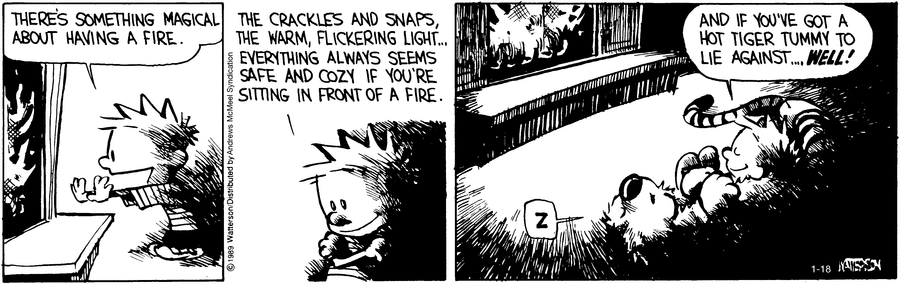
This week’s classic Calvin and Hobbes had a couple of examples of how well the strip walked the line between sentiment and humor.  Consider this fireside strip with its wonderful lighting:

Calvin Winter 1And then, just a couple of days later, you get this winter wonderland Calvin-style:
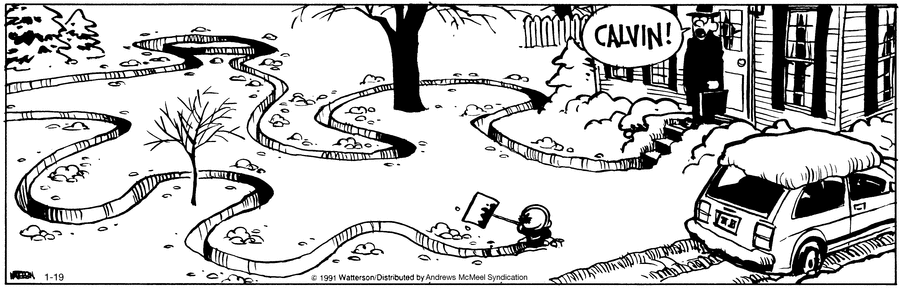
Calvin Winter 2It makes me think that some connection has to exist between “Calvin!” and “Alvin!” Heh.

(images from gocomics.com)

Posted in Uncategorized | Leave a comment

Sleuthing on Sunday

I recently mentioned how new TV had picked up some over the last week or two.  Compared to every other night of the week, Sunday is doubly-blessed.  Here’s the preview for this Sunday’s new episode of All Creatures Great and Small:

And here’s the preview for the show that comes on after it, Miss Scarlet and the Duke:

Both are good fun, with one a little more down-to-earth and the other a little more mystery-in-your-face.  I’m glad for both.

Posted in Television | Leave a comment

Transformation and Change

I mentioned a few days ago that I had gotten Andrew Root’s new book in the mail.  I’m about 50 pages in now, and it’s presenting a good challenge.  The folks at Outreach Magazine recently posted an excerpt from the book about the church and change.  It’s a nice clip.  Here’s a quality snippet to consider:

Change is almost always considered to be some kind of growth, and in late modernity that which grows must continually grow. Modernity is about change because it is about growth. It takes a lot of work, and a whole different imagination, to disconnect change from growth. Untying the two leads to something completely different: transformation in the Spirit. Being the church is about transformation, not change. Though on first blush these seem synonymous, transformation and change are quite different.

Transformation, in the Christian tradition, comes from outside the self, relating to the self with an energy beyond the self. Because transformation comes from an energy outside the self, it invites the self into the new as a gift, as grace. It demands no increase for continuation, no energy investment to receive it. Transformation is the invitation into grace; it comes with an arriving word, “Peace be with you” (John 20:19). Transformation is not the necessity to speed up but the need to open up and receive. Change, on the other hand, comes from within the self. Change makes the self into something new, using the power and the effort of the self: it is produced by the energy of the self.

Posted in Uncategorized | Leave a comment