A Key with Which to See

key in doorWhat I appreciate most about Oliver O’Donovan’s Self, World, and Time (which I have mentioned here and here) is its assertion that the way we live life matters.  This, I imagine, sounds like a no-brainer to most.  Ours is a culture obsessed with living particular ways of life.  It is perhaps the other end of the telescope for identity politics: this is not just who I am, this is also how I understand an authentic life to be lived.  We may not necessarily have a smorgasbord to choose from, but we do have a confusing collection of ways to navigate.  O’Donovan asserts:

Alas, it is the doom of modernity to be bound up in an over-simple knowingness about itself! Our own age is the hardest of all ages to understand.

If he’s right, then our reflections on the way we live life matters deeply.  Our understanding of the world we wake-up to matters deeply.  O’Donovan adds:

I find myself poised between the saving and losing of my soul.  The summons to wakefulness confronts me with the menacing possibility of failure to realize myself: “Awake!  Keep hold of your clothes!”

The “clothes” exclamation is, of course, connected to the New Testament pictures of preparedness in light of the coming of Jesus and God’s kingdom.  It is clear, though, that O’Donovan understands the stakes well: that practical reason, the way we understand and make our way through the world, truly matters.  And with his “inductive” intent throughout Self, World, and Time, he paints broadly and yet with the eye of a realist.

Without a key to the world’s meanings we shall never be able to sift through the complex of information we receive about, and through, the world, and bring it to some kind of order . . . Practical reason looks for a word, a word that makes attention to the world intelligible, a word that will maintain the coherence and intelligence of the world as it finds its way through it, a word from God.

Such a word from God, I believe, is possible.  What I find most interesting about O’Donovan’s approach is that it speaks so easily of “Christian Ethics” (or ethics in general), that one forgets that he isn’t simply talking about the Christian life.  And while many of us would not say the two are synonymous, there is a sense that there is a deep interchangeability between the two.

And so, O’Donovan claims, we “wake up” to find a self, a world, and a time, all unique and yet all part of a larger picture, a broader tapestry, that require no small amount of reflection that can lead to positive action.  The call of Christ, from beginning to end, demands it.

(image from locksmithracine.co)
Posted in Books, Faith, Teaching | Leave a comment

O’Donovan and the Good Place

Back in June I posted a couple of entries having to do with the opening pages of Oliver O’Donovan’s Self, World, and Time, which is the first entry in his “Ethics as Theology” series.  I finally finished the trilogy and have been spending some time re-reading and annotating sections.  It’s a good and interesting work for me, particularly as it stretches the reader in ways that are both deeply theological while totally grounded in day-to-day living (in ways that don’t quite feel like the norm for most theological or ethical writing).

As I mentioned in June, O’Donovan’s opening image of “waking up” really struck me as appropriate on multiple levels.  So much, really, that I decided to weave it into my first “ethics” lesson when our second semester starts this school year via the first three minutes of the pilot episode of LOST, where Jack Shepherd “wakes up” on the island.  Another, more recent, use of the opening-scene-wake-up is The Good Place, which is an amazing opportunity to talk ethics.  Here’s a preview of the show’s first episode back, when its third season premieres next week.  Of course, spoilers.

That first few seconds: a perfect O’Donovan moment.

Over the next few days I hope to get some thoughts down here based on Self, World, and Time.  And since it’s almost TV season, I’m sure there will be some previews and trailers to post, too.

Posted in Faith, Teaching, Television | Tagged | Leave a comment

A Song Worth Sitting With

The latest album from Death Cab for Cutie has been out for a few weeks now.  It’s the kind of album that draws you to the lyrics more than the music, which is always something that Ben Gibbard and company does well.  Here’s a song from Thank You for Today, “60 & Punk.”  Definitely a song worth sitting with for a while.

Posted in Music | Tagged | Leave a comment

Like It’s 1943

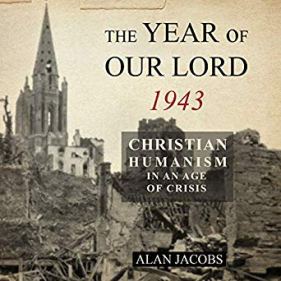
1943This weekend I finally finished The Year of Our Lord 1943 by Alan Jacobs.  In the book, Jacob traces the war-time thinking of thinkers like Simone Weil, Jacques Maritain, W. H. Auden, T. S. Eliot, and C. S. Lewis, particularly as each of them worked to articulate something like a Christian understanding of that particular moment in world history (in the hopes of setting the stage for how life might be lived once the war was over).  It’s an interesting read and a wonderful weave of five disparate threads (much like Elie’s The Life You Save May Be Your Own).  Jacobs handles the historic interplay well, moving both thematically and chronologically through each thinker’s life and thought.

In the end, the book is not particularly hopeful.  But it is helpful.  It’s helpful in showing us another period of (relatively) recent history where the stakes were high and where Christians could or should have said or done more.  While the five thinkers Jacobs chooses have a good bit of philosophical overlap, there’s enough that is unique to each that you find new surprises every few pages.  I found Weil’s reticence with the organized (Catholic) church interesting, particularly as she took a different but sincere approach to the questions posed by cultural power.  The book also humanizes Lewis some, as it weaves in personal anecdote to quotes from essays like “Learning during War-Time.”

The book comes to something of an abrupt ending, and that without his main protagonists.  Instead, Jacobs opts to bring in a sixth thinker, Jacques Ellul (who I first encountered in college through Steve Garber’s Fabric of Faithfulness).  And while there’s something frustrating about the shift, it also makes sense, as Ellul’s though often epitomizes a particular strand of post-war thinking.  That strand, at least as Jacobs teases it out, involves technology.  In particular, it’s the thread of how democracy inadvertently gave way to a kind of technocracy.

The question the book poses, in the end, is this: how late is too late?

It’s something sobering to think about.

+ + + + + + +

Jacobs recently did an interview with The Point about the book.  Appropriately titled “When the Ship Has Sailed” (remember: helpful, not hopeful), Jacobs gives a good summary of the approach of the five thinkers in general.  From the interview:

They don’t offer the same prescription, but to speak very generally, the older figures (Maritain, Eliot, Lewis) tend to believe, or at least hope, that it’s possible to rebuild and renew Christendom—to have a Western European society that is grounded in Christian tradition, though without any mandated acceptance of Christianity. (Their views are not altogether unlike those of Viktor Orbán in Hungary today.) Roughly speaking, Maritain hopes to draw and keep the attention of heads of state (including his own head of state in exile, Charles de Gaulle); Eliot hopes to influence the influencers, the people who worked behind the scenes in the various halls of power; and Lewis seeks to address a large public directly via talks, journalism, books and radio broadcasts. All of them count on an audience that had received some degree, however imperfect, of Christian formation, and could perhaps be persuaded to deepen their own interest and then infiltrate either the halls of power or their own neighborhoods with a body of Christian thought and practice.

For the younger figures, Auden and Weil, the ship of Christendom has sailed; for them, the chief question is the place that Christian ideas can find in societies that structurally reject them. They’re more likely to ask whether Christianity can be made intelligible, especially as something relevant to the whole social order, to people for whom it is a foreign language or sheer nonsense.

Don’t take this distinction as absolute, but in general terms it’s correct, I think.

I think those few paragraphs sums up so many different contemporary takes of the place of Christianity in contemporary culture.  The question for many, in the end, is whether or not the ship has already sailed.  And if it has, what next?

You can read the entire interview here.  And you can order the book here.

(image from amazon.com)

Posted in Books, Faith, Notes for a World's End | Tagged | Leave a comment

Further into the Great Degeneration

DegenerationBack in 2012, I read a little book by Niall Ferguson called The Great Degeneration.  I didn’t know much about Ferguson (and still don’t, really), but I found his book about the great, pending crisis concerning the decay and death of institutions and economies sobering and challenging.  Now, six years later, it (re)reads more and more true.

In the book, Ferguson charted what he saw as the degeneration of four key areas of contemporary life, what he called the four black boxes: the breakdown of inter-generational partnership in democracy, a free/regulated economy, the rule of law, and the evacuation from what was once a more civil society.  These four things pop up often in contemporary thinking.  And the ideas of institutions is always a horizon we see around us.  There are other black boxes, one might say, black boxes tied more closely to our day-to-day lives: institutions like families, churches, schools, communities.  Spend enough time on Twitter or reading contemporary journals and you’ll see that these institutions, too, have been degenerating for some time.  This is one reason why I keep something like a “Notes for a World’s End” tag in place: this is the world we are only beginning to navigate.

The institution being talked about the most these days is the Catholic church.  The last week or so has been a particularly tumultuous time for Catholics as they attempt to make sense of their leadership amidst a number of major crises.  And while I’m not Catholic, I have great respect for their heritage and thinking.  And I also know that Baptist life in many ways is a smaller mirror reflection of Catholic life . . . at least in a kind of systemic sense.  Both, honestly, have seen better days.  And while tomorrow I’ll get to a recent article by Michael Brendan Dougherty of the National Review, I’d like to point out some recent thinking from Alan Jacobs about the Catholic church (and the American presidency) as potential stand-ins for many other degenerating institutions.  From Jacobs’ blog:

Norms are created by institutions, and we live in an age of weak and despised institutions. This is how populist leaders arise: when a great many people believe that institutions exist merely to serve themselves, they come to despise not just those institutions but also the norms associated with them, and applaud leaders who scorn and seek to tear down the whole edifice. And if those leaders make their disdain known in sufficiently charismatic ways, few will notice when they are guilty of the very sins they decry. Moreover, when people see the sheer size of the institutions at which they’re so angry, they despair of any real change happening, and are content with listening to leaders who channel their own frustration.

General contempt for our institutions, government and church alike, makes them too weak to enforce their norms, which first enables corruption — the kind of corruption American Catholic bishops and members of the Congress of the United States are guilty of — and then produces populist figures who appear to want to undo that corruption. But the institutions are too weak to control the leaders either, so those leaders are empowered to do more or less whatever they want to do. This is the case with Trump, who will surely last at least until the 2020 election, and also, I think, with Francis, who will probably last until he dies or chooses like his predecessor to resign.

Moreover, since neither Trump nor Francis is interested in doing the work needed to repair their corrupt institutions — they don’t even have any incentive to do so: the ongoing presence of “swamps” is what lends them such legitimacy as they possess — all the products and enablers of corruption are safe.

Repair, of course, is what we are to be about, I think.  Shoring up, reconstructing, re-instituting, as the case may be.  But all too often it can feel like Noah, divinely commissioned to build an ark for a world where storms are too easily accepted or ignored.  Surely the “great degeneration” can be turned into a “great regeneration,” right?

Jacobs, by the way, has a great “sequel” to the excerpt above where he writes about recency bias.  It’s quite interesting and a good companion post to his other work in How to Think.  Maybe I’ll get my students to read it for class, too.  You can read that here.

(image from goodreads.com)

Posted in Books, Notes for a World's End | Leave a comment

Concerning Hurricane Lane

Today was one of those weird days where you are waiting and preparing for something that just hasn’t happened yet . . . and that can’t be undone once it’s happened.  I am writing, of course, of Hurricane Lane (which is an odd name for a storm, since it sounds more like “tornado alley” than a person’s name).  This morning was a mix of normal (tea and bagel for breakfast) and preparatory (tarps and sandbags and trying to make things safe from the wind).  I’m writing this at about 10:30 at night.  The wind finally picked up significantly about an hour ago and is still come-and-go.  We’re still a few hours away from rain.

Here’s a shot of the storm from the International Space Station from NASA on the 22nd.

Hurricane LaneTomorrow will be interesting.  I’ve got grading to do.  I’ve got a stack of books to work through.  And I imagine I’ll try to move around when possible.  Plus I’ve got a lot on my mind and heart because of the last few days of work.

Please pray for safety and a minimization of damage in the islands.  And please pray for those on other islands who have already experienced flooding, power outages, and heavy winds.

Posted in The Long Story | Leave a comment

Remembering to Remember

I’ve been oddly and unexpectedly reflective these last few days, mostly due to a conversation I had last week that was a kind of perspective on working with youth . . . and ultimately how it’s changed since I my days as a teenager.

I found the conversation frustrating, even though what was being said was pertinent and powerful.  But I felt . . . still feel . . . that something was missing, like an unnecessary sophistication had taken over.  That joy and happiness and something about a deep knowledge of Jesus through the Spirit was missing.  That something about sin had been psychologized in a way that might help as an adult but maybe not as someone younger with wider eyes (who is utterly aware of the depths of the sinful nature).

Two things in particular have come back to my memory.  One of them was the role that Chuck Swindoll’s teaching shaped me.  There was one particularly series, a short one titled Intimacy with the Almighty, that started by articulating two understandings of intimacy.  First: actual closeness with someone.  In devotional terms, this is time spent alone with God.  Second: a kind of becoming like someone because of that proximity.  At least that’s how I remember it.  And I like the “handle” of it.

The second memory was of going through the youth edition of Experiencing God with the youth group.  I’ve been thinking about the “seven principles” of the series and have found them wonderfully beautiful-yet-packed in their simplicity.  A more complicated me sees them and can easily say “but what about” in the way the principles are articulated.  And yet . . . it is true that God is always at work around you and that He desires a love relationship with you.

Surfing the web today I discovered that Steven Curtis Chapman had penned another song and released it a few months ago.  Not sure how I missed it.  But I am glad that I found it this afternoon after an unexpectedly long and frustrating day.  The guy has aged . . . as have we all.  And that’s okay.  Here’s the video for the song.  It’s a nice blessing at this point in the journey.  I don’t plan on being swamped in nostalgia.  But I want to “remember to remember” and to mindful of the deep joy and gladness to be found in Jesus that kind of feels at odds with the way so many of us now talk about the Christian faith.

Posted in Faith, Friendship, Music | Tagged | Leave a comment

The Question of Cohesion

cohesionI recently had a conversation with a married friend about the routines and habits of the single life.  He had recently spoken to a relative who often lived far away from his spouse; the spouse had been a very real example of the role routines play in helping someone often alone feel a sense of what Comment editor Brian Dijkema would call integrity.  The term is often used of the correspondence between one’s interior life and exterior actions, which is why the concept of cohesion is good, too.

In his upcoming editorial for the journal of public theology, Dijkema asserts:

In many ways, of course, we are thriving. Our lives and our work might look okay in any given moment, but in the quiet of the night, or as we walk out the door in the morning, we sense, as Jonathan Chaplin notes in this issue, “a disturbingly elusive sense of dis-integration.” We feel it when we come home from work and ask ourselves the question: “What did I do today?” Or, when then child doing her homework asks: “What does my physics homework have to do with that beggar I saw on the street?” When the chemist asks: “Should I make this compound?” When we step out of the polling booth, we ask: “Is that it?” Or, as you say your prayers before heading to bed, you look back on your day, and count the ways in which your words, your deeds—your desires—are painfully subluxated from what you want to do. Why did I do that again?

Points for working in “sublimated.”  These are good questions to ask, for sure.  But if we ask them regularly, if we never answer them in the first place, we should admit something is wrong.  They are canary questions in an existential coal-mine.  And Dijkema, as so many others, feels that something is deeply and deceptively wrong with our life together today.  Fragmentation and isolation are words that Dijkema uses . . . and that are words often used by others today.  Dijkema sees this happening on multiple levels.  He continues:

We experience this fragmentation both personally and politically. The individual’s lack of a sense of cohesion has its mirror image in institutional isolation. Given that to live in a modern society is to live in a differentiated society, and given that Christian social thought has articulated the goodness of such differentiation, how can we live well when such differentiation becomes fragmentation, compartmentalization, dis-integrating us as a society but also personally or existentially? We typically understand integrity as living an authentic life—a life where one’s actions are consistent with one’s beliefs. But that is not enough. Indeed, understanding integrity in this purely individualist way leads to the social vision of coherence proffered by liberal individualism. It just happens that this vision ends up leaving the individual lost and disconnected from others, from meaning, and, as Patrick Deneen notes, from both the past and the future. The fractures appear permanent, maybe even eternal.

And so the return to the dangers of the “individualist” way of life, which is something, too, disagree with.  Which can sound frustrating coming from the mouth of a single guy.  I like Dijkema’s use of concept of differentiation, particularly as it applies to cohesion.  But I also witness and experience firsthand that damage that can be done by fragmentation, compartmentalization, and dis-integration.  And I fight against it every day, even when I’m spending time by myself (like now, as I write this at the downtown Starbucks after a busy day at work).

+ + + + + + +

These concepts and questions will be important for a church or Christian community attempting to make sense of the popular culture.  They will also help us call into question our assumptions about the viability of community amongst between married couples, couple with families, and singles.  I was in a meeting just yesterday where it was clear to me that we have real work in understanding the weird forms of isolation right in front of us (with the isolation of the family perhaps being the weirdest and most-difficult-to-pin-down of all).

You can read all of Dijkema’s editorial here.  It’s a good deposit for what should be another great issue of a great journal.

(image from ieltsonlinetests.com)

Posted in Faith | Leave a comment

Sunday’s Best: Equivocating Density

Today’s Frazz comic by Jef Mallett is another great example of an intelligent conversation that employs multiple meanings of a word.  Plus there’s a lot to learn, which is always interesting.

Frazz Equivocating DensityIt’s a good Sunday for the comics, actually.  I’ll post a few more throughout the week.

(image from gocomics.com)

Posted in Uncategorized | Leave a comment

The Youngest Son’s Story

A couple of days ago I posted a scene from the book of Judges involving good and bad choices made by Gideon, also known as Jerubbaal.  After Gideon’s death, Abimelech the son makes a move to become the king of Shechem.  In the process, he kills 70 of his brothers.  One, Jotham, escapes.  This youngest of sons has a story to speak against his murderous brother when the leaders of Shechem gather.  It’s a nice story, a good poetic moment from Judges 9 in what is truly a bloody mess:

When it was told to Jotham, he went and stood on top of Mount Gerizim and cried aloud and said to them, “Listen to me, you leaders of Shechem, that God may listen to you. The trees once went out to anoint a king over them, and they said to the olive tree, ‘Reign over us.’ But the olive tree said to them, ‘Shall I leave my abundance, by which gods and men are honored, and go hold sway over the trees?’ 10 And the trees said to the fig tree, ‘You come and reign over us.’11 But the fig tree said to them, ‘Shall I leave my sweetness and my good fruit and go hold sway over the trees?’ 12 And the trees said to the vine, ‘You come and reign over us.’ 13 But the vine said to them, ‘Shall I leave my wine that cheers God and men and go hold sway over the trees?’ 14 Then all the trees said to the bramble, ‘You come and reign over us.’ 15 And the bramble said to the trees, ‘If in good faith you are anointing me king over you, then come and take refuge in my shade, but if not, let fire come out of the bramble and devour the cedars of Lebanon.’

And then, tale finished, the youngest son lets the story hang there, hoping that the people will realized they have settled for bramble instead of embracing something better.

Posted in Scripture | Leave a comment