Settling Into a Quiet Place

The folks at Vanity Fair recently posted a great clip of John Krasinski “breaking down” of the earliest scenes of his recent movie, A Quiet Place.  The movie really is as good as reviews are saying.  I think I had a tense smile on the entire time I was watching it: smiling because I knew I was watching something special but tense because it sucks you in from the very first scene and doesn’t really let you relax until the end.

Not only that, it’s definitely one of the most naturally beautiful movies that I’ve seen in a long time.  The locations for the movie are as lush as they are terrifying.  And so while sound plays perhaps the most important “character” in the movie, the natural world deserves some real applause, too.

Posted in Movies | Leave a comment

Where All Roads Lead?

There’s this semi-interesting online debate about whether Marvel’s Agents of SHIELD is the best superhero show on network television or the worst.  I’m not quite sure how I feel about the conversation.  While the show hasn’t quite fit the niche I thought it would, it has definitely created its own space in the world of funny-books-turned-to-television.  And now that it’s heading to a season finale (potentially series finale) titled “The End” (which also got name dropped in tonight’s episode), the show is really bringing things together.  And by “really” I mean bringing back long-time characters and concepts and mixing them up into something fresh.  Here’s the trailer for next week’s episode:

We’ve got about a month left (and a couple of weeks to see if they do a direct/immediate tie-in to Avengers: Infinity War) before the finale.  Let’s see if they go for broke.

Posted in Movies, Television | Tagged | Leave a comment

Run, Barry, Run (2018 Edition)

The Flash returned with new episodes last night.  And while it definitely had a “villain-of-the-week” vibe (as is often the case with superhero shows), it also had some nice, not-so-subtle moments that moved the story forward in interesting directions.  Marlize DeVoe is being used by the Thinker without her knowing/remembering.  Harry activates Gideon for the first time in a good while (and ever in this incarnation?).  And then Cisco gets an opportunity to leave Team Flash for potentially greener pastures.  And all while the season begins its final sprint to the end.  Here’s the preview for next week’s episode:

All in all, it’s been a good season from my perspective.  Sure, there’s been that “villain-of-the-week” vibe, but at least there’s a throughline that doesn’t involve an evil speedster.  And there’s definitely more humor at play than last season (even with Dibney taking it a bit too far here and there).  Sure, this preview looks pretty bleak, but I’m hopeful that Team Flash can keep the better direction of the season to the end.

Posted in Television | Tagged | Leave a comment

Thinking about Education

comment.transparentlogoToday I had the opportunity to lead out in our school’s annual “faith issues” workshop.  One of the aims of the meeting, at least from my perspective, is to continue the conversation of faith integration.  The folks over at Comment Magazine recently posted an interesting piece on the role that faith-based institutions can play in a world where technology has made much of what makes the college experience obsolete.  From “Christian Higher Educational in an Exponential Age”:

Faith-based schools seek to educate the mind—but their ultimate aim is formational. That is, developing and orienting students toward character, moral excellence, acute spiritual sensibilities, and meaningful societal contributions. To be clear, these aren’t simply things that Christian schools do or attributes they have. This is who they are: ethos informs identity, and identity drives practice . . .

The formational ethos of Christian schools has embraced and supported both a social and a personal dimension. With respect to the latter, a faith-based educational climate is not merely concerned with what Parker Palmer and Arthur Zajonc refer to as “the self-authoring mind.” Rather, Christian education is animated by a more ancient orientation. Aristotle believed that education proper should be aimed toward rightly ordered affections, desires, and impulses. In an ironic twist, this approach to learning has less to do with what we know but rather with what we love. In this conception of education, ordinate affections are at the heart of a prosperous, virtuous life. “The good life”—write Robert Skidelsky and Edward Skidelsky—”is not simply one of satisfied desire; it indicates the proper goal of desire. Desire is to be cultivated, directed to the truly desirable. Moral education is an education of the sentiments.” For the faith-based institution, “educating the sentiments” is a holistic notion, inculcated across a variety of university dimensions through repetition, experience, and relationship.

While I like the whole article . . . and these two paragraphs, in particular, that last little list is a nice summation of something important.  Repetition, experience, and relationship.  I think many organizations and institutions have a strong sense of the last two.  For those who want to be on the “cutting edge,” though, the idea of repetition tends towards a negative kind of redundancy.  Which isn’t always the case.  I’ve come to think of those repetitive things as part of the actual framework for the experience and relationship.  The article, which you can read in its entirety here, also makes nice use of Aristotle, hints at You Are What You Love, and includes some thoughts on the place of the liberal arts.  Definitely worth your time.

Posted in Teaching | Leave a comment

Solo Story Glory

The second full trailer for Solo: A Star Wars Story had to do one thing: make the movie much bigger and louder and unexpected that what we saw of the Super Bowl trailer a few months ago.  Here’s what we got yesterday:

I am much more hopeful for this movie.  Don’t get me wrong: the proof will be in the pudding upon actual viewing.  But this trailer gives us even more visual excitement (other worlds, different kinds of technology) and a little more sense of what to expect from the ensemble cast.  If anything, Disney’s approach to this movie cements the idea that every cinematic Star Wars story is an ensemble story.  At least for now.

Posted in Movies | Tagged | Leave a comment

From Lent to Eastertide

Well, the forty days of the Lenten season have led to the fifty days of Eastertide.  This, in turn, takes us up to the Ascension of Jesus and the day of Pentecost (and then to a summer and autumn of “ordinary time”).  This is my second year trying more intentionally to track the movements of the liturgical calendar of the church.  I was soberly encouraged by some thoughts that James K. A. Smith posted to Twitter about the season.  He started with:

The goods of the liturgical calendar are internal to the practice. Its gifts are the fruit of inhabiting its storied timekeeping, not what it makes you “think about” or what themes it offers to “talk about.”

He then continued:

Indeed, talking *about* liturgical time is susceptible to a kind of chatter that indicates we’re not dwelling in it.

I get Smith’s sentiment and see it as the fruit of “a longer obedience” in the direction the liturgical calendar.  And I acknowledged that I’m not there yet.  At the same time, I wonder what such an approach means for churches that are at different places in their understanding of the liturgical calendar.  This morning I greeted a fellow church member with “Happy Easter.”  Her response was something along the lines of “It’s still Easter?”  And rightly so, as our church has tended to “dabble” with the calendar (and often it has done a good job with that, really).  The preacher the made a number of comments about “being an Easter people,” but not necessarily in a way that is rooted in anything beyond the need of the moment.

At the service that often attend on Sunday evenings, the focus throughout Lent (and now, it seems throughout Eastertide) has stayed away from focusing on the Gospel accounts to focus on other still-appropriate topics (in this case, the seven deadly sins and then the Acts 4 passage for this week).  This is all well-and-good for those with a more rooted understanding of the season, I think, particularly if your personal devotionals have been rooted in the Gospels.  But it can also create some slight cognitive dissonance for those still in the process of learning the rhymes and rhythms of the season.

Smith concludes:

You’re indwelling liturgical time when you don’t need to constantly signal it—when it’s the water you swim in without commentary. Then the life of Christ has become your calendar; the tick-tock you take for granted is kingdom time.

So I’m totally not there yet (which is why there’s a post about it, obviously).  At the same time, I wonder about the point of it all, the “then the life of Christ has become your calendar” part.  I think “the life of Christ has become your calendar” particularly as “the life of Christ becomes your life.”  I think that’s probably one thing that “goes without saying” that shouldn’t simply go without saying.  If the Spirit is forming the life of Christ within us (as individuals and as communities), then the “calendar” approach to the life of Christ has to be more than just a Hallmark or civil calendar but “just for Christians.”


Posted in Faith | Leave a comment

Between the Gift and the Economy

Over the last few weeks, I’ve tried to articulate some thoughts about church and community.   I started by looking at some quotes from authors like Walker Percy and C. S. Lewis.  Eventually I landed on and spent some time with Ephraim Radner, particularly his work in A Time to Keep on single adults in church.  And while there is much more to say about the topic, I thought I’d try to bring some kind of conclusion together, if only for the time being.  I’d like to do that through the images of gift and economy.

+ + + + + + +

The simple fact is that people in community are ultimately economic beings.  Families have it (each member with a particular task or chore based on any of a number of factors).  Churches have it (each member takes on some particular role based on gifts, talents, calling, or need).  And workplaces have it (where particular places are filled through the hiring process).  And so we are utilitarian instrumentalists: we work together for the greater good, all too often reducing one another to function.  But when we function properly, the community is considered healthy.

But what should be done with those who do not fit this community-as-economy reality?  And in a church culture where the needs always outnumber the members, how do we maintain some sense of community that is not predominately utilitarian or instrumentalist?  And what do we do when, because of our overuse of people as resources, we find that the economy is no longer viable (and perhaps then realize that the instrumentalized economy is not the point of it all)?  Don’t get me wrong: the biblical story is full of people being called to take up responsible roles in the larger body, to work as a form of contribution.  But that is not the only, or even dominant, image that Jesus and the New Testament writers give for the church.  And what hope is there for the “seeker” when so much of the economy is based on using those who have “found” and thus in some kind of settled disposition?

+ + + + + + +

One thing I really liked about Radner’s articulation of the single celibate in church life is that they have something unique-to-them to “bring to the table” that comes from their own experience of “naming and wandering.”  But that doesn’t seem to be the way things work in a church community.  Sure, you can add a little bit of personal flavor to the way you teach your Sunday school class, but that’s about all the variety that many churches can handle.  And then, when you do, you can imagine many church members nodding their heads and saying, “There goes old so-and-so, doing what they always do.  Why can’t they just try and fit in a little better?”

Christians in community ought not have to choose between the gift and the economy.  Just because a single adult doesn’t bring a spouse or child into the worship service doesn’t mean that they enter the sanctuary empty handed.  The challenge, perhaps, is to help them see the significance of what they bring with them, even if it’s more abstract and awkward.  And while the time must come for them to reach into the community and “take their place,” that should be done with a sense that singles need just as much caring for as everyone else in the congregation, because their load is heavy, too.

+ + + + + + +

Talking about such things without sounding like a whiner is difficult.  For those that see the church program as synonymous with “the kingdom” and the work of God, anyone who calls that program into question looks like a rebel or malcontent.  To consider someone stingy because they do not give what we ask (even though they have a real gift needing to be shared) is presumptuous. To ask singles to fend for themselves while unquestionably towing a party line that praises the economy over the gift is spiritually dangerous for everyone involved.  That we are not wise enough to know what to do about such matters will hurt us all in the long run.

Posted in Books, Faith | Leave a comment

What You Bring to the Table

A Time to KeepOne could easily assume, based on my reflections over the last couple of weeks, that the plight of the single, celibate adult is the bulk of Ephraim Radner’s point in A Time to Keep.  That couldn’t be farther from the truth.  What Radner does well is follow the thread of the single adult making sense of faith in light of the Great Transition for a chapter or two in a way that treats the body of Christ with a dignity not often found in discussions of church culture.  And so, while the thread of the single adult remains as the book comes to a close, the real thrust if things is on the place of “working and eating” in the context of church community.

It turns out that there’s a lot at stake in eating.

One eats in order to survive; one eats together for the same reason and out of the same dynamic . . . food is our life in the material fashion . . . Hence, food marks the first and basic level at which societies engage in self-repair, and it is just where churches have most frequently expressed their ministries: soup kitchens, basement meals, celebrations, and, of course, particular liturgical actions.

That last phrase, of course, is a strong arrow point in the direction of the Lord’s Supper.  Radner brings the Johannine recounting of the Last Supper into play in a way that can help us understand how language brings out the role of food in community.

In the same way, “I have called you friends,” says Jesus to the disciples at the Last Supper (John 15:5).  The language of friendship here is aimed at just this creaturely gathering at the meal.  Among the most potent terms of friendship are those related to sharing bread, as in Psalm 43:9, quoted by Jesus in John 13:18: love “betrayed” most deeply is the love of one with whom bread has been broken.  It is what in English we call a “companion,” or literally, “one with whom we share bread.”  Companions are common bread eaters.  Hence the eucharistic meal moves from the disciples back to the common table, to a community, to married life, to family; it stretches back to genealogy, to generation, to survival.  And all of these are gathered into the probative reach of friendship in Christ.  This is our creaturehood as it is given, fallen and otherwise.  This life we live as just these creatures is how God does what God does and is God.  For “this is my body, given for you . . . .”

+ + + + + + +

In the end, for Radner, both working and eating are ways of being mindful of the Psalmist’s request: teach us to count our days so that we can apply our hearts to wisdom (Ps. 90:12).  And eating brings both work and friendship together.

If anything, that’s been one of the odd tensions of getting older and finding community rooted in both working and eating.  When I was younger, I think the friends and I had the eating part down quite well.  And there was enough overlap with daily life that the two felt connected (even if we weren’t always “doing ministry” together).  There was a healthy personalization of work because of the fellowship around the table.  Now, farther down the road, there’s lots of working and still some eating, but the overlap feels less.  Sometimes, in what are really blessed moments for me, I get to sit around the table with others and there’s a real sense of “in things together” that still catches me by surprise.  Other times, there is eating for the sake of the program, a kind of instrumentalization of fellowship that can be okay in the short term but dangerous in the long.  What Radner does as he brings A Time to Keep to a close is he rightly elevates these seemingly mundane things to remind us of the high and holy stakes of our daily lives together.

+ + + + + + +

I think I’ve got one final post to bring up in the vein of single adults, the church, and the place of friendship and work in the overlap.  More on that tomorrow.

Posted in Books, Faith | Leave a comment

Working Things Out

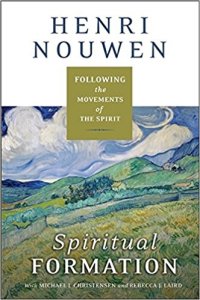
Nouwen Spiritual FormationIn a posthumous collection of his writings titled Spiritual Formation, Henri Nouwen wrote of how we perceive people more often as characters than as individuals.  To see others as characters is ultimately to see them as people “to use as we need or want.”  Nouwen build off that with something easily connected to the role of the single and celibate adult in the church:

A teacher is more than a teacher, and computer technicians and auto mechanics are more than their functions.  A person is more than his or her character or figure.  If you relate to me only as someone who can do something for you or whom you can use for your own purposes, then I am not going to show my best self to you.  I am going to become defensive, suspicious, a little careful, and I may hide my true feelings and opinions.

As I read that one morning during spring break, I found a paragraph that helped me make sense of the difficulty that I have being a single and celibate adult trying to be a part of community where a certain kind of practicality and function dominate the conversation.  And I have to confess to being guilty of this approach myself.  It is a dark and diminished version, I think, of what Ephraim Radner asserts about single adults in the life of the church in A Time to Keep.

+ + + + + + +

After a lengthy discussion of friendship in general and friendship through the lens of the single person in particular, Radner moves on to the topic of work and the single adult.  There’s a good chance, of course, that spotting a single adult working in the church means finding someone working hard to fill in the gaps that can’t be met by those who are married with children.  Earlier in my time at one church, I found myself at various times teaching Sunday school, serving as a greeter, serving on personnel committee, serving on a pastor search committee, serving on the discipleship committee, and doing it mostly without any immediate peer group.  Such things are a joy and an honor to do, don’t get me wrong.  But such activities are matters of meeting program and institutional needs, which can often leave people in a weird state when the momentum dies.

Radner asserts that “the central element of our calling as creatures is to engage in the growth of affection: to love God and neighbor.”  Most Christians can connect those two things with committee work in something less than three easy moves.  “Friendship,” Radner continues, “is rightly seen as the most crystallized form of affection, such that “friendship with God” itself became a vision of redemption in writers like Irenaeus and long after.”  This friendship, when coupled with the freedom the single adult experiences, allows the single adult to “bring gifts of particularity” to the broader church community that the dynamics of marriage and family life might not allow.  Radner concludes: “friendship’s deeper impulse and movement is the discovery of delight.  The single person’s gift, as single rather than married, is epitomized in bringing friendship into the kids of the generative (family-based) community.”  Radner sees this happening primarily through means of “working and eating.”

+ + + + + + +

With working, Radner connects the task of the single adult to the task of Adam in the Garden prior to Eve.

In the end, though, it is praise that marks the growth of such singling out of things, through their naming.  If our movement toward such naming is blocked, overlooked, lost, or forgotten, then always there must be those who are caught in the woods alone, for a period, in a certain solitude, where they begin to hear the clamor of the world, otherwise lost in the trudging, or sometimes frantic reactivity of survival.  The work of the single person is to give names to creatures that God has made. Jesus walks alone, on order to know the name of every sheep that is his (Matt. 18:12; John 10:3).

From there, Radner has much to say about work.  He sees it, of course, as something affected by the Great Transition, as something that too often leads to a kind of death and not a particular kind of life.  The important thing to note, at least for me, is that he does not define the work of the single adult in community life as simply meeting the needs of a particular program.  To call it something like naming is to call everyone in the church community to something better (and something quite different from what seems to be the norm for many churches).  It is more than seeing them as characters who simply need to get “plugged in” in a way that is really a kind of institutional “plugging of a leak.” If that’s all it is, and there is evidence of that kind of reality over the long haul, then maybe that particular ship should sink.

+ + + + + + +

As I finish this late Tuesday night, I’m thinking I’ve got two more posts to work out using Radner’s A Time to Keep: one about eating and the other a kind of summary-challenge for myself as much as for anyone else (the working titles are “What You Bring to the Table” and “The Dangers of Rejecting Gifts”).  From there I’d like to spend a little more time with Nouwen, particularly his work on spiritual direction and formation.  By then the next batch of new episodes of The Flash should have some previews for me to post, too.

Posted in Books, Faith | Leave a comment

Toward Friendship

A Time to KeepIt was Frederick Buechner who first introduced me to the idea that theology is, on some level, always autobiographical.  This is not to dismiss the orthodox body of truth at all but to emphasize the fact that theological truth refracted through the individual brings out something significant and particular to the mix.

So what of a theology of the single adult and the church?  Over the last few weeks I’ve tried to work through some of Ephraim Radner’s thoughts on the “vocation of singleness” from A Time to Keep, his survey of “theology, mortality, and the shape of human life.”  I would like to “wrap up’ (not really possible) his thoughts on friendship as something particular to singles before looking at his thoughts on work.

I mention the autobiographical nature of theology because my thoughts on friendship have taken on a different nuance now that I’m a little older and further along what Radner calls “the arc of life.”  As blessed as I have been during my time in Honolulu (and before that in Texas and Tennessee), the pursuit of lasting friendship has been a real struggle.  Part of that has been an expectation issue.  The greater part of it, though, has been an “ordering” issue . . . an “everything in its place” disposition that holds on loosely while holding on properly.

For me, a big part of the struggle has been the battle between the concrete and the abstract.  There has been an almost insurmountable growth of a kind of “intangibility” to my life the older I’ve gotten as a single adult.  It’s a kind of “out of sight, out of mind” reality that things like social media only amplifies for me (there’s that weird prostitution of promotion that can come from posting about your life . . . and yet it also makes you a little more real to those you love far and wide).  The “equal and opposite reaction” to this reality is what blogger Eve Tushnet has called an “isolation” that leads to “the slow crafting and hardening of a private world.”  It can be a kind of double damnation (and with no language to speak your way out of it).

So what role, if any, can friendship for and with the single adult play in this kind of abstract-but-hardened privacy?  Well, Radner asserts that “the reality of friendship is one that provides a ground for other relations; it is not only a parallel or alternative to these relations.”  He asserts that “the affective aspect of friendship—love—is divinely significant in its own right” and that, as such, has possibilities for the cure that ails us when it comes to our understanding of relationships of all kinds during and after the Great Transition.  He goes on to say that

friendship’s cultivation is indeed a “responsibility” to be taken up, pursued, ordered, and cultivated.  From the pastoral side of things, we can assuredly say that the church must teach people how to be friends, because it is a significant aspect of every relationship.

It is the particularity of the single adult that results from the blessing-and-curse individuality that makes friendship with singles significant for the church, even if he calls the integration of the single into church life “a grating but also a formative process.”  Radner adds:

Friendships constantly press against these edges of distinctions, and the resistance all of us experience in this is often the hardest to bear within the communal dynamics of genealogy—families, cooperatives, politics.  The sexually partnered existence that constitutes marriage and moves into family quickly subsumes, and often avoids, this grating character, except when the challenges of mortality slink through the cracks.  The single person here is the sound of every person’s movement across the ground and needs to be heard and in any case eventually will be.  It is hard to remember one’s spouse’s individuality.  But we must, but this is the impulse of our affection.  Yet creaturely existence often involves the juggling, lost balance, and dropping of affection necessarily linked with generation, so that friendship itself loses its way within the community of generative existence—but for its constant kindling and challenge by single persons through the press of their friendships within the unconscious flow and forgetfulness of ordered community.

Friendships are cultivated with all the care and dangerous fragility of any sustenance agriculture.  There is the careful time of discerning and planting—and here wisdom and experience can bring only success—and not a little luck.  There is the giving over of oneself in loyalty, the breaking up by betrayal, the hard and welcome corrections and growth, the difficult learning and respecting of limits as in all things, and long-standing reaping and replenishing.  Friendship is a life’s work.  It can, furthermore, be deformed, as with many friendships we know that become privatized and possessive, tyrannical and oppressive. So too, of course, can the “collective” demands of survival itself.  The friendship, however, that is marked by whatever confluence of location, shared acts, doing, and attention will ever uncover more and more of “just this person” in “just this time and place.”

+ + + + + + +

Near the end of his articulation of friendship as part of the single person’s vocation, Radner asserts that “friendships are for the sake of others, however.  Thus, the friendships of single people are to be cultivated, protected, honored, and then brought in to the whole, the ordered life of families, wherein others may learn from them.”

Reading this, one would be led to think that friendship with singles is a big deal.  But it’s a difficult or tricky thing, which Radner wisely points out.  That wisdom and experience are somehow necessary seems a bit absurd, as most of us think that friendships probably just happen (as that is often our experience in certain social settings like school).  But he’s right, correct in a way that I can see now that I’m farther down the road.  Reading this, it makes more sense why married people find it easier to be friends with other marrieds: the particularity of the individual is subsumed enough so that maybe not that much is asked.  But a single with all of that time and attention to give?  That can be a total minefield.

+ + + + + + +

I find myself asking some questions of friendship and this line of thinking.

  1. Why does it seem like single people have a difficult time befriending one another?
  2. Why does it seem like Jesus just isn’t enough for a basis in Christian friendship (what I call a “brothers-in-crisis vs. a brothers-in-Christ mentality”)?
  3. What do you do with technology that helps make friendship more of a possibility while also producing more potential pitfalls?
  4. How can people grow in friendship when there seem to be so few living examples of healthy friendship with older people?
  5. How do you nurture friendship well in a world that is post-Great Transition?

I think the concept of “rightly ordered” is vital to having a healthy concept and practice of friendship.  I think that many of us who have been around for a while and who have a “concrete private world” that leaves us in a place of abstraction, we wonder where, if anywhere, we actually belong.  The conversation requires space enough and time to have it out.  Most people, I fear, don’t have enough of either.

+ + + + + + +

Okay.  Next time it’s all about work and the single adult in the context of the church community.

Posted in Books, Faith | Leave a comment