Education and the Industrial Solvent

FactoryMuch like liberalism, industrialism has acted as a kind of universal solvent that has assisted in what some would call the dissolution of whatever the most recent world might have been (though we now exist in the wake of its passing, some might say).  And so industrialism can seem opposed to the arts, to social and mental health, to home economics, to a kind of self-sufficiency.  Considering education in light of industrialism is also an easy (but not untrue) step to take.  I think it was media guru Seth Godin who first introduced me to the idea that things like scantron tests are the epitome of education’s embrace of the industrial approach to learning.

So even though he’s almost always talking about agriculture and a particular way of life ,I often read Wendell Berry’s thoughts on industrialism and its effects on society as a way of thinking about education (particularly of a kind of Christian education).  This was especially true of one part of “The Thought of Limits in a Prodigal Age.”  There are a few times in the following excerpt where you could replace “agrarianism” with “education” and it still make some good sense.

Industrialism and agrarianism are almost exactly opposite and opposed.  Industrialism regards mechanical or technical functions as ideal.  It rates its accomplishments by quantitative measures.  Though it values the prestige of public charity, it is motivated necessarily by the antisocial traits that assure success in competition.  Agrarianism, by contrast, arises from the primal wish for a home land or a home place– the wish, in the terms of our tradition, for the freedom and independence that come with dependence on a parcel of land, however small, that one owns and is owned by or has at least the use of. Agrarianism gratin its highest practical value to the good husbandry of the land.  It is motivated, to an extent effective and significant, by neighborliness, family loyalty, and devotion to the coherence and longevity of communities.

+ + + + + + +

How you think about education matters.  How you think about knowledge shapes the entire learning enterprise.  There has always been a kind of “jumping through hoops” to learning . . . hoops that often start early and properly in the memorizing of facts and figures but that, in the long run, see learning as not much more than a manipulative to get at something else.

Real learning, I am convinced, comes with qualitative measures that have striking social component and that don’t settle for simple win/lose competition.

+ + + + + + +

At some point I hope to get to Patrick Deneen’s thoughts on education as found in Why Liberalism Failed.  Until then, it’s good to mindful of writers like Berry who help us see the costs of many things easily lost in our current culture of transition.  And the arena of education is a vital part of that picture.

(image from thewheelz.com)

Posted in Books, Notes for a World's End, Teaching | Tagged | Leave a comment

Provision

LembasOne of the reasons I am drawn to a consideration of moving “from one world to the next” is because I spend a good deal of time talking with students who are making their own transition from one world to the next.  Just this week I was able to check in with many students who were making final and major decisions about what schools they will attend in the fall.  And so, to borrow a phrase, I get to stand at a kind of “thin space” between two parts of life.  Their stories are a reminder that I stand in my own space between worlds.  The question, of course, is what we will carry with us.

+ + + + + + +

A couple of days ago I found myself praying with my students about the provisions of God.  “Provisions” is an odd word, really.  One we often have a sense of without thinking too much about.  It’s also a word that Wendell Berry takes some time to unpack in “The Thought of Limits in a Prodigal Age.”  As he speaks of what it means to consider living a “limited” life while the world around us blindly expects something limitless, Berry asserts that provision is “being attentively and responsibly present in the present.”  He goes on to say that

We do not, for example, love our children because of their potential to become well-trained workers in a future economy.  We love them because we are alive to them in this present moment, which is the only time when we and they are alive.  This love implicates in a present need to provide: to be living a responsible life, which is to say a responsible economic life.

Which doesn’t sound very Romantic, for sure.  But part of what Berry seems to argue for regularly is an attention to what is right in front of you while remaining mindful of a greater, divine horizon.  Berry continues:

Provision, I think, is never more than caring properly for the good that you have, including your own life.  As it relates to the future, provision does only what our oldest, longest experience tells us to do.  We must continuously attend to our need for food, clothing, and shelter.  We must care for the land, care for the forest, plant trees, plant gardens and crops, see that brood animals are bred, keep the house and the household intact.  We must teach the children.  But provision does not foresee, predict, project, or theorize about the future.  Provision instructs us to renew the roof of our house, not to shelter us when we are old– we may die or the world may end before we are old– but so we may live under a sound roof now.  Provision merely accepts the chances we must take with the weather, mortality, fallibility.  Perhaps the wisest of the old sayings is “Don’t count your chickens before they hatch.”  Provision accepts, next, the important of diversity.  Perhaps the next-wisest saying is “Don’t put all of your eggs in one basket.”  When the bad, worse, or worst possibility presents itself, provision only continues to take the best possible care of what we have, or of what we have left.

This is a kind of living that we do just below our level of consciousness, often.  And yet it is something that maybe we aren’t learning to do all that well anymore.  One reason might be because of our obsessional with disposable living.  With that might be a twisted version of the second wise saying: our multiple baskets exists as ways of “hedging our bets” in ways that actually work against what is good and true.

+ + + + + + +

Why the picture of lembas from The Lord of the Rings?  I guess because it is the perfect example of a provisional gift.  It is something simple: bread.  And it is something profound: bread that will last a long while and strengthen you well for your journey.  And it requires care and economy, because once it’s gone, it’s gone.

Also, if it hadn’t been lembas, it would have been some depressing screenshot from the cinematic version of The Road, a story all about provision.

+ + + + + + +

Perhaps we would do well at this time in the Story to remember the connection between provision and Providence.

(image from the University of Leicester)

Posted in Books, Faith, Notes for a World's End | Leave a comment

Celibacy and the Reversed Revolution

reedMore often than not, Ross Douthat’s New York Times columns serve as Rorschach tests for contemporary political and social issues.  Today’s column, “The Redistribution of Sex,” has proved especially thought-provoking and line-drawing.  And rightly so.  You can read it here.

I recently read somewhere (Twitter, I think) that what we are witnessing now is not the dissolution of the Christian worldview but the dissolution of whatever worldview replaced the Christian one.  I think there’s some truth to that.  As such, it’s definitely a case for adding it to the “Notes for A World’s End.”

I quite like the column; I think Douthat gets a lot of things correct, particularly this paragraph:

. . . because the culture’s dominant message about sex is still essentially Hefnerian, despite certain revisions attempted by feminists since the heyday of the Playboy philosophy — a message that frequency and variety in sexual experience is as close to a summum bonum as the human condition has to offer, that the greatest possible diversity in sexual desires and tastes and identities should be not only accepted but cultivated, and that virginity and celibacy are at best strange and at worst pitiable states. And this master narrative, inevitably, makes both the new inequalities and the decline of actual relationships that much more difficult to bear …

Should we be disturbed by some of the conclusions drawn (and by some of the sources used).  But in an immanent culture, economic terms are one of the few categories of thought that can apply (the other, really, is the category of personal rights and freedoms).

+ + + + + + +

So, if we ask questions of “what’s at stake?” and “what are we losing?” and “what can we do to salvage what is good but in danger?” a la Harris and Berry and others, what positive answer does Douthat give?  Well, it’s a good one.  A difficult one, but a good one. Near the end of the column Douthat asserts:

There is an alternative, conservative response, of course — namely, that our widespread isolation and unhappiness and sterility might be dealt with by reviving or adapting older ideas about the virtues of monogamy and chastity and permanence and the special respect owed to the celibate.

This, of course, is where the church could chime in.  Unfortunately, we are too often as impotent as everyone else at addressing this well (partly from culpability and partly from a lack of language in most denominations).  Monogamy.  Chastity.  Permanence.  Those are words you don’t hear all that often, unless you might hear it in marriage counseling?  And celibacy?  Well, one of the reasons I spent a couple of weeks writing through Ephraim Radner’s A Time to Keep is because of his thoughtful articulation of the place of the celibate single in the context of the church traversing the seasons of life.  No non-marital counseling opportunities to talk through celibacy in most churches, unfortunately.  If you’re not a church that has wrestled with a theology of the body that goes beyond the wedding night (the Catholic church has and the Anglican church has a few thinkers who have wrestled with this), then you’ve got some real work cut out for you.  If you want to be there to help pick up the pieces of the lives shattered by the sexual revolution (something Dreher has written about a number of times, I believe), then you’re going to need to enter into long and difficult conversations about truly significant things.

+ + + + + + +

Douthat, then, turns quickly back to the rest of his argument, teasing out the likely response of our contemporary culture (which doesn’t sound possible but totally is).  It fits the saddest versions of our science fiction, really.  And it should be a warning to us all.

+ + + + + + +

So you can add monogamy, permanence, and chastity to the list started with Berry’s “limits.”  And celibacy, of course, connects intimately to the idea of limits.  As with the other terms, the challenge is finding a way to articulate these ideas and practices in a way that brings out the life-giving qualities in each.  The world, perhaps, is watching and waiting (even if they don’t realize it).

(image from thesharemagazine.com)

Posted in Faith, Internet, Notes for a World's End | Tagged | 1 Comment

Limitless, Prodigal, and Dispersed

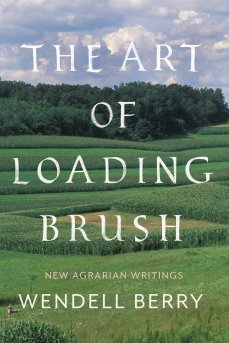
art of loading brushOne does not have to read far into an essay written by Wendell Berry to sense deep loss, a kind of sadness that both tugs and pulls.  As he acknowledges in his introduction to his most recent collection of writings, The Art of Loading Brush, his writings “have often repeated certain movements of thought” that are rooted in a particular experience in a particular place that echoes with the experiences of many, even those of us who hear what he says as an echo of an echo (of, perhaps, an echo).  Consider this from “The Thought of Limits in a Prodigal Age.”

The old complex life, at once economic and social, was fairly coherent and self-sustaining because each community was focused upon its own local countryside and upon its own people, their needs, and their work.  That life is now almost entirely gone.  It has been replaced by the dispersed lives of dispersed individuals, commuting and consuming, scattering in every direction every morning, returning at night only to their screens and their carryout meals.  Meanwhile, in a country everywhere distressed and taxed by homelessness, once-used good farm buildings, built by local thrift and skill, rot to the ground.  Good houses, that once sheltered respectable lives, stare out through sashless windows or have disappeared.

As one might guess from the title of the essay, the issue of limits and extravagance are at the heart of Berry’s thinking . . . and sadness.  To follow Michael Harris’s train of thought, Berry would see us unwittingly trading a healthy sense of limits with a sense that the world, its resources and possibilities, are limitless (and therefore worthy of our prodigal dispositions towards it).

Later in the essay, Berry comes to conclusions similar to Patrick Deneen concerning our contemporary approach to freedom:

We have the liberal freedom of unrestrained personal behavior and the conservative freedom of unrestrained economic behavior.

All of which puts us in a dangerous position as prodigal people in a prodigal culture.

+ + + + + + +

And so something about the way forward involves limits.  That’s not something that is easy for most of us to hear.  We would reject the sky if we were forced to believe that the sky really is the limit.  Berry is invested, though in both sky and sea, land and the life they bring together.  And if you’re going to talk about limits, you have to talk about the art of economics.  And, Berry asserts, the arts.

The good care of land and people . . . depends primarily upon arts, ways of making and doing.  One cannot be, above all, a good neighbor without such ways.  And the arts, all of them, are limited.  Apart from limits they cannot exist.  The making of and good work of art depends, first, upon the limits of purpose and attention, and then upon limits specific to the kind of art and its means . . .

Enduring structures of household and family life, or the life of a community or the life of a country, cannot be formed without limits.  We must not outdistance local knowledge and affection, or the capacities of local persons to pay attention to details, to the “minute particulars” only by which, William Blake thought, we can do good to one another.  Within limits, we can think of rightness of scale.  When the scale is right, we can imagine completeness of form.

+ + + + + + +

There is, of course, a danger in nostalgia for nostalgia’s sake.  But something should be said for understanding that what has gone before us has great value.  And that size does matter.  If nothing else, Berry’s sobering picture of “the dispersed lives of dispersed individuals” should give us pause and lead us to think seriously about the corner we have backed ourselves into.  A proper return to scale, and a kind of rejection of our twisted limitlessness, can provide some kind of road sign for a way forward.

(image from amazon.com)

Posted in Books, Faith, Notes for a World's End | Tagged | Leave a comment

Taking Two in July

Now that the hubbub over Avengers: Infinity War has died down (although really it hasn’t), we can turn our attention to the next entry in the Marvel Cinematic Universe: Ant-Man and the Wasp.  The trailer dropped today and probably went a long way in giving some movie-goers some comfort after this weekend’s exquisitely traumatizing end to Infinity War.  We already know that this movie is set in between Civil War and Infinity War, which gives it a two-year window.  I think the closest thing we’ll get to anything Infinity War-related will be in the closing stingers for the movie.

This trailer keeps things pretty down-to-earth, which is nice.  Hopefully there will be a lot more about the “quantum” nature of the universe, though, which could always come into play a good bit more in the near future.

Posted in Movies | Leave a comment

Notes for a World’s End

The World's EndAt the begin of Paul Auster’s apocalyptic In the Country of Last Things, the narrator makes a significant observation:

That is perhaps the greatest problem of all.  Life as we know it has ended, and yet no one is able to grasp what has taken its place.  Those of us who were brought up somewhere else, or who are old enough to remember a world different from this one, find it an enormous struggle just to keep up from one day to the next.  I am not talking only of hardships.  Faced with the most ordinary occurrence, you no longer know how to act, and because you cannot act, you find yourself unable to think.  The brain is a muddle.  All around you one change follows another, each day produces a new upheaval, the old assumptions are so much air and emptiness.  That is the dilemma.  On the one hand, you want to survive, to adapt, to make the best of things as they are.  But, on the other hand, to accomplish seems to entail killing off all those things that once made you think of yourself as human.

A few pages later, the narrator concludes:

What you must do, then, is to be prepared for anything.

The story, of course, gets more difficult from there.

+ + + + + + +

In his grossly under-appreciated work, The End of Absence, journalist Michael Harris asserts something similar, perhaps a tad bit less apocalyptic, but nonetheless revealing.  As he reflects on advances in technology, Harris is mindful that people of a certain again are able to recall both life before and after the digital divide of the last twenty years.  After reminding the reader of the 20th century techno-cultural prophet Marshall McLuhan, Harris writes of a “profound wreckage” that our new “medium” has wrought.  He continues:

As we embrace a technology’s gifts, we usually fail to consider what they ask from us in return– the subtle, hardly noticeable payments we make in exchange for their marvelous service.  We don’t notice, for example, that the gaps in our schedules have disappeared because we’re too busy delighting in the amusements that fill them . . . Why would we bother to register the end of solitude, of ignorance, of lack?  Why would we care than an absence has disappeared?

Harris’s wreckage is more hopeful than Auster’s narrator.  He continues:

. . . if we work hard enough to understand this massive game changer, and the name the parts of the new game we want to go along with and the parts we don’t, can we then pack along some critical aspect of our earlier lives that these technologies would otherwise strip from us?  Or will we forget forever the value of that lack and instead see only a collection of gains?  It’s hard to remember what we loved about absence; we never ask for our deprivation back . . .

If we’re the last people in history to know life before the Internet, we are also the only ones who will ever speak, as it were, both languages.

Because of this, Harris asserts that we should ask two key questions moving forward into whatever is next:  what will we carry forward? and what worthy things might we thoughtlessly leave behind?

+ + + + + + +

One thing I remember from some of my “philosophy of religion” studies in seminary was a quote from Anthony Thiselton that has long been lodged in my brain.  If I remember it correctly, Thiselton one time asserted that “history reminds us of what is possible; fiction reminds us of what is essential.”  I remember thinking the saying odd, like he had gotten the two things confused.  But I think the statement is true.  And now, as much or more than ever, we are living at a time where fiction and history, where what is possible and what is essential, are inextricably linked.

+ + + + + + +

Perhaps there are three kinds of people living today: those who have not heard of the Benedict Option, those who find the Benedict Option an utter necessity, and those who think that the Benedict Option is utter hogwash.  It can be an interesting Rorschach test.  The Benedict Option as articulated by Rod Dreher, of course, is often misconstrued as an over-reaction to our current historical moment, as a call to “head for the hills” because Christians have lost their say in what is vital to our culture.  You don’t have to ascribe to this Option (or any of the myriad others named after whatever philosopher or thinker strikes your fancy) to realize, to understand that things have changed/are changing.  you can see it in Kinneman and Lyon’s Good Faith or in Deneen’s Why Liberalism Failed.  Every end of the political spectrum feels like everything is in danger right now.  And every end of the spectrum is, in some way, correct.

The question is, how do we move through this?  I’ve been asking myself that for some time, most recently in my reflections around Radner’s A Time to Keep.  I would like to think that mine is a particularly Christian seeking and asking (though I sometimes find glimmers of hope and despair in other places, too).  A lot of my reading has been about trying to find some way through, knowing that around has never really been an option.  This has been brought to mind again recently because of life circumstance as well as the books I continue to read and the conversations I continue to long for.

+ + + + + + +

So I thought I’d start a thread for this.  Whether it’s Wendell Berry or Henri Nouwen, Alan Jacobs or James K. A. Smith, Tolkien or Lewis or Chesterton, my students or my family or my friends, they all connect somehow to this thread for things found and lost and found again.

How do you “prepare for anything” in a world that’s been changing for longer than you’ve known it?  And how do you hold on to and articulate unchanging truth in a world moving so quickly that the passing shadows end up chasing one another?  How do you, as Harris asserts, know what to carry forward without leaving worthy things accidentally behind?

(image from rottentomatoes.com, because Edgar Wright’s The World’s End is brilliant and deserves mention every time possible)


Posted in Books, Faith, Notes for a World's End | Leave a comment

Infinity War Unlimited

It’s been a long time since I got to have as much fun talking movies with my students.  Friday was a fun game of playing coy about what I saw Thursday night (“who’s your favorite hero?  Oh, good luck with that).  And today was a nice time catching up with other fans talking theories and favorite moments and reiterating “I don’t want to go, I don’t want to go” as students left the room.  Good fun.

And it’s good to see that the cast of Avengers: Infinity War has been having fun, too.  That’s one of the nice side-effects of a large-cast, tent-pole movie like this one.  Here’s a fun clip of “the Marvel bunch” from the Tonight Show.

And here’s the “After Avengers” clip that points towards tomorrow’s Ant-Man and the Wasp trailer release.

So let’s enjoy this infinite moment for as long as we can.  Let’s speculate and prognosticate away, because it could be a very long year.

Posted in Internet, Movies | Tagged | Leave a comment

The Real Business of the Infinity Gauntlet

Now that the Infinity Gauntlet is (or isn’t?) in play in Avengers: Infinity War, it’s time for the object of great power to get put to real use . . . particularly the use mentioned in this classic Parks and Recreation scene.  I think I’ve posted it before, but now’s a good chance to bring it back into short-term memory.

Posted in Movies, Television | Leave a comment

“There was another idea . . .”

So I’m about 24 hours away from the Avengers: Infinity War premiere.  I’ve “muted” what I could on Twitter.  I’ve stayed away from any reviews or websites (except for the Rotten Tomatoes score).  But I saw this commercial on TV tonight and had to chuckle a bit.

Hopefully I’ll get a spoiler-free review up before midnight tomorrow.  That’s the plan, at least.

Posted in Movies | Tagged | Leave a comment

9 Minutes of “40”

Sunday night at church we sang Psalm 40.  It was a nice rendition of the song and all, but I couldn’t help but think that maybe we could’ve sung U2’s (shortened) version of the Old Testament song of waiting and salvation.  So later Sunday night I risked a “deep dive” into YouTube to see if I could find a good rendition of the song that so often served as the end of U2’s concerts.  What I found was a recent post from a thirty-year old concert that captures something vital about a band that has done some amazing work.  It starts with some paraphrasing of the song, turns into a sing-along, and then morphs into a few different things (including the band’s requisite slow-fade from the stage at concert’s end).  I think it’s time well-spent.

Posted in Faith, Music, Scripture | Tagged | Leave a comment