Between the Programs and the Pews

RNS-PEW-CATHOLICFor the last year or so, I have often found myself thinking about my “pet false distinction” when it comes to church life: either “eat the body” or “be the body.”  The former points to a heightened place of liturgy that crescendoes in communion.  The latter points to a heightened place of the church program that crescendoes in mission.  I totally admit the false distinction, what I communicate to my students as the “either-or fallacy.”  Both of them, too easily and too often, are missing out on something that we neglect to our danger.  Henri Nouwen points to it in the “where do I begin?” chapter of Spiritual Direction.

Through the discipline of spiritual direction, we explore in the presence of another wise Christian companion or two God’s claim on our lives, what has been and what may now be.  We recognize God’s activity and again say yes to the direction in which the Spirit calls us.  The direction might be fearful or even quite radical, but we might also be surprised to see that the call of God is a call that is very attractive and that we are able to respond to it because we are being drawn by a loving force.

It is not enough, Nouwen asserts, for us to be content with something like this conversation of “spiritual direction” as a rare and limited thing.  And it’s not just “psychological questions with psychological answers.”  There is a deeply spiritual reality at play in between the programs and pews of our churches.  Nouwen continues:

It is important that we start to think about a ministry in which we help one another to practice spiritual disciplines and thus live in such a way that we become more sensitive to the ongoing presence of God in our lives.  What finally counts is not just that there are good spiritual men and women in this very chaotic world, but that there are communities of Christians who together listen with great care and sensitivity to the One who want to make this healing presence known to all.

This is no easy thing, definitely not as tactile as communion or as measurable as programs and projects.  And while it’s always been necessary, many of us have done a good job of making it optional at best and irrelevant at its worst.  Maybe it’s a “chicken or the egg” situation: we do not have people asking the questions because we are not practicing and showing a better way.  The sooner we can start practicing the better way, the sooner we will, perhaps, find people asking better and deeper questions.

(image from sojo.net)

Posted in Books, Faith, Notes for a World's End | Leave a comment

The Passage (not Saved by the Bell)

One of the best contemporary fiction reading experiences I’ve had over the last few years was with Justin Cronin’s The Passage.  The book was one of those rare “first in a trilogy” books that was so well-done that a continuation seemed almost unnecessary.

So I’m pleased to hear that FOX has picked up The Passage (with Mark-Paul Gosselaar as Wolgast) for a run this next season.  It’s been long enough that I don’t remember all of the details (and it’s no small book), so this trailer is engaging without giving too much away (or making too many easy call-backs).

FOX did a great job this past season with The Gifted, a comic book property that was basically X-Men without the X-Men.  If The Passage is anywhere near as good, as well-paced and well-acted, then it should be a great television experience.

Posted in Books, Television | Tagged | Leave a comment

Lanier and the Care of 21st Century Souls

Ten ArgumentsIn his recent interview with New York Magazine, futurist Jaron Lanier responded to a question about his “urgent” arguments against social media.  And while he has a whole book about the topic dropping at the end of the month, he ends the interview by positing a concern based on the spiritual consequences of digital life.  From the interview:

The argument is that social media hates your soul. And it suggests that there’s a whole spiritual, religious belief system along with social media like Facebook that I think people don’t like. And it’s also . . . phony and false. It suggests that life is some kind of optimization, like you’re supposed to be struggling to get more followers and friends. Zuckerberg even talked about how the new goal of Facebook would be to give everybody a meaningful life, as if something about Facebook is where the meaning of life is.

It suggests that you’re just a cog in a giant global brain or something like that. The rhetoric from the companies is often about AI, that what they’re really doing — like YouTube’s parent company, Google, says what they really are is building the giant global brain that’ll inherit the earth and they’ll upload you to that brain and then you won’t have to die. It’s very, very religious in the rhetoric. And so it’s turning into this new religion, and it’s a religion that doesn’t care about you. It’s a religion that’s completely lacking in empathy or any kind of personal acknowledgment. And it’s a bad religion. It’s a nerdy, empty, sterile, ugly, useless religion that’s based on false ideas. And I think that of all of the things, that’s the worst thing about it.

Just because it’s “phony and false” doesn’t mean that there’s nothing there, and I think Lanier knows it.  Like any emergent system, the network of social media apps has become something bigger than any one thing.  Even if it is a shadow of true living, it is still a kind of life.  Strange to think, but we’ve created and nurtured a culture of so little substance that social media has become a necessary substitute from which only some kind of people can afford to refrain.

+ + + + + + +

And so we might find ourselves hollowed out on both sides: socially and spiritually, on both the outside and the inside.  But the inside is vital.  The Three Ages of the Interior Life speaks of the complete necessity of a healthy interior life, of an interior space and conversation where creation and Creator meet.

This interior life thus conceived is something far more profound and more necessary in us that intellectual life or the cultivation of the sciences, than artistic or literary life than social or political life . . .

This shows the the interior life, or the life of the soul with God, well deserves to be called the one thing necessary, since by it we tend to our last end and assure our salvation . . .

The interior life of a just man who tends toward God and who already lives by Him is indeed the one thing necessary.  To be a saint, neither intellectual culture nor great exterior activity is a requisite; it suffices the we live profoundly by God.

For many of us, the ubiquity of technology has accelerated the chipping away or obliteration of any kind of interior life.  Evidence of “living profoundly by God” isn’t always easy to come across in the current climate.

+ + + + + + +

This dovetails nicely with the second question posed in Henri Nouwen’s Spiritual Direction: where do I begin?  Or, perhaps for some of us, where do we begin again when trying to make space for an interior life that serves as a well from which God’s Spirit can flow?  This is especially pertinent if so much of our lives now happen online.  Nouwen asserts:

There is a real tendency to think of the spiritual life as a life that will begin when we have certain feelings, think certain thoughts, or gain certain insights.  The problem, however, is not how to make the spiritual life happen, but to see where it actually is happening.  We work on the premise that God acts in this world and in the lives of individuals and communities.  God is doing something right now.  The chipping away and sculpting is taking place whether we are aware of it or not.  Our task is to recognize that, indeed, it is God who is acting, and we are involved already in the spiritual life.

And so the question arises: what space can we carve out from our routines that makes room for a God bigger than our technology?  And how do we put technology and its attendant apps back in the place of “tools” instead of the place of “masters”?  That will be a question good for us to wrestle with as we move deeper into the 21st century.  So the perceived “desert of the moment” brought on by the digital is the place that most of must start from.  That or we have to set up places of rescue on the desert’s edge, ready and waiting for the exiles and refugees of digital life.

(image from amazon.com)

Posted in Books, Faith, Notes for a World's End | Tagged | Leave a comment

A Land of Lonely Hunters

comment.transparentlogoA common theme from the last few weeks of news articles and essays and reading points to the issue of loneliness as a real fruit of our modern era.   I suppose we’ve known this since the release of Bowling Alone, at least.  But loneliness has its many facets, makes appearances in surprising ways at every stage of life.

The folks over at Comment Magazine are putting together a summer issue dealing with loneliness and social isolation.  They’ve already posted this editorial from James K. A. Smith and this essay from Wesley Hill about loneliness and celibacy.  It is good to see difficult things addressed well.

Henri Nouwen also has something to say about loneliness in his collected writings on Spiritual Direction.  From the chapter on “Who Will Answer My Questions?” Nouwen writes

To live the questions requires that you first look within yourself, trusting that God is present and at work within you.  This is a very difficult task, because in our world we are constantly pulled away from our innermost self and encouraged to look for answers outside of ourselves.  If you are a lonely person, you have no inner rest to ask, wait, and listen.  You crave people in the hope that another will bring you answers.  You want them here and now.  But by first embracing solitude in God’s presence, you can pay attention to your inner, clamoring self before looking to others for community and accountability.  This has nothing to do with egocentrism or unhealthy introspection because, in the words of Rainer Maria Rilke’s advice to a young poet, “what is going on in your innermost being is worthy of your whole love.”

Sobering words, yet true.  And they hold out the hope of being some kind of corrective for a society and culture of growing loneliness.

You can learn more about Comment Magazine here.

Posted in Books, Faith, Notes for a World's End | Tagged , | Leave a comment

Ascension Day

I was glad this morning to read the Daily Office reading of Daniel 7:9-14 (ESV).

“As I looked,

thrones were placed,
    and the Ancient of Days took his seat;
his clothing was white as snow,
    and the hair of his head like pure wool;
his throne was fiery flames;
    its wheels were burning fire.
10 A stream of fire issued
    and came out from before him;
a thousand thousands served him,
    and ten thousand times ten thousand stood before him;
the court sat in judgment,
    and the books were opened.

11 “I looked then because of the sound of the great words that the horn was speaking. And as I looked, the beast was killed, and its body destroyed and given over to be burned with fire. 12 As for the rest of the beasts, their dominion was taken away, but their lives were prolonged for a season and a time.

13 “I saw in the night visions,

and behold, with the clouds of heaven
    there came one like a son of man,
and he came to the Ancient of Days
    and was presented before him.
14 And to him was given dominion
    and glory and a kingdom,
that all peoples, nations, and languages
    should serve him;
his dominion is an everlasting dominion,
    which shall not pass away,
and his kingdom one
    that shall not be destroyed.

The day, of course, got away from me, as Thursdays often do.  But it’s been nice this afternoon, with the day slowly fading, to remember the significance of this day in the biblical narrative.  It is a good reminder, in this time removed from Easter, to be redirected to what is beyond us and ahead of us.  I thank God for the Son who rises.

Posted in Faith, Scripture | Leave a comment

Nouwen and the First Question

QuestionsFor a number of years I have been convinced that one of the best things that I can do as a teacher is to ask good questions.  Question-asking has been particularly fruitful with upperclassmen, as it allows for a more mature response amongst people who may have been around one another a lot without really getting to know each other all that well.  So I was pleased to see that the editors who put together Henri Nouwen’s Spiritual Direction used the framework of questions, with each chapter posing a question tied directly to the disciplines of Heart, Book, and Community.  The book’s first question is one I found to be one of the most pertinent: who will answer my questions?

+ + + + + + +

One of the statements in this section of Nouwen’s book that strikes me most is the assertion that

Without a question, an answer is experienced as manipulation or control.  Without a struggle, the help offered is considered interference.  And without the desire to learn, direction is easily felt as oppression.

As a teacher I’ve had to wrestle with that first sentence: answering a question before it is even asked.  The better option, of course, is to lead people to ask the right questions and to understand the stakes of asking the right question well.  I think this is especially true . . . and difficult . . . when it comes to the spiritual life.  Here’s how Nouwen connects direction and questions:

Seeking spiritual direction, for me, means to ask the big questions, the fundamental questions, the universal ones in the context of a supportive community.  Out of asking the right questions and living the questions will come right actions that present themselves in compelling ways.  To live the questions and act rightly, guided by God’s spirit, requires both discipline and courage . . .

+ + + + + + +

I would argue that many of us don’t know where to go to ask the questions rooted in our hearts, the big questions.  As Nouwen points out, the willingness to ask questions and seek answers brings with it a vulnerability that can be difficult to handle.  We don’t like not having the answers.  Beyond that, we don’t know what to do with that weird no-man’s-land that exists before the answer we find gets internalized on our part.  By that I mean there’s a small-but-wide distance between the head knowledge of an answer and the heart knowledge of that answer.  We do our best to live with the first until we find ourselves embraced by the second, but that can take time.

What is clear from holding life up to Nouwen’s framework of Heart, Book, and Community is that the three are so intwined that you can’t hold them apart for long.  The answers to our hearts’ questions are answered in the Bible.  And those necessary questions are best understood in the context of the Christian community.  And yet sometimes the three seem so opposed to one another . . . or at least so distant from one another . . . that the dissonance keeps us silent and distant ourselves.

+ + + + + + +

And so who will answer our questions? involves but is bigger than the heart.  For Nouwen, part of asking the question means living the question (something that I learned from Donald Miller years ago, actually).  The other part means finding people who can ask and answer and live through those questions with you.  Which means we need pastors who can ask and answer questions with us.  We need teachers who can ask and answer questions with us.  Parents and children and friends co-workers.  We must learn to ask the questions together knowing that there are answers, that God provided and provides those answers, and that those questions and their answers have and can be lived out with real conviction.

(image from 3aw.com.au)

Posted in Books, Faith, Notes for a World's End, Teaching | Tagged | Leave a comment

Triangulating for Spiritual Direction

TriangulationBefore beginning the main discussion in Spiritual Direction, Henri Nouwen points to three different points of connection, spiritual disciplines, that are necessary for a healthy approach to a wisdom that can help us “to slow down and order our time, desires, and thoughts to counteract selfishness, impulsiveness, or hurried fogginess of mind.”  Those three things deserve some attention, I think, before moving forward.

+ + + + + + +

The first “discipline” for spiritual direction is what Nouwen calls “the discipline of the Heart.”  Nouwen sees this as “first and most essential” in a way that could cause concern for many Christians.  But I understand where he’s coming from: it’s clear that most of us have absolutely no idea what to do with our hearts.  We know it’s “deceitful above all things” (Jeremiah 17) even while it is the thing we need to guard “because everything we do flows from it” (Proverbs 4).  Nouwen links this discipline with the work of more ancient Christians, particularly in the area of prayer.  Nouwen asserts:

The discipline of the Heart makes us aware that praying is not only listening to but listening with the heart.  Prayer helps us stand in the presence of God with all we have and are: our fears and anxieties; our guilt and shame; our sexual fantasies; our greed and anger; our joys, successes, aspirations, and hopes; our reflections, dreams, and mental wandering; and most of all our family, friends, and enemies– in short, all that makes us who we are.  With all this we have to listen to God’s voice and allow God to speak to us in every corner of our being.

I read this and remember what Eugene Peterson once said: that his main task as a pastor was to teach his parishioners how to pray.  The kind of prayer Nouwen writes of hear sounds a million miles removed from most of our experiences in churches and with other Christians.  But I also think that Nouwen is onto something, particularly in light of the quote that closes this post.

+ + + + + + +

The second discipline on Nouwen’s list is probably the one that most of us would put as first: “the discipline of the Book.”  For this, Nouwen speaks of looking “to God through lectio divina— the sacred reading of the scriptures and other spiritual writings.”  This reading leads back to prayer, Nouwen asserts.

When we listen to a sentence, a story, or a parable not simply to be instructed, informed, or inspired but to be formed into a truly obedient person, then the Book offers trustworthy spiritual insight . . . Scripture does have a personal word for us, yet knowledge of the historic Christian teaching helps us avoid the easy trap of wanting scripture to support our own designs.

For me this means having a sense of the Biblical Story as a whole (with thanks to Wright, for me) so that I can understand how to play my role fittingly (with thanks to Vanhoozer, for me).  It is the reminder that whatever “self-actualization” or “will of God” for my life must fall in line with the work of the Trinity in the Bible and the world around me.  This doesn’t mean proof-texting and abstracting Scripture so that it means whatever you want in the moment.

+ + + + + + +

The third area of focus from Nouwen’s perspective is “the discipline of the Church or faith community.”  Nouwen asserts that “this spiritual practice requires us to be on relationship to the people of God, witnessing to the active presence of God in history and in community.”  He goes on to say that

A faith community reminds us continuously of what is really happening in the world and in our lives.

Nouwen speaks if the importance of the common language and practices of “church liturgy and lectionary” and the formation that can occur when we follow “Christ’s life throughout the year.” Nouwen adds that

To listen to the Church is to listen to the Lord of the Church.

This, I would argue, is not what most of us think when we consider how the Church can help us understand the world around us.  I consider the local church vital to my own spiritual growth as a youth and young adult, and that was without liturgy and lectionary.  And now that I have a better sense of those two things, I find some confusion about the role that the Church should play.  How does one bring the events of life and the world to bear on conversations with the Church about the spiritual life?  Even still, the Church in both its history and immediacy should be vital to making headway in spiritual direction.

+ + + + + + +

In yesterday’s post I attempted a “play” on the Nietzsche-quote-turned-book-title about “a long obedience in the same direction,” which is a goal that we all should have with the spiritual life, particularly as we embrace it over a life-time in the context of a shifting (church) culture.  The great hope, of course, is that things will “get fixed” when we get all of the right ingredients in place, particularly our hearts, Scripture, and the church.  Thankfully, Nouwen reminds us to think wisely and clearly about that:

To receive spiritual direction is to recognize that God does not solve our problems or answer all our questions, but leads us closer to the mystery of our existence where all questions cease.

That, I think, is no vague truth.  It is to behold well the One who is the Way, the Truth, and the Life in all His crucified, resurrected, and ascended glory.  But the beholding, even for a moment, isn’t all that easy.

(image from 4n6.com)

Posted in Books, Faith, Notes for a World's End, Scripture | Tagged | Leave a comment

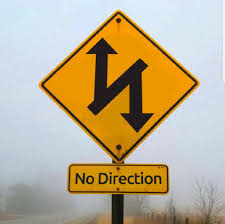
Nouwen and a Long Obedience with No Direction

No DirectionIn yesterday’s post I asked a question that twisted the popular 2 Corinthians 4:16-18 passage a bit: what if the changes effected in contemporary culture have led us to feeling more renewed in body but more diminished, even damaged, in soul?  And if that is true, what, if any way, can lead us towards some kind of healing?  And is there a way beyond the fad and fashion of the moment that can help us?

+ + + + + + +

I would like to exist in a world where good and honest questions can be asked and the Bible could be used both to open and answer those kinds of questions.  In my experience, that’s not as likely as it should be.  So one way of trying to draw out the necessary conversation is to insert the work or words of another.  And so bringing in Aquinas to help triangulate a discussion of faith and the nature of the universe can work well in ways that simply presenting Genesis 1 or Colossians 1 cannot (which is not the Bible or God’s fault, mind you).  And so you bring C. S. Lewis into a conversation on morality or J. R. R. Tolkien into a conversation about creativity.  You could also venture out into areas and authors not normally tied to particularly Christian conversations.  That can work as long as there is a real grounding in Christian orthodoxy matched with a real sense of how to handle more ambiguity in conversation than usual.

+ + + + + + +

One of the Christian authors who has been particularly helpful for me over many years when considering the spiritual condition of people has been Henri Nouwen.  His Creative Ministry was a huge early influence on my understanding of the various aspects of ministry (and I picked that one up because the closest bookstore didn’t have a copy of The Return of the Prodigal, his most famous book, and one I still have not read).  As with almost any other Christian thinker (and feeler), Nouwen has his detractors, which is understandable.  It’s rare to agree with everything anyone says.  But I have found real nourishment and challenge in his writing.  That’s part of the reason why I spent spring break reading through two posthumous collections of Nouwen’s thought: Spiritual Direction and Spiritual Formation.  I read them partly to balance out some of the headier reading that I was doing.  I also read them because this year of transition (tied to what I’ve called my temporary vocational stretch) had left me in need of some framework for processing the current moment.  I found that in both books, with the questions of Spiritual Direction and the “movements” of Spiritual Formation.

+ + + + + + +

I first learned of the concept of “spiritual direction” from Eugene Peterson (in one of his pastoral books, The Contemplative Pastor, perhaps).  The concept has always intrigued me, partly because of the potential it holds for someone in the pastorate but also because of my own need for some kind of direction that goes deeper than just a “duty” mentality for the spiritual life.  But spiritual direction can be hard to find.

In fact, I’d posit that a large chunk of any contemporary Christian malaise could be attributed to our inability to engage in the kinds of conversations that spiritual direction implies.  From the book’s introduction:

The goal of spiritual direction is spiritual formation– the ever-increasing capacity to live a spiritual life from the heart.

And then:

Any spiritual direction commitment affords the opportunity for spiritual friendship, and provides the time and structure, wisdom and discipline, to create sacred space in your life in which God can act.

On some level, this is Christian Discipleship 101.  It is time and space shaped by prayer and Scripture and accountability.  But it also intentionally brings what one of my college professors called “the vicissitudes of life” into the conversation in a way that looks like a conversation longer than a quiet moment here or there.  It includes something Nouwen calls “spiritual friendship,” which is maybe a way of elevating the idea of “brother in Christ” as something including but much more than simply a “brother in crisis” when life goes haywire.

+ + + + + + +

The title of this post is a twist on a Nietzsche quote “redeemed” by Eugene Peterson as a title for a book on “discipleship in an instant society.”  One could easily argue that many of us now exist in a contemporary Christian culture worn out by constant movement, unending activity, with no real sense of direction or intention (beyond “that’s what we’re supposed to do”).  What I’d like to do over the next few days is glean some wisdom from Nouwen’s approach to spiritual direction as I think about a transition from one moment in life to the next.  Nouwen asserts, I think in most instances rightly, that he has

a lot more to say . . . because the journey of the spiritual life calls not only for determination and discipline, but also for an experiential knowledge of the terrain to be crossed . . . In the terrain of the spiritual life, we need guides.

If we are going to move with intention and direction, if we are going to move from one world to the next with a real hold on the nuts-and-bolts of the Christian life as vital to the human experience, He might have something to say.  The terrain is beautiful but also dangerous, easily to get lost in and even easier to give up on.  I’d like to go as far as I can in the right direction.

(image from a band on Facebook named “No Direction”)

Posted in Books, Faith, Notes for a World's End, Scripture | Tagged | Leave a comment

A Different Wasting Away

clay jarsLong before I knew him as the author of Old School, one of my favorite novels, Tobias Wolff was the author of one of my favorite quotes: we are made to persist– that’s how we find out who we are.  Last week I posed the question of what it might look like for us to persist in light of what some perceive to be an interregnum between “ages,” between worlds and ways of life.  This week, I’d like to spend some time drawing some spiritual connections for the contemporary moment, what it might look like to persist as Christians in this particular context.

+ + + + + + +

This past weekend I was reading a book that made passing mention of 2 Corinthians 4:16-18 in the context of the spiritual life.  It’s a famous passage, though perhaps not as famous as Paul’s image ten verses earlier about “this treasure in jars of clay.”  Paul writes:

So we do not lose heart. Though our outer self is wasting away, our inner self is being renewed day by day.  For this light momentary affliction is preparing for us an eternal weight of glory beyond all comparison,  as we look not to the things that are seen but to the things that are unseen. For the things that are seen are transient, but the things that are unseen are eternal.

Paul, of course, is writing to particular people in a particular context.  There are certain non-repeatable realities at play in first-century Corinth.  It is clear from the context of 2 Corinthians 4 that Paul and other Christians are experiencing a real “wasting away” of the body/outer self because of persecution and hard work.  At the same time, these many years later, we know (or are learning) what it feels like for our bodies to betray us, even if only from the normal wear-and-tear of life.  But what if the second half of the equation has changed?  What if, instead of daily renewal, we experience a kind of loss in the inner self?  Oswald Chambers, I think, called it “spiritual leakage” that you just don’t notice because the damage is subtle.  What if we have no real sense of the “eternal weight of glory” that we are being prepared for because our “theology of suffering” has itself suffered?  What if, in line with Ephraim Radner, our traversal of the Great Transition has left us with better physical health but with less ability to understand and nurture the necessary inner self?  What if our embrace of things transient has left us with little to no grasp of “the things that are unseen” and eternal?  And  how do we “redirect” ourselves in better ways that call us back to a daily renewal?
(image from neighbourhoodchurch.org)
Posted in Books, Faith, Notes for a World's End | Leave a comment

The Thing with Tully

TullyThe first thing I did after breakfast yesterday was buy a copy of Chuck Palahniuk’s latest novel, Adjustment Day.  This was an unpredictable decision, as I haven’t read any long-form Palahniuk in a good long while.

The next thing I did was catch an early showing of Tully, a dark comedy from Diablo Cody and Jason Reitman starring Charlize Theron.

Then Tully, almost out of nowhere, turned into a kind of Chuck Palahniuk story.

And just a few paragraphs into reading it, Palahniuk’s new  novel turned into something that could easily be found in today’s headlines.

It was a weird Saturday morning.

+ + + + + + +

Tully is a difficult movie to watch.

And Charlize Theron is brilliant in it.

One could easily see this as a thematic “sequel” to another Cody-Reitman-Theron story, Young Adult, which was equally gripping and disturbing.

By disturbing and difficult, I don’t mean unwatchable or disgusting.  I mean so potentially grounded in reality that you can’t help but feel the awkward laughter rising in your gut because, even if you’re nothing like Theron’s character, you know you’re watching something true.

In Tully, Theron plays Marlo, wife of Ron and mother of three (the movie begins with #3 on the way).  Upon realizing how utterly defeated she feels with her life-situation after the birth of Mia (#3), Marlo decides to take her brother up on his offer for a “night nanny.”  Enter Tully, played deftly by Mackenzie Davis.  Watching Marlo and Tully bond over Marlo’s life experience is both awkward and enthralling (the awkward is the first few times Tully comes to work, the enthralling is the period of time that Tully effects real change for Marlo).

Tully is ultimately the story of a lonely woman, wife, and mother, struggling to make sense of her moment in time.  Theron and company do an amazing job of helping Marlo’s world feel claustrophobic with a dash of meaninglessness, too.  And when the resolution comes, and it comes from an unexpected place, it rings true in a good but difficult way.

“I’m here for the transition,” Tully tells Marlo twice as the story comes to an end.  It doesn’t take spouse and children to know that such is life . . . and such is the need for others who can be with us through those transition moments.

(image from nytimes.com)

Posted in Books, Movies | 1 Comment