
It was the book’s key phrase, “Only Connect,” that led me to purchase a copy of E. M. Forster’s Howards End a few years ago. I forget what writing about community included the quote, but it was more than enough to get me to look for a Barnes and Noble Classic edition. I read the first few pages and couldn’t get into it at all. (I am too often that way with anything that carries a whiff of the classics, unfortunately. Maybe it’s my way of saving things for later in life?)
I had heard word that a cable company was doing an adaptation of the book, but it wasn’t something I pursued. But I’ve also been missing some BBC from my life (such a long break for Doctor Who while Broadchurch and Orphan Black are both over and done). So when it showed up in iTunes over the weekend, I thought I’d give it a try. I have to admit, it was quite enjoyable. Granted, I have not seen the 1992 Academy Award-winning adaptation, but I sometimes take an approach to classic movies that reflects my approach to classic books.
What I like about the story really is the interesting approach it takes to the idea of connection and interpersonal responsibility. The story follows two sisters, the Schlegels, as the connect up and down socially in turn-of-the-century England. Their interest in books and music and the humanities is something you just don’t see articulated all that often. And when they find people in other “classes” that share some of those interests . . . well, it’s an opportunity for both connection and disaster. There are some very hopeful moments, moments where a thing like loneliness is named, moments where you believe that we have within us the ability to transcend some of the ways life divides us. And then there are the disastrous moments where the connection goes bad, where the other parts of what make us human work against our hopes of “only connecting.”
It probably isn’t a mini-series for everyone. There’s a lot of talking but not much action. Fans of the earlier movie will probably find much to dislike (though Hayley Atwell and Philippa Coulthard are brilliant as the Schlegel sisters). Perhaps more than many recent works, though, it hints to and points at something that too often is missing from our discussion of life and culture today. Something spoken plainly of in this current First Things article. Even at its darkest, though, Howards End points to the possibility of connection, which is no small thing in our world today.
Here’s a look at the trailer for the series. Be warned: spoilers.
 Today marked the birthday of one of my favorite authors, G. K. Chesterton. To mark the occasion, a number of fans on Twitter shared how they were introduced to the early-20th century author. For many it was their involvement with the Roman Catholic church. For other, it was the writings of C. S. Lewis or some other apologist. For me, it was the autobiographical writings of Frederick Buechner. His first autobiographical book, The Sacred Journey, introduced the character of Sunday as found in The Man Who Was Thursday, which was the first full Chesterton book that I read in college. From there it was to Orthodoxy and then to some of his other writings. This past Christmas I joyfully ordered a copy of The Spirit of Christmas, a collection of essays, stories, and poems about the Christmas season. I look forward to reading it during the Advent and Christmas seasons for many years to come.
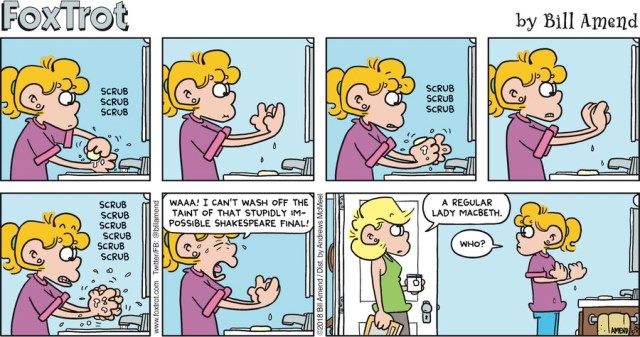 (image from gocomics.com)
 A few weeks ago I asked my students a round of questions about marriage and friendship. As is often the case with seniors, the answers were interesting. A couple of kids, quite out of the blue, decided to answer my questions with references to Parks and Recreation, one of the last great sitcoms. The students pointed out the way that characters like Leslie Knope and Ben Wyatt and even Ron Swanson were able to embrace both romantic love and real friendship in ways rarely seen.
 Last night I caught a last-minute early showing of Solo: A Star Wars Story. I had kind of talked myself out of any early showing. Buzz around the movie had been mediocre at best. There had been some drama behind the scenes, which is always a warning sign (even if you bring in Ron Howard to fix it). But then, as the school year’s end came closer, I thought I’d see if there were any early tickets available. There were, and so I went.
 (image from gocomics.com)
 Yesterday marked the end of the Easter season. A week and a half after marking the ascension of Jesus, the church celebrates the day of Pentecost, a commemoration of the birth of the church through the presence of the Holy Spirit. At the church service I attended last night, the sanctuary was accented with red and leis were exchanged during the passing of the peace. It was a nice way to mark the end of a particular part of the church’s liturgical calendar.


 Space Enough, and Time