The Gospel Charge to Stay Awake

Yesterday’s Gospel reading from the Daily Office started with one of my favorite “kingdom” verses and then moved into O’Donovan/wake-up territory.  The “kingdom” verse and following from Luke 12:

32 “Fear not, little flock, for it is your Father’s good pleasure to give you the kingdom. 33 Sell your possessions, and give to the needy. Provide yourselves with moneybags that do not grow old, with a treasure in the heavens that does not fail, where no thief approaches and no moth destroys. 34 For where your treasure is, there will your heart be also.

I love the image of the Father’s gift of the kingdom . . . that it’s His “good pleasure,” too.  The bundle of the two verses following add to the significance of pursuing an “kingdom” life, too.

And then the O’Donovan part:

35 “Stay dressed for action and keep your lamps burning, 36 and be like men who are waiting for their master to come home from the wedding feast, so that they may open the door to him at once when he comes and knocks. 37 Blessed are those servants whom the master finds awake when he comes. Truly, I say to you, he will dress himself for service and have them recline at table, and he will come and serve them. 38 If he comes in the second watch, or in the third, and finds them awake, blessed are those servants! 39 But know this, that if the master of the house had known at what hour the thief was coming, he would not have left his house to be broken into. 40 You also must be ready, for the Son of Man is coming at an hour you do not expect.”

Be ready.  Be found awake when the master returns.  Be dressed for action.

This weekend I was rereading Stanley Hauerwas’s essay on “How I Think I Learned to Think Theologically,” which I read a couple of years ago but hadn’t revisited since.  I was surprised to see O’Donovan’s thoughts from Self, World, and Time show up throughout the essay.  It was good and encouraging to see the weaving.

Posted in Books, Faith, Notes for a World's End, Scripture | Leave a comment

Once More, Rural Juror

Earlier this week I won a new TV (at the year-end luncheon).  It was a nice surprise.  So before I set it up this evening, I had one last episode of 30 Rock to finish on my old, two lines down the left side of the screen, TV.  Fittingly, it was the season seven finale, which was also the show’s final episode.  One of the many things 30 Rock succeeded at being was a love-letter to television (same sentiment but opposite approach when compared to Studio 60 on the Sunset Strip).  Here’s the closing scene/song for the show, giving us the most we ever got of that great 30 Rock gag, “The Rural Juror.”

Truly, the words don’t really matter.

Posted in Music, Television | Tagged | Leave a comment

About MeowMeowBeenz

I finished Jaron Lanier’s Ten Arguments for Deleting Your Social Media Accounts Right Now a couple of days ago.  There were a number of times while reading the book, particularly when Lanier hit a social-relationship beat, where this plot-line from Community came to mind.  Behold: MeowMeowBeenz.

The fifth-season episode turned into a great sci-fi/social commentary episode that we would all do well to watch at some point.

I’ll get my thoughts on Lanier’s book together soon.

Posted in Books, Television | Tagged | Leave a comment

“Hope in the Disastrous World of Time”

Grey HavensIt’s always good to find writers you appreciate writing well about the stories you love.  Even though I can’t yet bring myself to reread the Harry Potter series, I always enjoy reading things about the story of “the boy who lived,” including the essays by Alan Jacobs about Potter’s adventures.  So I was doubly-glad to see him posting some reflections on The Lord of the Rings.  The context: a response to some thoughts from British science fiction writer Adam Roberts on the possibility of healing.  Jacobs writes:

I would say that healing is not only possible for Tolkien but inevitable — and yet inevitable in a very curious way. That magnificent moment in The Lord of the Rings when Sam, having expected to die on Mount Doom, awakens to find that he is alive and so is Frodo and so is Gandalf and so cries, “Is everything sad going to come untrue?” — surely this is the most perfect embodiment in his writings of what Tolkien calls “eucatastrophe”

“Eucatastrophe,” of course, it the word Tolkien used as a contrast to catastrophe: in this case, a good and joyful ending.  Jacobs wisely notes that victory in Middle Earth is never as final as one might like.  The most recent sense of that can be found in the cinematic version of The Hobbit, where we see the confrontation between the White Council and a reemerging Sauron.  Jacobs goes on to say:

That all victories over evil are contingent and limited and temporary is a strong theme here — and the forgetfulness of all the races of Middle Earth tends to reinforce those limits, and makes the return of evil more likely even among those who start out with “clean earth to till.”

And so, as Tolkien puts it (and Jacobs echoes) there is a long defeat that points to some ultimate, final victory.  But it is not this day.

There will be, then, a “final victory,” but that will be (to return to the quotation from “On Fairy Stories”) “beyond the walls of the world.” Within the walls of the world all victories, all healing, will be temporary and imperfect — eucatastrophic only in the short term. In the longer term the effects of even the most heroic and righteous deeds will seem so narrow and brief that they will scarcely seem worth doing.

Which is why, for Tolkien, the best impetus to heroic and righteous deeds comes from some intuition of a final victory not in history but beyond history. To lack that intuition while clearly seeing the “long defeat” of history clearly is the curse of Denethor — not a person, for all his wisdom, to envy. For Tolkien, the suspicion that there is some perfect righteousness “beyond the walls of the world” is what prompts righteousness and generosity in the here and now. It’s what might make some of us strive to “uproot evil in the fields that we know, so that those who live after might have clean earth to till.”

It’s a beautiful post.  You can read all of it here.  And, as always, you can read your way into the world of “the long defeat” in The Hobbit and The Lord of the Rings.

(image from the University of Leicester)

Posted in Books, Faith, Notes for a World's End | Tagged , , | Leave a comment

Opening Your Eyes

Yesterday I posted some reflections on Oliver O’Donovan’s assertion that something significant happens in one’s life when you “wake up” to the world.  Whenever I think of waking up to the world around you, of finding yourself somewhere else or new, this scene comes to mind.

I wish the clip from the first episode of LOST was a little longer.  Jack wakes up, unaware of his surroundings, hearing things, encountering a dog, getting up and running to a beach (past that one hanging shoe).  Whatever world he is in now is completely different than the world before he lost consciousness.  It’s a great illustration of what O’Donovan might be going for.

+ + + + + + +

After articulating the place that “waking up” plays in the language of the biblical story, O’Donovan asks a series of significant questions that lays out his approach to life in the world:

To what, then, must we wake?  To what give our fullest attention?

He sees the answer given in the Bible in three parts.  First, we wake up to “the truth of the world.”  By this O’Donovan means a world (called “my world”) that is “bounded past and future by a world which was not and will not be mine, which did not and will not surround me, interact with me, condition and respond to me.”  This is a reality that is “beyond myself” yet still somehow includes me.

Second, we wake up to a self of some kind. “The summons to wakefulness is therefore a summons to attend to my agency,” O’Donovan declares.  But we wake up in a world that is already before and will later be after us, so “even when my first observations of the world were granted to me, knowledge of my self lagged behind them.”  As such, we are always catching up.

Finally, we wake in time.  “World and self are co-present only in the moment of time which is often to us for action.”  Which sounds kind of existential and somewhat contingent, but I understand what O’Donovan is going for here (I think).  “The opening of the present is to the future, but not equally to the whole of the future but to the future immediately before us, the next moment into which we may venture our living and acting, the moment which presents itself as a possibility.”  And so we are pressed in on both sides by time, with the future as the only real opening and the present as our opportunity, however limited, to walk well into what is next.

+ + + + + + +

It feels a bit like knowing and naming the arena of your existence, these three assertions O’Donovan makes concerning our being awake and attentive.  The knowing and naming are important, two things that require genuine humility and deep trust.  But if we are awake, then we are somehow responsible.  The question then is “where do we go (and what do we do) from here on out?”

Posted in Faith, Notes for a World's End, Television | Tagged | Leave a comment

Waking Up/Staying Awake

Last month I started a new tag and thread on the site about “Notes for a World’s End.”  The premise of the thread was that this current moment is an odd but interesting turning point for me (and perhaps for others) on multiple levels.  The hope of the thread is to draw together some resources and reflections for making this particular moment a little clearer, not out of despair but our of faith, hope, and love.  I spent a few days looking at the first couple of questions asked in Henri Nouwen’s Spiritual Direction.  And while I plan to return to Nouwen at some time soon, I’ve had a nice and challenging detour to my thinking thanks to a book I bought years ago but never read.

+ + + + + + +

Self, World, and TimeEvery spring, I spend a quarter of the school year talking about ethics with seniors.  It’s one of my favorite times of the year.  There’s a lot of good presuppositional “stuff” that goes into the conversation of how we determine something to be right or wrong.  And while I help my students be aware of multiple approaches to ethics, I hope that they will see the biblical story as a vital lens for decision-making.  But that can be difficult since many students tend to write off the Christian faith as something that actually shuts down conversation.  Some time ago, I think it was because of a comment by James K. A. Smith, I purchased a copy of Self, World, and Time, the first of three books about “ethics as theology” by Anglican theological Oliver O’Donovan.  I just couldn’t get into it.  I’ve since read a couple of shorter things by O’Donovan and found him to be a great, relatable thinker of the ethical dimension of the church in the 21st century.  So I decided to give Self, World, and Time another chance.  He has something good, I think, about “finding a way forward” for Christians striving to live faithfully and fittingly in our part of the biblical story.
+ + + + + + +

Within four pages of the the book’s first chapter, O’Donovan used a word, a metaphor, that I have come to appreciate greatly over the last few years, mostly because of its presence throughout the Gospel narratives and the writings of Paul.  It is the image, the metaphor, of waking up/staying awake.  O’Donovan roots this in a conversation about moral awareness, which definitely connects to a bigger picture of living fittingly and faithfully.  O’Donovan asserts:

Let us say, we awake to our moral experience in the beginning.  What seems like the beginning is not really a beginning at all.  We wake to find things going on, and ourselves going on in the midst of them.

This moral awakening, O’Donovan, points to an “awakening that will be complete and final: ‘Awake, sleeper, rise from the death, and Christ will shine upon you!'” from the fifth chapter of Paul’s letter to the church in Ephesus.  From there, he traces the biblical instances of waking from sleep, pointing out that the charge to “wake up” in the Old Testament seems to be spoken to God quite often.  Then it shows up in the apocalyptic parables and sermons of Jesus, in certain moments of His passion week, and ultimately in John’s Revelation.  O’Donovan concludes:

And so the command to wake is addressed in the New Testament chiefly to the church, which out to be able to count, if any agent could, on being awake already.  It sets the church in a moment of crisis, put on the spot, by relating the achieved past to the future of Christ’s coming and to the immediate future of attention and action.  Wakefulness is anything but a settled state, something we presume on, as we can usually presume we are awake as we go about our business.  It brings us sharply back to the task in hand, the deed to be performed, the life to be lived.  Waking is thrust on us.  We do not consider it, attempt it and then perhaps achieve it; we are claimed for it, seized by it.  That is why it is not just one metaphor among many for moral experience, but stands guard over the birth of a renewed moral responsibility.

+ + + + + + +

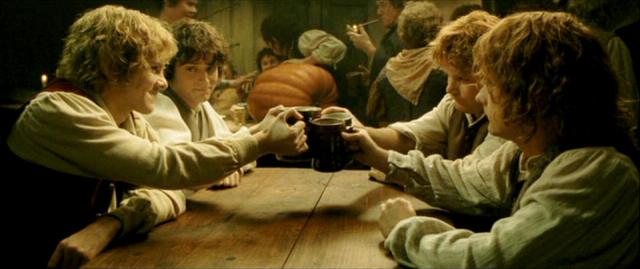
One can easily imagine the significance of this idea, this truth, to stories and literature involving high stakes and worlds on the brink of being lost forever.  Often it is the weight of the world and one’s journey through it that tires one out, leaves us nodding off.  You get a glimpse of that even (and perhaps especially) at the end of Frodo’s journey in The Lord of the Rings.  Upon the completion of their task, as the four hobbits return to Hobbiton after Gandalf’s departure, Tolkien writes:

“Well here we are, just the four of us that started out together,’ said Merry. ‘We have left all the rest behind, one after another. It seems almost like a dream that has slowly faded.’

‘Not to me,’ said Frodo. ‘To me it feels more like falling asleep again.”

Hobbits back in Hobbiton+ + + + + + +

And so in this little metaphorical (or digital) notebook for a world’s end I cannot help but write two simple words: stay awake.  I’ll come back to the idea and O’Donovan’s approach to it over the next couple of days.

(images from amazon.com and lotr.wikia.com)

Posted in Books, Faith, Notes for a World's End, Teaching | Leave a comment

Beyond Information and Skill

Caldecott WordNow that the school year is over, I have the time to think through changes for classes in the fall.  I recently tracked down my copy of Stratford Caldecott’s The Beauty of the Word.  Written from a particularly Catholic perspective, the book is a nice gloss on the classical trivium and Dorothy Sayers’ “Lost Tools of Learning.”  It’s a good resources for me as I look to tweak some language and articulations of curriculum.

One of the educational assertions made early in the book has to do with the very purpose of education.  From Caldecott:

… education is not primarily about the acquisition of information.  It is not even about the acquisition of ‘skills’ in the conventional sense, to equip us for particular roles in society.  It is about how we become more human (and therefore more free, in the truest sense of that word).

Books like Patrick Deneen’s Why Liberalism Failed spend time articulating this from a political standpoint, particularly the idea that education is meant to set you free from things like the self and certain systems.  In a commencement address from 2011 titled “Dream Small,” James K. A. Smith told graduates from King College in Bristol, TN that

The measure of your education is not what you know, but what you love. And as Saint Augustine never tired of saying, what you love is what you enjoy. Your teachers have not just tried to inform you about the world; they’ve tried to pass on to you a love for corners of God’s world that you perhaps never saw before. They have invited you into the nooks and crannies of God’s creation—into the fascinating complexity of the brain or the mournful cadences of Bach, in the play of poetry or the dazzle of digital media. You’ve been invited to wonder, to be perplexed, to puzzle, to discern, to critique, to take delight. To enjoy. Your education hasn’t just equipped you for a career, it has trained your joy.

It’s no small or easy thing to rethink, to “retool,” an approach to learning.  But it’s something that I want to try to do as I prepare for the next school year.  It is good to have guides who have gone before you, who have done some digging and dirty work and now invite you in as part of it.  I’ll probably do some similar reflections over the next couple of weeks as I work to wrap up one school year and prepare for another.

(image from amazon.com)

Posted in Books, Faith, Teaching | Leave a comment

The Problem with Technology (or the problem with us)

I’m still slowly making my way through Jaron Lanier’s book on social media.  At the same time, I’m revisiting the fourth season of The Office, which many people seem to consider the show’s best season.  It’s interesting to see how far technology has come even since that season, in particular the episode where Michael uses GPS to get directions for one last visit to a recently-lost client.  It’s a funny picture of our awkwardness with technology (with Dwight serving as the frustrating reminder that sometimes common sense just needs to prevail).

The whole tension of the season’s beginning revolves around the introduction of a more efficient Dunder-Mifflin website, which allows for more efficient ordering.  It also pushes out those who had previously done that job with personality and a little panache.  That’s something still relevant for our time.

Posted in Television | Tagged | Leave a comment

On Preaching

Pulpit-viewI’ll be preaching at church this Sunday, my second time since our pastor resigned a few months ago.  It’s always tricky for me to speak in front of a congregation, partially because I spend so much time in front of a classroom, which has a very different dynamic.  Another tricky aspect of preaching is that speaking to a church in transition can be awkward because you want to talk about the transition while also NOT wanting to talk about the transition.

I found some real challenge and encouragement in this recent piece by Fleming Rutledge, a priest, author, and teacher in the Anglican tradition.  The article, recently posted to Christianity Today, presents some strong words good to hear when stepping in for one Sunday here and there . . . or for preaching every week.  She writes:

If the preacher is not personally invested in expounding the text, so that he or she seems to be risking something, it’s not biblical preaching. If the sermon does not seem to be coming out of the preacher’s inmost convictions, it’s not biblical preaching. If the preacher is not preaching as George Whitfield did, “a dying man to dying men,” it’s not biblical preaching.

It is all too easy to not invest yourself personally in the text and what is being preached.  It is easy to forget that “you are dying,” even though you might feel that way the whole week prior to stepping into the pulpit.  Rutledge continues:

The preacher should be changed by his preaching in some way, every time. If the text is really having its way with you, you will know it, and those who have ears to hear will know it. If you know you are dying, you will know the word of life when you hear it, and it will not be something plucked out of an online homiletical resource. It will be wrenched out of your gut by something—Someone—whose power issues forth from the same living Word that brought the creation into being out of nothing—ex nihilo.

It can be difficult to let on that “you’re dying” when speaking before others.  Perhaps that is one of the greater challenges of the pulpit: to live and die simultaneously.  Something to think about, particularly as that ties into my passage for this Sunday: 2 Corinthians 4.  Maybe I’ll even find a way to work Rutledge’s thoughts into my sermon, almost as a way of feeling a little less alone in front of the congregation.

(image from cribbsification.com)

Posted in Faith, Scripture, Teaching | Tagged | Leave a comment

Surveying Howards End

It was the book’s key phrase, “Only Connect,” that led me to purchase a copy of E. M. Forster’s Howards End a few years ago.  I forget what writing about community included the quote, but it was more than enough to get me to look for a Barnes and Noble Classic edition.  I read the first few pages and couldn’t get into it at all.  (I am too often that way with anything that carries a whiff of the classics, unfortunately.  Maybe it’s my way of saving things for later in life?)

I had heard word that a cable company was doing an adaptation of the book, but it wasn’t something I pursued.  But I’ve also been missing some BBC from my life (such a long break for Doctor Who while Broadchurch and Orphan Black are both over and done).  So when it showed up in iTunes over the weekend, I thought I’d give it a try.  I have to admit, it was quite enjoyable.  Granted, I have not seen the 1992 Academy Award-winning adaptation, but I sometimes take an approach to classic movies that reflects my approach to classic books.

What I like about the story really is the interesting approach it takes to the idea of connection and interpersonal responsibility.  The story follows two sisters, the Schlegels, as the connect up and down socially in turn-of-the-century England.  Their interest in books and music and the humanities is something you just don’t see articulated all that often.  And when they find people in other “classes” that share some of those interests . . . well, it’s an opportunity for both connection and disaster.  There are some very hopeful moments, moments where a thing like loneliness is named, moments where you believe that we have within us the ability to transcend some of the ways life divides us.  And then there are the disastrous moments where the connection goes bad, where the other parts of what make us human work against our hopes of “only connecting.”

It probably isn’t a mini-series for everyone.  There’s a lot of talking but not much action.  Fans of the earlier movie will probably find much to dislike (though Hayley Atwell and Philippa Coulthard are brilliant as the Schlegel sisters).  Perhaps more than many recent works, though, it hints to and points at something that too often is missing from our discussion of life and culture today.  Something spoken plainly of in this current First Things article.  Even at its darkest, though, Howards End points to the possibility of connection, which is no small thing in our world today.

Here’s a look at the trailer for the series.  Be warned: spoilers.

Posted in Books, Movies, Teaching | Leave a comment