 A few weeks ago, one of my favorite authors posted the syllabus to “Living and Thinking in a Digital Age,” the honors course he would be teaching this fall semester. Beyond that, he posted links and DropBox-copies for most of the class readings. You can read the course syllabus here. I decided to “take” the class myself, particularly as questions of analog and digital have become a hot topic in my vocational circle.
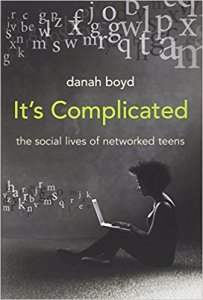
The first “chunk” of the course focused on “trying to get a grip on the digital tech that shapes our everyday lives.” The reading for the section included to chapters from It’s Complicated by Danah Boyd and articles on smartphones, cognition, and teenage use of SnapChat.
It’s amazing how dated It’s Complicated reads, even though it was published in early 2014. Boyd acknowledges this, of course. And she does her best to point out underlying trends and realities that predate social media that have been consistent of the teenage-experience of socialization. That was one takeaway from the reading for me: that, as with so much other stuff, digital stuff mostly just accelerates and emphasizes preexisting trends. Boyd asserts that social media represents “networked publics,” which are digital instead of brick-and-mortar like malls and theaters. Something new about social media, Boyd asserts, is that “social network sites downplayed the importance of interests and made friendship the organizing tenant of the genre.” Beyond that, social media seems to be the “real replacement” for the mass culture that people my age and older grew up with. Ultimately, in Boyd’s view, social media as networked publics have four “affordances”:
+ persistence: the durability of online expressions and content;
+ visibility: the potential audience who can bear witness;
+ spreadability: the ease with which content can be shared; and
+ search ability: the ability to find content.
The second chunk of Boyd’s work for the course focused on the idea that kids today are “digital natives.” There are social class concerns embedded with Boyd’s thinking, which definitely teases things out in a direction I did not predict. But she also focuses on the simple assertion that maybe kids aren’t as “digitally native” as we think. I see that quite often with students who can work their phones adequately but who search for gmail instead of typing in the address, who have used laptops for years but have no knowledge about changing margins in a word processing program.
Beyond these basic assertions, two other things from Boyd stand out. The first has to do with adult apprehension of digital technology. When it comes to an adult perspective on teen use of social media, Boyd asserts:
More often than not, what emerges out of the people’s confusion takes the form of utopian and dystopian rhetoric . . . such as the dystopian notion that teens are addicted to social media or the utopian idea that technology will solve inequality.
The second has to do with what ultimately motivates teenagers when it comes to social media. Boyd asserts:
Most teens are not compelled by gadgetry as such– they are compelled by friendship. The gadgets are interesting to them primarily as a means to a social end. Furthermore, social interactions may be a distraction from school, but they are not a distraction from learning.
I don’t totally track well with Boyd there, but I appreciate the distinction she makes. There are always present those entranced with gadgets, those who would rather fiddle with objects than work things out with people. It’s the promise of connection and friendship, it seems, that drives usage. I do wonder, though, what Boyd thinks constitutes “learning.”
+ + + + + + +
What I appreciate about the course, and Jacobs’s thinking in general, is that it presents technology and its effects as a necessary and good conversation. Too often “technological determinism” keeps those kinds of conversations from happening until decisions are already made, implemented, and regretted.
The next “chunk” of the course focuses on higher education. I’ll reflect on that chunk soon.
(image from amazon.com)


 Space Enough, and Time