Class in Session: In a Digital Age

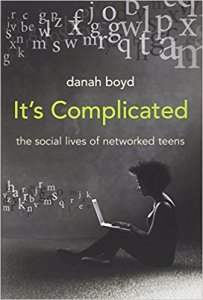
it's complicatedA few weeks ago, one of my favorite authors posted the syllabus to “Living and Thinking in a Digital Age,” the honors course he would be teaching this fall semester.  Beyond that, he posted links and DropBox-copies for most of the class readings.  You can read the course syllabus here.  I decided to “take” the class myself, particularly as questions of analog and digital have become a hot topic in my vocational circle.

The first “chunk” of the course focused on “trying to get a grip on the digital tech that shapes our everyday lives.”  The reading for the section included to chapters from It’s Complicated by Danah Boyd and articles on smartphones, cognition, and teenage use of SnapChat.

It’s amazing how dated It’s Complicated reads, even though it was published in early 2014.  Boyd acknowledges this, of course.  And she does her best to point out underlying trends and realities that predate social media that have been consistent of the teenage-experience of socialization.  That was one takeaway from the reading for me: that, as with so much other stuff, digital stuff mostly just accelerates and emphasizes preexisting trends.  Boyd asserts that social media represents “networked publics,” which are digital instead of brick-and-mortar like malls and theaters.  Something new about social media, Boyd asserts, is that “social network sites downplayed the importance of interests and made friendship the organizing tenant of the genre.”  Beyond that, social media seems to be the “real replacement” for the mass culture that people my age and older grew up with.  Ultimately, in Boyd’s view, social media as networked publics have four “affordances”:

+ persistence: the durability of online expressions and content;

+ visibility: the potential audience who can bear witness;

+ spreadability: the ease with which content can be shared; and

+ search ability: the ability to find content.

The second chunk of Boyd’s work for the course focused on the idea that kids today are “digital natives.”  There are social class concerns embedded with Boyd’s thinking, which definitely teases things out in a direction I did not predict.  But she also focuses on the simple assertion that maybe kids aren’t as “digitally native” as we think.  I see that quite often with students who can work their phones adequately but who search for gmail instead of typing in the address, who have used laptops for years but have no knowledge about changing margins in a word processing program.

Beyond these basic assertions, two other things from Boyd stand out.  The first has to do with adult apprehension of digital technology.  When it comes to an adult perspective on teen use of social media, Boyd asserts:

More often than not, what emerges out of the people’s confusion takes the form of utopian and dystopian rhetoric . . . such as the dystopian notion that teens are addicted to social media or the utopian idea that technology will solve inequality.

The second has to do with what ultimately motivates teenagers when it comes to social media.  Boyd asserts:

Most teens are not compelled by gadgetry as such– they are compelled by friendship.  The gadgets are interesting to them primarily as a means to a social end.  Furthermore, social interactions may be a distraction from school, but they are not a distraction from learning.

I don’t totally track well with Boyd there, but I appreciate the distinction she makes.  There are always present those entranced with gadgets, those who would rather fiddle with objects than work things out with people.  It’s the promise of connection and friendship, it seems, that drives usage.  I do wonder, though, what Boyd thinks constitutes “learning.”

+ + + + + + +

What I appreciate about the course, and Jacobs’s thinking in general, is that it presents technology and its effects as a necessary and good conversation.  Too often “technological determinism” keeps those kinds of conversations from happening until decisions are already made, implemented, and regretted.

The next “chunk” of the course focuses on higher education.  I’ll reflect on that chunk soon.

(image from amazon.com)

Posted in Books, Teaching | Tagged , , | Leave a comment

Singing “The Truth”

Up until a couple of years ago, I didn’t even know the song “The Truth” by Caedmon’s Call existed.  I first heard it when I purchased the third Guild album.  The better rendition of the song, though, is found on the second Guild album.  The construction of the lyrics is amazing.  Someone recently posted a video of the song, with leads by Derek Webb.  I’m glad a performance of the song exists in visual form.

Posted in Faith, Music | Tagged | Leave a comment

When Time Takes Its Time

Here’s a recently uploaded classic from Rich Mullins, one of those songs that almost haunts you because of its beautiful simplicity.

Posted in Faith, Music | Tagged | Leave a comment

When the Flash is Back

Well, this is interesting:

Looks like we’re getting Barry Allen back quite early in the fourth season of The Flash.  New logo.  New costume.  “The Flash Reborn,” indeed.

One month to go . . .

Posted in Television | Tagged | Leave a comment

Walking Away from the Best Thing

“You’re the Best Thing About Me” definitely passes the “play it loud when no one is around” metric, which is always a good sign.  The more I’ve listened to U2’s latest, though, the more I am mindful of the upbeat song’s sad ending.  Which, of course, is what makes it a “song of experience.”

Here’s a performance of the song from late night television last week.  Good stuff.

Posted in Music | Tagged | Leave a comment

“Boy Like Me” 20 Years Later

We’re less than a couple of weeks away from the 20th anniversary of the tragic death of Rich Mullins.  Here’s another CCM Magazine-produced cover of a Mullins classic.  This time: “Boy Like Me, Man Like You” by Jason Gray.

Posted in Faith, Music | Tagged | Leave a comment

From Sweetest Thing to the Best Thing

I’m not a big fan of lyric videos, but I’ll  make an exception for the first song from U2’s forthcoming album, Songs of Experience.  Here’s “You’re the Best Thing About Me.”

It’s upbeat with a melancholy undertow.  I’m curious to see how long it sticks in the consciousness.

Posted in 2017, Music | Tagged | Leave a comment

Leslie Knope and the Tourist

Last weekend I spent some time in my classroom trying to catch up in hopes of getting ahead.  To help with this, I put Parks and Recreation season two in the DVD player.  The show is immensely re-watchable.  I haven’t really spent much time with season two since it aired, though.  I vaguely remember the show not being that funny until Chris Traeger and Ben Wyatt arrive.  So it’s been nice to find that the show’s second season actually holds up quite well.  There are a lot of nice moments in the season, including the budding relationship between April and Andy.

In the episode I just finished, unflappable Leslie Knope starts to see something unexpected in Justin Anderson, the guy she’s dating.  This moment between Leslie and Ron Swanson doesn’t just epitomize the quality of their friendship, it says something significant about the people we surround ourselves with.


Posted in Television, The Long Story | Tagged | Leave a comment

Community and Wholeness

turn of the crankA few weeks ago, I posted a quick reflection on Wendell Berry’s thoughts on community and health.  I think about that essay often, which is why another chunk of it shows up here today.  This is from 1994, before the ubiquity of the internet and cell phones.

If we were lucky enough as children to be surrounded by grown-ups who loved us, then our sense of wholeness is not just the sense of completeness in ourselves but also is the sense of belonging to others and to our place; it is  an unconscious awareness of community, of having in common.  It may be that this double sense of singular integrity and of communal belonging is our personal standard of health for as long as we live.  Anyhow, we seem to know instinctively that health is not divided.

Of course, growing up and growing older as fallen creatures in a fallen world can only instruct us painfully in division and disintegration.  This is the stuff of consciousness and experience.  But if our culture works in us as it should, then we do not age merely into disintegration and division, but that very experience begins our education, leading us into knowledge of wholeness and holiness.  I am describing here the story of Job, of Lazarus, of the lame man at the pool of Bethesda, of Milton’s Samson, of King Lear.  If our culture works in us as it should, our experience is balanced by education; we are led out of our lonely suffering and are made whole.

In the present age of the world, disintegration and division, isolation and suffering seem to have overwhelmed us.  The balance between education and experience has been overthrown; we are lost in experience, and so-called education is leading us nowhere.

Like so many other authors, something about what Berry articulates connects with some part of my own experience, helping me name it and own it.  That’s true here, as well.  While no place or time is perfect, I was definitely fortunate enough to grow up in the kind of culture Berry writes about here.  I found it in college and in bits and pieces in seminary, too.  The idea of wholeness, though, has been a bit more elusive these last few years.  Existential experience is there, but the education than can frame it healthily is mostly missing.  I do see a kind of wholeness in the lives of others, but it’s not the kind of wholeness that expands and welcomes.  It is temporary at best . . . maybe even fleeting.

So if you cannot find that kind of wholeness at home, you have to become something of a turtle, able to carry it around with you, even as it serves as a kind of isolating factor.

Berry’s inclusion of figures like Job and Lear and Samson strikes a kind of chord.  They are a reminder that sometimes life offers you a full-circle moment.  Not always, but sometimes.  Their ‘education’ was in no way easy.  But it is something to think about, something that can help frame our experiences in a way that other parts of our more ‘formal’ culture cannot.

When I think of the “undivided life,” the words of Psalm 86 come to mind:

Teach me your way, Lord,
    that I may rely on your faithfulness;
give me an undivided heart,
    that I may fear your name.

An undivided heart may be reflected in an undivided life.  Both, I think, are good things for which to pray.

Posted in Books | Tagged | Leave a comment

All Those Little Things

One of the highlights of each week this semester is Thursday morning chapel prep.  It’s the putting things together, the talk and camaraderie from testing out mics and speakers.  And it’s being around music, too.

This morning included a nice exchange between students and teachers about the merit of U2.  Here’s a live performance of “The Little Things That Give You Away,” from their upcoming Songs of Experience album.

Posted in Music | Tagged | Leave a comment