A Reduction of Dimensions

readingI’m often interested in the interplay of genres and forms, particularly when it comes to storytelling and when one form seems to subsume another.  The easy target, of course, is television and the internet.  The relationship between television and the novel comes up often, too.  David Foster Wallace, a child of the television and a writer of novels, thought about it some, particularly in the context of loneliness.  In a recent article at The New Atlantis, Erik P. Hoel brings up the question of “fiction in the age of screens” in light of what that means for writers, including those who move from the printed page to the silver screen.

It is something about the interiority of novel-reading, Hoel seems to suggest, that will remind us that we are always more than the categories used by culture to define us.

Novels will always have a place because we are creatures of both the extrinsic and the intrinsic. Due to the nature of, well, the laws of reality, due to the entire structure and organization of how universes might simply have to be, we are forced to deal with and interact entirely through the extrinsic world. We are stuck having to infer the hidden intrinsic world of other consciousnesses from an extrinsic perspective. This state leaves us open to solipsism, as Wallace suggested in saying that novels are a cure for loneliness. But the loneliness that novels cure, unlike television, is not social. It is metaphysical.

At the same time, our uncomfortable position — both flesh and not — also puts us in danger, beyond just that of solipsism, of forgetting the intrinsic perspective, of ignoring that it holds an equal claim on describing the universe. In contemporary culture there has been a privileging of the extrinsic both ontologically and as explanation. We take the extrinsic perspective on psychology, sociology, biology, technology, even the humanities themselves, forgetting that this perspective gives us, at most, only ever half of the picture. There has been a squeezing out of consciousness from our explanations and considerations of the world. This extrinsic drift obscures individual consciousnesses as important entities worthy of attention.

Recently I overheard a conversation between two psychiatrists in the hallway next to my lab. One doctor was describing a patient, a young woman whose primary problem seemed to be that she was spending too much money on clothes. For the next five minutes the two debated what medications to put her on. Extrinsic drift is why people are so willing to believe that a shopping addiction should be cured by drugs, that serotonin is happiness or oxytocin is love. It’s our drift toward believing that identities are more political than personal, that people are less important than ideologies, that we are whatever we post online, that human beings are data, that attention is a commodity, that artificial intelligence is the same as human intelligence, that the felt experience of our lives is totally epiphenomenal, that the great economic wheel turns without thought, that politics goes on without people, that we are a civilization of machines. It is forgotten that an extrinsic take on human society is always a great reduction of dimensions, that so much more is going on, all under the surface.

Given its very nature, the novel cannot help but stand in cultural opposition to extrinsic drift. For the novel is the only medium in which the fundamental unit of analysis is the interiority of a human life. It opposes the unwarranted privileging of the extrinsic half of the world over the intrinsic. It is a reminder, a sign in the desert that seems to be pointing nowhere until its flickering neon lettering is read: There is something it is like to be a human being. And what it is like matters. The sign points to what cannot be seen.

I like the author’s approach to the intrinsic/extrinsic perspective and approach, how we tend to deal with reality categorically in a way that forgets the individuals (which is interesting because you would think the opposite is most true).  It falls in line with Yuval Levin’s assertion that the have misconstrued identity and community.

That last paragraph is great.  You can read the whole article here.

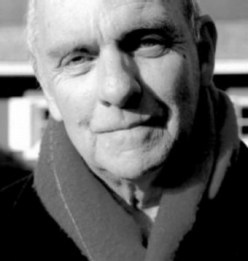
(image from thenewatlantis.com)

Posted in Books, Internet, Television | Leave a comment

A Jingle of Loose Change

From earlier this year, when Peterson was in Hawaii.  Can’t believe I hadn’t already posted this, as it’s a good clip of a great song.

Posted in Faith, Internet, Music | Tagged | Leave a comment

Fifty Years of Star Trek

The first episode of Star Trek aired 50 years ago today.  And while I’ve had an on-again/off-again relationship with the franchise, I can surely appreciate its contribution to the collective consciousness of 21st century America.  I think the only show I followed faithfully was probably Voyager, and even then I disappeared for a while before seeing if they ever made it back to the Delta Quadrant.

The folks at Paramount have released a short “50th Anniversary” trailer that hits some real high points of the story.  Check it out.

Posted in Internet, Movies, Television | Leave a comment

Reminders of the Sacred Journey

frederick-buechnerIt was the music of Wes King that led me to the books of Frederick Buechner.  King’s “Magnificent Defeat” was inspired by a Buechner sermon of the same name.  I remember in college reading through Buechner’s sermons and early biographical works (particularly The Sacred Journey, which I would eventually use in a class).  Discovering Buechner was a creative turn for me, finding a preacher who wielded words well and to great effect, who captured something about the sentiment of living without falling into sentimentality.  I’m thankful I have his writings to carry with me as I grow older.

Musician Andrew Peterson recently posted an “address” he recently delivered at the Buechner Institute at King College titled “The Consolations of Doubt.”  From the start, Peterson captures something great about Buechner’s style and influence.

Once upon a time I lived in a world of dirt roads and diamondbacks. Alligators haunted the lakes, four wheelers and hunters haunted the woods, and as Flannery O’Connor famously said, Christ haunted the South. He was everywhere. He was in the Bible verse printed on the front page of the church bulletin, he was in the oddly hyphenated words in the hymnbook, he showed up on the church marquee, he was prayed to before the football games and before meals, he was on bumper stickers next to confederate flags, his name lifted jubilantly from the tongues of worshipers during four hour Sunday meetings on one side of the tracks, and on the other the name of Jesus launched like a rocket from my father’s mouth as he paced behind the podium where the white folks sat dutifully and muttered an occasional “Amen.”

Buechner’s sermons always remind you that your own story is a nestled story, told in the messy context of day-to-day life full of vital detail.

From there, Peterson tells of his own idiosyncratic struggle with the doubts of faith and how Buechner’s challenge to “listen to your life” helped him understand that struggle well.  He weaves in Thomas Merton and C. S. Lewis and Michael Card and the doubts of faith and then brings things together.

Before Buechner I had no context in which to admit to myself, let alone to anyone else, that this God, this basket in whom I have deposited every last one of my eggs, was a mystery as much as he was a revelation. Because of Buechner’s frank and persistent admission that he isn’t quite sure about this whole Jesus thing 100% of the time—and lest you get defensive on his behalf, why don’t we all just admit here that it’s just as true of us?—I found myself opening up to a new and deeper consolation than that of surety—the consolation of doubt.

The consolation that comes when one traveler says to the other, “I’ve been here before, and I still don’t know where I’m going. It’s a mystery, but at least we’re in this thing together.” And wherever two or more are gathered in his name, even if they’re lost and angry and doubtful and confused, Jesus is in their midst. Maybe especially so.

The whole address is a worthy effort and a great way to spend some time.  You can read the whole thing here.

(image from urbansimplicity.net)

Posted in Books, Faith, Internet, Music | Leave a comment

Tools (Reflections on Demolition)

Last night this three-day weekend started with a viewing of Demolition, starring Jake Gyllenhaal and Naomi Watts.  I think I was probably one of the five people who actually saw it in the theater when it dropped this past spring.  It’s the kind of movie that, were I in my mid-twenties, I’d take multiple friends for a viewing.  The movie, trailer below, plays out a bit like Fight Club for the financial district (that and underground fighting is replaced with sledgehammers and screwdrivers).

For all of the power tools and house destruction, there’s an subtlety to the movie.  It happens in particular scenes: conversations about work on the commuter train, conversations about foul language at the kitchen table, inner monologues that surprise you in direction they take.

One of my favorite moments in the movie is when Gyllenhaal’s character, Davis, starts to wonder if his whole life has become a metaphor (am I the fallen tree?  am I the wind that fell the tree?).  From early in the movie, you get the sense that the movie is about a young man who has (supposedly) been given tools to fix things.  But when things fall apart, he uses the tools to take things even farther.  The question, then, is what you can do to put things back together again.  In its way, it’s a generational story about emptiness and loss and, well, the inability to pass on the kinds of tools that matter and can make a life.

In my humble estimation, the only weakness to the movie is its need to go in a romantic direction (and the unexpected by-product that comes with that).  I suppose that’s a big part of trying to sell any movie that’s not an action flick these days.

It’s an odd hero’s journey, one quite illuminating at its best.  It takes an interesting (though potentially questionable) approach to grief (of the lack thereof).  It’s not necessarily the kind of movie you’d watch often.  But once in a while, in a world unaware of its need for repair, it’s something good to think through.

Posted in Internet, Movies | Leave a comment

Merton on Suffering

At this point in life’s journey, I’m pretty sure I’ve not heard enough good sermons about suffering.  In fact, it’s only been in the last couple of months that I can really say that I’ve heard suffering spoken of appropriately and practically from the pulpit (particularly in light of the sufferings of Jesus).  On some level, suffering is a silver thread through Merton’s No Man is an Island.  He spends one chapter on the topic particularly, though.  Here are some of his thoughts.

Useless and hateful in itself, suffering without faith is a curse.

A society whose whole idea is to eliminate suffering and bring all its members the greatest amount of comfort and pleasure is doomed to be destroyed.  It does not understand that all evil is not necessarily to be avoided.  Nor is suffering the only evil, as our world thinks.

Especially so, today, the more comfortable and affluent parts of our lives are about eliminating (or even ignoring) suffering.

. . . But the grace of Christ is constantly working miracles to turn all useless suffering into something fruitful after all.  How?  By suddenly staunching the wound of sin.  As soon as our life stops bleeding out of us in sin, suffering begins to have creative possibilities.  But until we turn our wills to God, suffering leads nowhere except our own destruction.

We must face the fact that it is much harder to stand the long monotony of slight suffering than a passing onslaught of intense pain.  In either case what is hard is our own poverty, and the spectacle of our own selves reduced more and more to nothing, wasting away in our own estimation and in that of our friends.

Suffering transformed into something else, something better, truly is a work of grace.  How odd to name sin so close to the wounds we too often hold dear and precious.

Posted in Books, Faith | Tagged | Leave a comment

“I Know Why the Caged Internet User Sings”

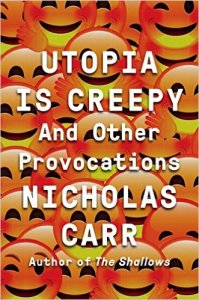
creepyNicholas Carr’s writing has been key in helping me see the now in the context of the bigger picture when it comes to technology.  Carr will release a collection of essays (new and old) in a week titled Utopia is Creepy and Other Provocations.  He does a great job of weaving the personal and the public together.  Consider this excerpt from the book’s introduction, aptly titled “The Worldwide Cage.”

I love a good gizmo. When, as a teenager, I sat down at a computer for the first time – a bulging, monochromatic terminal connected to a two-ton mainframe processor – I was wonderstruck. As soon as affordable PCs came along, I surrounded myself with beige boxes, floppy disks and what used to be called ‘peripherals’. A computer, I found, was a tool of many uses but also a puzzle of many mysteries. The more time you spent figuring out how it worked, learning its language and logic, probing its limits, the more possibilities it opened. Like the best of tools, it invited and rewarded curiosity. And it was fun, head crashes and fatal errors notwithstanding.

In the early 1990s, I launched a browser for the first time and watched the gates of the web open. I was enthralled – so much territory, so few rules. But it didn’t take long for the carpetbaggers to arrive. The territory began to be subdivided, strip-malled and, as the monetary value of its data banks grew, strip-mined. My excitement remained, but it was tempered by wariness. I sensed that foreign agents were slipping into my computer through its connection to the web. What had been a tool under my own control was morphing into a medium under the control of others. The computer screen was becoming, as all mass media tend to become, an environment, a surrounding, an enclosure, at worst a cage. It seemed clear that those who controlled the omnipresent screen would, if given their way, control culture as well.

Skip ahead, then, to 2005 and Carr’s first real response to what has been dubbed “Web 2.0” and you’ll see shifts less subtle go even farther.¹

On Monday morning, I posted the result on Rough Type – a short essay under the portentous title ‘The Amorality of Web 2.0’. To my surprise (and, I admit, delight), bloggers swarmed around the piece like phagocytes. Within days, it had been viewed by thousands and had sprouted a tail of comments.

So began my argument with – what should I call it? There are so many choices: the digital age, the information age, the internet age, the computer age, the connected age, the Google age, the emoji age, the cloud age, the smartphone age, the data age, the Facebook age, the robot age, the posthuman age. The more names we pin on it, the more vaporous it seems. If nothing else, it is an age geared to the talents of the brand manager. I’ll just call it Now.

And so the question for Carr, and for all of us really, is about how we might live well in the Now.  Carr’s is a lead I would like to follow:

It was through my argument with Now, an argument that has now careered through more than a thousand blog posts, that I arrived at my own revelation, if only a modest, terrestrial one. What I want from technology is not a new world. What I want from technology are tools for exploring and enjoying the world that is – the world that comes to us thick with ‘things counter, original, spare, strange’, as Gerard Manley Hopkins once described it. We might all live in Silicon Valley now, but we can still act and think as exiles. We can still aspire to be what Seamus Heaney, in his poem ‘Exposure’, called inner émigrés.

You can read the entire piece here.

Carr blogs occasionally here.

You can order Utopia is Creepy here.  Or you can track it down at your local bookstore on September 6.

_____________________________________

¹  “Web 2.0” is the name given to the more user-friendly web thanks to the presence of social media like MySpace and Facebook.

Posted in Books, Internet | Leave a comment

When the Town Doesn’t Hit Back (My Brave Face)

Some time ago, one of my favorite musicians “kickstarted” a multi-ep project.  If the campaign went beyond budget expectations, Andrew Osenga promised an ep of covers voted on by his supporters.  That ep “dropped” this week and included a song that has always kind of been on the periphery for me (as has most of Paul McCartney’s music post-Beatles).  He did a great cover of this song:

Russ Ramsey recently interview Osenga about his take on the song, which is based on a rough cut by McCartney and Elvis Costello.  It’s a nice interview punctuated with links to that rough cut along with the Osenga’s version embedded at article’s end.  You can read and listen here.

Posted in Internet, Music | Tagged | Leave a comment

Praying, Sleeping, and Dreaming

alarm clockThomas Merton begins No Man is an Island with the intent of helping the reader understand how best we can love ourselves, one another, and God well.  Then, from such a straightforward beginning, he takes a more circuitous route, tracing through hard truths about friendship and asceticism and hope.  In the third chapter of the book, Merton tackles the practice of prayer, asserting from the beginning that

As a man is, so he prays.  We make ourselves what we are by the way we address God.  The man who never prays is one who has tried to run away from himself because he has run away from God.  But unreal though he be, he is more real than the man who prays to God with a false and lying heart.

And so while the route seems circuitous, there is also a strong sense of the route being most fortuitous, as Merton reframes some of the simple truths of the Christian life in a way that builds a better argument.

All true prayer somehow confesses our absolute dependence on the Lord of life and death.  It is, therefore, a deep and vital contact with Him Whom we know not only as Lord but as Father.  It is when we pray truly that we really are.  Our being is brought to a high perfection by this, which is one of its most perfect activities.  When we cease to pray, we tend to fall back into nothingness.  True, we continue to exist.  But since the main reason for our existence is the knowledge and love of God, when our conscious contact with Him is severed, we sleep or we die.  Of course, we cannot always, or even often, remain clearly conscious of Him.  Spiritual wakefulness demands only the habitual awareness of Him which surrounds all our actions in a spiritual atmosphere without formally striking our attention except at certain moments of keener perception.  But if God leaves us so completely that we are no longer disposed to think of Him with love, then we are spiritually dead.

One of the most significant things I have read from Eugene Peterson was the simple assertion that his first and most important task as a pastor was to teach people how to pray.  That really is at the center of the “abiding reality” Jesus spoke of in John’s Gospel.  Note the idea of “spiritual wakefulness” demanding “habitual awareness,” which means such an approach can be learned.  The picture of spiritual death is a pivot to a powerful paragraph.

Most of the world is either asleep or dead.  The religious people are, for the most part, asleep.  The irreligious are dead.  Those who are asleep are divided into two classes, like the Virgins in the parable, waiting for the Bridegroom’s coming.  The wise have oil in their lamps.  That is to say they are detached from themselves and from the cares of the world, and they are full of charity.  They are indeed waiting for the Bridegroom, and they desire nothing else but His coming, even though they fall asleep while waiting for Him to appear.  But the others are not only asleep: they are full of other dreams and other desires.  Their lamps are empty because they have burned themselves out in the wisdom of the flesh and in their own vanity.  When He comes, it is too late for them to buy oil.  They light their lamps only after He is gone.  So they fall asleep again, with useless lamps, and when they wake up they trim to investigate, once again, the matters of a dying world.

It is not enough that we are asleep, Merton suggests.  As sleepers, we “are full of dreams and other desires.”  On a deep level we are distracted and distant.  Help us, Lord, to wake up.

(image from pronagger.com)

Posted in Books, Faith | Tagged | Leave a comment

Asceticism and Hope

andy and redOne of the many great moments in Shawshank Redemption that sticks with you long after that wonderful final shot closes is Andy’s take on hope:

Remember Red, hope is a good thing, maybe the best of things, and no good thing ever dies.

Andy Dufresne has a particular hope, of course, one that involves freedom and rest.  And his hope is what helps him survive in a situation that was on many levels beyond his control.

In No Man is an Island, Merton speaks of hope and a different kind of situation for those trying to understand his place in a particularly Christian culture (which we should, of course, call church).  The situation is asceticism, which is a word you don’t often hear in Christian circles.  We often have a strange relationship with “the things of this world,” whether they are things created or manufactured.  Mix in an awkward theology of “blessing,” and you almost end up with no need to rethink “the things of this world.”

Hope is the living heart of asceticism.  It teaches us to deny our ourselves and leave the world not because either we or the world are evil, but because unless a supernatural hope raises us above the things of time we are in no condition to make a perfect use either of our own or of the world’s true goodness.  But we possess ourselves and all things in hope, for in hope we have them not as they are in themselves but as they are in Christ: full of promise.  All things are at once good and imperfect.  The goodness bears witness to the goodness of God.  But the imperfection of all things reminds us to leave them in order to live in hope.  They are themselves insufficient.  We must go beyond them to Him in Whom they have their true being.

We cannot often hope because we are too busy reshaping the world around us as a form of induced forgetfulness about the bigger and broader picture.  To chose a path of asceticism, much like both Jesus and Paul, requires some of “engine” for living.  That engine is hope.

We leave the good things of this world not because they are not good, but because they are only good for us insofar as they form part of a promise.  They, in turn, depend on our hope and on our detachment for their fulfillment of their own destiny.  If we misuse them, we ruin ourselves together with them.  If we use them as children of God’s promises, we bring them, together with ourselves, to God.

Leaving good things is no easy task.  And yet leaving them behind is a way of putting things in their place, too.  Like Michael Card once sang, ” we can’t imagine the freedom we find in the things we leave behind.”

Upon our hope, therefore, depends the liberty of the whole universe.  Because our hope is the pledge of a new heaven and a new earth, in which all things will be what they were mean to be.  They will rise, together with us, in Christ.  The beasts and the trees will one day share with us a new creation and we will see them as God sees them and know that they are very good.

Meanwhile, if we embrace them for themselves, we discover both them and ourselves as evil.  This is the fruit of the tree of the knowledge of good and evil—disgust with the things we have misused and hatred for ourselves for misusing them.

But the goodness of creation enters into the framework of holy hope.  All created things proclaim God’s fidelity to His promises, and urge us, for our sake and for their own, to deny ourselves and to live in hope and to look for the judgment and the general resurrection.

An asceticism that is not entirely suspended from this divine promise is something less than Christian.

The question all of this begs in light of Merton’s subject in No Man is an Island is how this relates to people.  Is there a way of practicing an asceticism of relationships?  That doesn’t sound very appealing.  And yet if there is one category of “thing” that we treat like objects, that category is people.

(image from biography.com)

Posted in Books, Faith, Movies | Tagged | Leave a comment