Recalibrating the Heart

James K. A. Smith’s newest book, You Are What You Love, drops in a couple of weeks.  Brazos Press has been releasing short videos of Smith talking about the book each week.  Here’s the most recent video, which ends with the idea of “recalibrating” the heart.

Posted in Books, Faith | Leave a comment

Understanding the Benedict Option

Yesterday I used the storyline of Kung Fu Panda 3 as a segue into talking about Rod Dreher’s Benedict Option.  Here’s a talk that Dreher gave last year at a Q Conference (learn more about that organization here).  In the video, he takes a while to get to the Benedict Option, but that’s because he’s attempting to build a case.  I would encourage you to pay particular attention to the idea of Moralistic Therapeutic Deism.

If you are more of a reader, you can find a FAQ from Dreher about the Benedict Option here.

Tomorrow I’ll post some of my main takeaways from Dreher’s proposal.  There are obviously multiple facets to his arguments.  Some of them are more pertinent to me than others.  Then, on Thursday, I’ll take a look at some of his “detractors” in the discussion.

Posted in Faith, Internet | Tagged | Leave a comment

Kung Fu Panda 3 and the Benedict Option

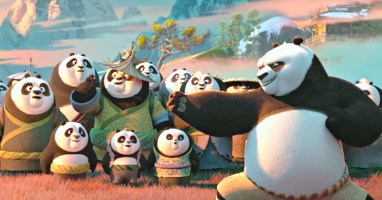
kung fu panda villageThe story of Kung Fu Panda 3 begins with adversaries on parallel paths. Po, the hero of the series, is set to take on the duties of teacher. At the same time, the villain Kai has returned from the spirit realm in order to steal all of the chi of the remaining masters. Po, of course, knows nothing of chi. Fortunately, Po’s long-lost father returns and takes him to the hidden village where the secrets of chi were said to have been kept. What starts as a sweet family reunion quickly sours when Po’s father confesses that the pandas of the hidden village have long forgotten the art of chi. The pandas are cute, cuddly, but ultimately clueless when they are called on to train Po in the only way that can bring him victory over Kai.

When I watched the movie over its opening weekend, my mind immediately turned to Rod Dreher’s Benedict Option. Over the last couple of years, Dreher has attempted to articulate what he sees as a dire plight for the church in contemporary society. The concept comes from Alisdair McIntyre’s After Virtue and is a nod to the work of Saint Benedict centuries ago. Much like Po’s panda village, the church was at one time known for embodying something good, life-giving, and necessary. Forces and movements have been at work, though, that have assisted in a real divergence from any perceived Christian roots in the American story. And so when our culture perhaps most needs what the church has to offer, we find ourselves sort of cute, potentially cuddly, and too-often clueless about what we have to offer to the world around us. Much like the panda village, Dreher might assert, we have forgotten what made us salt and light, a source of life, in the first place.

Dreher has, of course, been colored a doomsday prophet by some and a cultural coward by others (his use of the term retreat in his articulation of the Benedict Option has been a key point of attack). I am not usually given to such perceived alarmism. But there’s something about his articulation of the issue that I can’t quite shake. So over the next few days, I hope to unpack some of his thinking, particularly its root and its potential fruit. Tomorrow I’ll share a video of Dreher talking about the Benedict Option at a Q conference from last year. Then I’ll consider an essay on church history that has been a go-to document for the “why” of the Benedict Option. I’ll also try to write through some of the pushback that Dreher has received, some of it from thinkers Dreher would call his friends.

While the final confrontation between Po and Kai in Kung Fu Panda 3 is beautifully rendered, the final turn of Po’s mastery of chi is disappointing. Turns out that the power to defeat the great evil of Kai can be found in the pandas being who they are, in embracing what is already true of them. On one level, that’s weak storytelling sauce. It’s the lesson of The Wizard of Oz without the actually journey down the Yellow Brick Road. There is something (biblical) to be said about remembering what you have forgotten. It’s more sobering and hopeful, though, to learn things beyond and better than what you already know (or at least seem to practice).

(image from movieweb.com)

Posted in Books, Faith, Movies | Tagged | Leave a comment

Tapping into the Heart

Here’s a second video from Brazos Press leading up to the release of James K. A. Smith’s You Are What You Love.  Along with its predecessor, the video is a nice taste of what Smith seems to have been thinking through for years (at least as far back as Desiring the Kingdom, which I highly recommend).

Posted in Books, Faith, Internet, Teaching | Tagged | Leave a comment

The Ever-Present Future

futureDouglas Coupland has been writing and drawing us into the future for some time.  He has a particular knack for “getting things right” years before they happen.  While I don’t always enjoy his short essays for the Financial Times, I did particularly enjoy his most recent entry, “Escaping the Superfuture.”  His experience:
Lately I’ve been experiencing a new temporal sensation that’s odd to articulate, but I do think is shared by most people. It’s this: until recently, the future was always something out there up ahead of us, something to anticipate or dread, but it was always away from the present.

But not any more. Somewhere in the past few years the present melted into the future. We’re now living inside the future 24/7 and this (weirdly electric and buzzy) sensation shows no sign of stopping — if anything, it grows ever more intense. Elsewhere I’ve labelled this experience “the extreme present” — or another label for this new realm might be “the superfuture”. In this superfuture I feel like I’m clamped into a temporal roller coaster and, at the crest of the first hill, I can see that my roller coaster actually runs off far into the horizon. Wait! How is this thing supposed to end?

The answer, of course, is that it doesn’t.  Not really.  Not ever.  The most we can do, perhaps, is occasionally remind us of our “pre-internet brains,” which is itself a tricky thing.  Technology plays a key role (perhaps the key role) in our ever-present future, and we probably aren’t going to back down on our handheld devices anytime soon.

Except for that other handheld device that can do something about time (and we’re not talking about a sonic screwdriver or time-turner here).  The book, it seems, is at least a temporary antidote to our current situation.  Coupland continues:

A few paragraphs back I asked what sort of technology it would be that would help rescue us from this nonstop trapped-inside-the-future nagging buzz we all share living in the 21st century. This was a trick question because we already have this technology: it’s called books. But there’s another twist here and it’s this: it’s harder to read books these days. We all know it. It is a very rare and very honest person who’ll cop to the truth that they don’t read half as much fiction as they did 10 years ago. People seem to be buying novels but they just join the pile beside the bed that topples over when you go to plug in the laptop’s power cord.

The twist, of course, is that it’s harder for us to read these days, now that our brains have been rewired to all of our digital stimuli.  But as long as there are books, there is hope.

I’ve got my own stack of books for my spring break.  I’ve committed to reading a chapter a day of Faith Speaking Understanding (by VanHoozer).  I’m also halfway through Rushkoff’s Throwing Rocks at the Google Bus.  At some point this week, I’ll dive back into Kinneman and Lyon’s Good Faith.  All of these books are helping me bring the present and future (and even the past) together.  Plus I enjoy the read.  Give me a novel, though, and you’re giving me a hard time.

You can read the rest of Coupland’s essay here.

(image from communitysolution.org)

Posted in Books, Internet | Tagged | Leave a comment

Singular Song

I started the week with my favorite song from Steven Curtis Chapman’s new album, Worship and Believe.  Thought I’d close out the week in a similar fashion.  Here’s “One True God,” a song that retells the biblical story and points us in that story’s direction.  The album version includes Chris Tomlin, but this video is all Steven Curtis Chapman.

Posted in Faith, Music | Leave a comment

Taking a Dip in Myth

IMG_0718Lewis continued his discussion of The Lord of the Rings as myth in “The Dethronement of Power,” his review of The Two Towers and The Return of the King that appeared in the October 1955 issue of Time and Tide.
‘But why’, (some ask), ‘why, if you must have a serious comment to make on the real life of men, must you do it by talking about a phantasmagoric never-never land of your own?’ Because, I take it, one of the main things the author wants to say is that the real life of men is of that mythical and heroic quality. One can see the principle at work in his characterisation. Much that in a realistic work would be done by ‘character delineation’ is here done simply by making the character an elf, a dwarf, or a hobbit. The imagined beings have their insides on the outside; they are visible souls. And Man as a whole, Man pitted against the universe, have we seen him at all till we see that he is like a hero in a fairy tale?

. . . The value of the myth is that it takes all the things we know and restores to them the rich significance which has been hidden by ‘the veil of familiarity.’ The child enjoys his cold meat (otherwise dull to him) by pretending it is buffalo, just killed with his own bow and arrow. And the child is wise. The real meat comes back to him more savory for having been dipped in a story; you might say that only then it is the real meat. If you are tired of the real landscape, look at it in a mirror. By putting break, gold, horse, apple, or the very roads into a myth, we do not retreat from reality, we rediscover it. As long as the story lingers in our mind, the real things are more themselves . The book applies the treatment not only to bread or apple but to good and evil, to our endless perils, our anguish, and our joys. By dipping them in myth we see them more clearly. I do not think he could have done it any other way.

Oh to see the world as it really is!  But that would mean being willing to recast it by reminding ourselves of the bigger story in which we find ourselves, the bigger story we often reduce to our own size.

(photo taken June 2014 at The Green Dragon in Hobbiton)

Posted in Books | Tagged , | Leave a comment

Nostalgia and Narsil

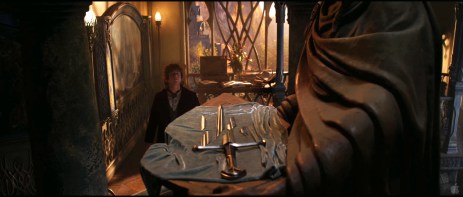
Bilbo_narsilIn his review of The Fellowship of the Ring, Lewis tackles the charges of “fiction as escapism or nostalgia” head-on.  We saw hints of it in yesterday’s excerpt.  We get an even better sense of it in the selection below.  As with so many other things, Lewis does a great job of adding a “twist” to our understanding of what’s going on.
Nostalgia does indeed come in; not ours nor the author’s, but that of the characters. It is closely connected with one of Professor Tolkien’s greatest achievements. One would have supposed that diuturnity was the quality least likely to be found in an invented world . . . But in the Tolkienian world you can hardly put your foot down anywhere from Esgaroth to Forlindon or between Ered Mithrin and Khand, without stirring the dust of history. Our own world, except at rare moments, hardly seems so heavy with its past. This is one element in the anguish which the characters bear. But with the anguish there comes also a strange exaltation. They are at once stricken and upheld by the memory of vanished civilizations and lost splendour. They have out-lived the second and third Ages; the wine of life was drawn long since. As we read we find ourselves sharing their burden; when we have finished, we return to our own life not relaxed but fortified.

Lewis is, of course, making mention of Tolkien’s creation of a world with depth in all directions.  It’s a well-worn world, with a (hi)story beneath every stone.  And that’s why the loss in the story is so palpable: it’s felt on multiple levels.  We feel loss.  We feel the characters’ immediate loss.  We feel the characters’ deep and lasting loss, too.  “Our own world, except in rare moments, hardly seems so heavy with the past,” Lewis asserts.  That might even feel more true half a century later.

I like Lewis’s final comment a lot, that we leave Tolkien’s world “not relaxed but fortified.”  That should be its own genre of literature, really.  Definitely a list worth making.

(image from lotr.wikia.com)

Posted in Books, Faith | Tagged , | Leave a comment

Middle Earth as Myth (not allegory)

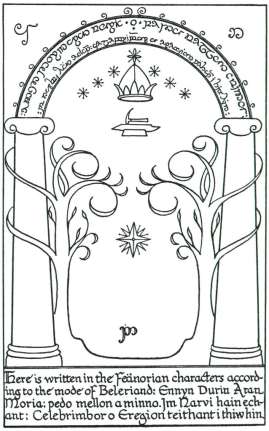
Doors of DurinOne of the things you hear most when reading Tolkien (or reading about Tolkien) is whether or not The Lord of the Rings is an allegory.  Tolkien, of course, flatly denied the charge, but that hasn’t kept decades of readers from speculating about the atomic bomb and world wars and the effects of the industrial age.  Lewis picks up on the possibility, too, but quickly dismisses it in his review of The Fellowship of the Ring.  Consider:

What shows we are reading myth, not allegory, is that there are no pointers to a specifically theological, or political, or psychological application. A myth points, for each reader, to the realm he lives in most. It is a master key; use it on what door you like. And there are other these in The Fellowship equally serious.

That is why no catchwords about ‘escapism’ or ‘nostalgia’ and no distrust of ‘private worlds’ are in court. This is no Angria, no dreaming; it is sane and vigilant invention, revealing at point after point the integration of the author’s mind. What is the use of calling ‘private’ a world we can walk into and test and in which we find such balance? As for escapism, what we chiefly escape is the illusion of our ordinary life. We certainly do not escape anguish. Despite many a snug fireside and many an hour of good cheer to gratify the Hobbit in each of us, anguish is, for me, almost the prevailing note. But not, as in the literature most typical of our age, the anguish of abnormal or contorted souls: rather that anguish of those who were happy before a certain darkness came up and will be happy if they live to see it gone.

I love the image of myth-as-key, that a myth “points the reader to the realm he lives in most.”  It’s a “master key,” almost like the elvish word of entry to Moria or the way into the Lonely Mountain.  And that is why, in Lewis’s estimation, the story of Frodo and Sam, Aragorn and Arwen, Gandalf and Galadriel, is more than just escapist literature.  More on that tomorrow.

(image of the Door of Durin by Tolkien from lotr.wikia.com)

Posted in Books, Movies, Uncategorized | Tagged , | Leave a comment

“When the Gods Returned to Earth”

IMG_0674One of the things you find on almost every copy of J. R. R. Tolkien’s The Fellowship of the Ring is a quote from C. S. Lewis.  “Here are beauties which pierce like swords or burn like cold iron; here is a book that will break your heart,” the copy reads.  Those words are from the Lewis-penned review of FOTR that was published in the August 1954 issue of Time and Tide under the title “The Gods Return to Earth.”  I finally got a copy of the review as an entry in Image and Imagination, a Canto Classics collection of Lewis’s literary pieces.  And while the reviews aren’t the books themselves, they’re pretty darn close.

*****

What Lewis most appreciates about The Fellowship of the Ring (it seems) is something that is an almost-instant turn-off for newbies to the novel: the long introduction “concerning hobbits.”  In Lewis’s estimation, the long description of “the life and times of hobbits” is essential to the story.

Yet there were good reasons for such an opening; still more for the Prologue (wholly admirable, this) which precedes it. It is essential that we should first be well steeped in the ‘homeliness’, the frivolity, even the (in its best sense) the vulgarity of the creatures called Hobbits; these unambitious folk, peaceable yet almost anarchical, with faces ‘good natured rather then beautiful’ and ‘mouths apt to laughter and eating’, who treat smoking as an art and like books which tell them what they already know. They are not an allegory of the English, but they are perhaps a myth that only an Englishman (or, should we add, a Dutchman?) could have created. Almost the central theme of the book is the contrast between the Hobbits (or ‘the Shire’) and the appalling destiny to which some of them were called, the terrifying discovery that the humdrum happiness of the Shire, which they had taken for granted as something normal, is in reality a sort of local and temporary accident, that its existence depends on being protected by powers which Hobbits dare not imagine, that any Hobbit may find himself forced out of the Shire and caught up into that high conflict. More strangely still, the event of that conflict between strongest things may come to depend on him, who is almost the weakest.

Readers of the books (not so much viewers of the movies) know that the Shire plays a major role in the stories last major movement.  All of that unambition, peace, and good-naturedness gets put to the test in a way that Frodo and friends are more than prepared to deal with.

It’s interesting to think of the peace of the Shire as “a sort of local and temporary accident.”  The world beyond its protected borders, though, is full of “high conflict.”  For sure the Shire is there for contrast, but I can’t help but think there’s more going on than simply saying “here’s life at its simple best.”  Lewis mentions the “myth” aspect of the story early in the review, something that comes up often in the rest of the review (and which we’ll see more of tomorrow).

(image taken in Hobbiton in New Zealand, summer of 2014)

Posted in Books, Movies | Tagged , | Leave a comment